
Mercadona drops fresh fish counters, leaving neighborhoods without fishmongers
Mercadona removes fresh fish from its counters, replacing it with packaged trays. Prices jump to €18/kg vs €10/kg at local shops, ending the traditional model.
English · Original discussion in Spanish · Published
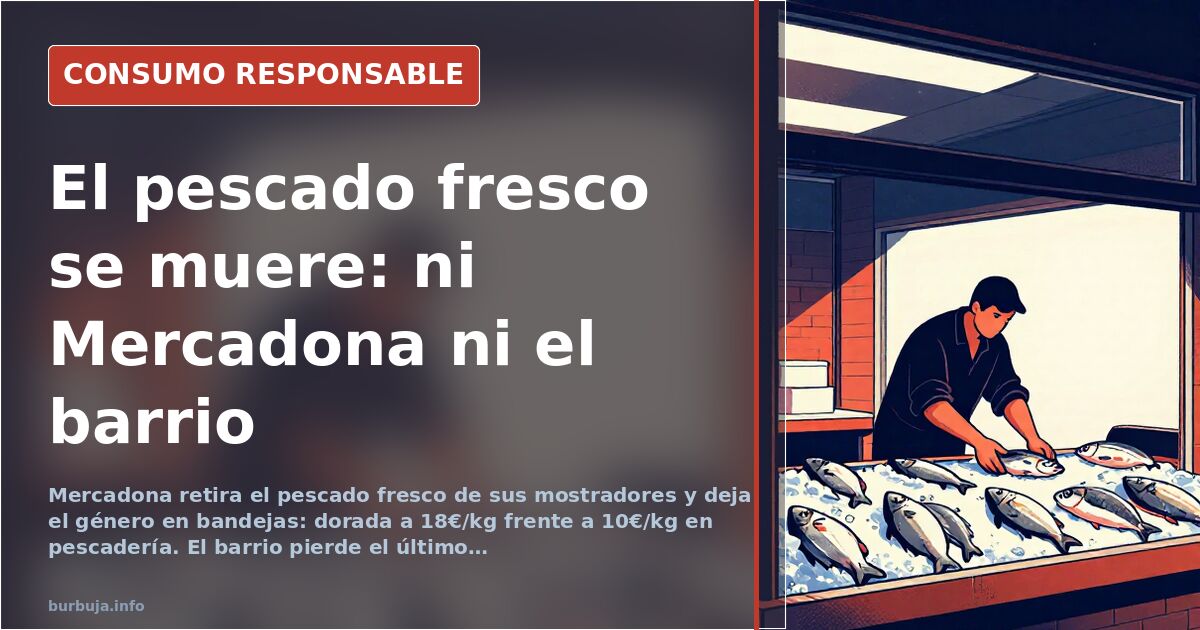
Traditional fishmongers fade amid queues, prices, and plastic-wrapped fillets
You walk into a Mercadona, pass by the fish counter, and there is no one there. No queue, no staff, no product. Juan Roig’s chain has been dismantling traditional fish service in many of its stores, leaving fish only in plastic trays, frozen, or out of stock entirely. This is not just a neighborhood anecdote; it is the final blow to a retail model that had been struggling for years. Anyone wanting hake cut on demand must look elsewhere. And options are dwindling.
Mercadona swaps fresh fish for trays, and customers notice
The official argument is efficiency. A fish counter requires specialized staff, daily logistics from markets, perishable goods that depreciate within hours, and waste that eats into margins. Plastic trays, however, last longer, restock themselves, and don’t require someone to clean a sea bream in front of you. The result, as anyone comparing prices knows: sea bream costs €10 per kilo at a fishmonger but €18 per kilo in a plastic tray. In this case, the buyer pays for "efficiency."
Some argue fish has become a luxury item. It’s not an exaggeration: bream has been seen at €50 per kilo, then dropped to €10 per kilo 24 hours later, heading straight to the bin. Anchovies have hit €9.80 per kilo, while mackerel or scad cost €10. With these figures, local fishmongers don’t compete with trays; they compete with butcher shops, chicken, and pasta.
Why are neighborhood fishmongers closing?
Because the customer base isn’t renewing. Someone working eight hours, plus split shifts and two-hour commutes, won’t spend time cleaning anchovies for dinner. They buy something quick, cook it in twenty minutes, and move on. Surviving fishmongers operate in municipal markets and coastal towns, where product is fresher and prices more reasonable. In inland neighborhoods, fish stalls have shrunk until opening up for four regular customers is no longer profitable. Entire markets have ended up converted into parking lots.
The recurring complaint isn’t just price. It’s assortment. Items once available are now missing: condensed milk, branded yogurts, cookies, fried tomato sauce, bottled milk. Private-label products have also changed taste, according to long-time shoppers. Fruit, they say, looks pretty but is sold unripe. Tomatoes are bland. Beef is forgettable. Given this landscape, customers who can switch chains do; those who can’t, settle.
Fresh fish doesn’t disappear: it moves to the coast and to canned goods
In coastal areas, neighborhood fishmongers remain alive. In municipal markets of seaside towns, fish and seafood rival what is sold in Madrid’s most select fish shops. The paradox is that many inland residents still believe Spain’s best fish is sold in the capital, when the bulk of product reaching Madrid’s neighborhoods cannot compete with what is sold right at the port. Fresh fish has become a proximity product for those living near the sea and a luxury item for everyone else.
Canned goods remain, but they aren’t perfect either. The supply of quality canned fish is limited, and prices are high. Mackerel in tomato sauce can cost more than double in the Canary Islands than in Norway, according to circulating comparisons. And Canary bananas, a local product of the archipelago itself, can be twice as expensive as imported bananas with tariffs in Norway. Market logic, at least, invites questions.
Fishing can’t take much more: quotas, apps, and fuel
The problem starts at sea, not at the counter. Waters are increasingly polluted with less fish, regulations complicate activity—restrictive hours, closed zones, quotas, minimum sizes, catch-registration apps—and costs don’t drop. Fuel prices have risen, so going out to fish a few miles offshore, unloading, and returning no longer makes financial sense given auction prices. If fish is scarce and expensive, the counter is just the last link in a broken chain.
The result is a fishmonger fading from both ends: from above, because product is costly and scarce; from below, because customers lack time or desire to queue. Mercadona chose the most profitable model, leaving fresh fish to those willing to pay elsewhere. Remaining traditional fishmongers can differentiate themselves, yes. As long as they find someone willing to wait half an hour and pay €18 for what used to cost €10.
With these numbers, fresh fish should have a line at the door. It doesn’t. Instead, the line is at the plastic tray counter.
You walk into a Mercadona, pass by the fish counter, and there is no one there. No queue, no staff, no product. Juan Roig’s chain has been dismantling traditional fish service in many of its stores, leaving fish only in plastic trays, frozen, or out of stock entirely. This is not just a neighborhood anecdote; it is the final blow to a retail model that had been struggling for years. Anyone wanting hake cut on demand must look elsewhere. And options are dwindling.
Mercadona swaps fresh fish for trays, and customers notice
The official argument is efficiency. A fish counter requires specialized staff, daily logistics from markets, perishable goods that depreciate within hours, and waste that eats into margins. Plastic trays, however, last longer, restock themselves, and don’t require someone to clean a sea bream in front of you. The result, as anyone comparing prices knows: sea bream costs €10 per kilo at a fishmonger but €18 per kilo in a plastic tray. In this case, the buyer pays for "efficiency."
Some argue fish has become a luxury item. It’s not an exaggeration: bream has been seen at €50 per kilo, then dropped to €10 per kilo 24 hours later, heading straight to the bin. Anchovies have hit €9.80 per kilo, while mackerel or scad cost €10. With these figures, local fishmongers don’t compete with trays; they compete with butcher shops, chicken, and pasta.
Why are neighborhood fishmongers closing?
Because the customer base isn’t renewing. Someone working eight hours, plus split shifts and two-hour commutes, won’t spend time cleaning anchovies for dinner. They buy something quick, cook it in twenty minutes, and move on. Surviving fishmongers operate in municipal markets and coastal towns, where product is fresher and prices more reasonable. In inland neighborhoods, fish stalls have shrunk until opening up for four regular customers is no longer profitable. Entire markets have ended up converted into parking lots.
The recurring complaint isn’t just price. It’s assortment. Items once available are now missing: condensed milk, branded yogurts, cookies, fried tomato sauce, bottled milk. Private-label products have also changed taste, according to long-time shoppers. Fruit, they say, looks pretty but is sold unripe. Tomatoes are bland. Beef is forgettable. Given this landscape, customers who can switch chains do; those who can’t, settle.
Fresh fish doesn’t disappear: it moves to the coast and to canned goods
In coastal areas, neighborhood fishmongers remain alive. In municipal markets of seaside towns, fish and seafood rival what is sold in Madrid’s most select fish shops. The paradox is that many inland residents still believe Spain’s best fish is sold in the capital, when the bulk of product reaching Madrid’s neighborhoods cannot compete with what is sold right at the port. Fresh fish has become a proximity product for those living near the sea and a luxury item for everyone else.
Canned goods remain, but they aren’t perfect either. The supply of quality canned fish is limited, and prices are high. Mackerel in tomato sauce can cost more than double in the Canary Islands than in Norway, according to circulating comparisons. And Canary bananas, a local product of the archipelago itself, can be twice as expensive as imported bananas with tariffs in Norway. Market logic, at least, invites questions.
Fishing can’t take much more: quotas, apps, and fuel
The problem starts at sea, not at the counter. Waters are increasingly polluted with less fish, regulations complicate activity—restrictive hours, closed zones, quotas, minimum sizes, catch-registration apps—and costs don’t drop. Fuel prices have risen, so going out to fish a few miles offshore, unloading, and returning no longer makes financial sense given auction prices. If fish is scarce and expensive, the counter is just the last link in a broken chain.
The result is a fishmonger fading from both ends: from above, because product is costly and scarce; from below, because customers lack time or desire to queue. Mercadona chose the most profitable model, leaving fresh fish to those willing to pay elsewhere. Remaining traditional fishmongers can differentiate themselves, yes. As long as they find someone willing to wait half an hour and pay €18 for what used to cost €10.
With these numbers, fresh fish should have a line at the door. It doesn’t. Instead, the line is at the plastic tray counter.
Also available in: Deutsch
Summary of a discussion on Burbuja.info - Foro de economía, actualidad y política., translated from Spanish and reviewed before publication. Read the full discussion (135 replies).
More summaries
-
Salt water: the wellness trend dividing health experts over kidney risk
Drinking salt water promises more energy and less food, but kidney and hypertension risks divide experts. Data, testimonials and the science behind it…
-
Hypertension: Patients Question Lifelong Medication
Patients with hypertension share experiences on medication, keto diets, and arm asymmetry after diagnoses of spikes up to 190.
-
Spain: Fridge dies in a year, boots last eleven
In Spain, product durability varies wildly regardless of price. From fridges failing early to boots lasting over a decade, quality control remains inconsistent.
-
Fuel Efficiency: Drive at 105 km/h and 2,000 RPM
Driving at 105 km/h, increasing tire pressure, or using sixth gear at 2,000 RPM are key tips for saving fuel, though they have limits.
-
BM discounts branded tuna: 70% off with two cans
Branded tuna drops 50% at BM supermarkets and 70% for two cans, but the chain is concentrated in northwest Spain.
-
Shopee exits Spain: Chinese bargain era ends
Shopee shuts down in Spain without clear reasons, leaving shoppers with pricier AliExpress and mandatory VAT on imports.