
Batch Cooking: Why Weekly Meal Plans Fail and How to Fix Them
Weekly meal plans often collapse due to rigid schedules and lack of freezer space. Discover how batch cooking and smart freezing can save time and money.
English · Original discussion in Spanish · Published
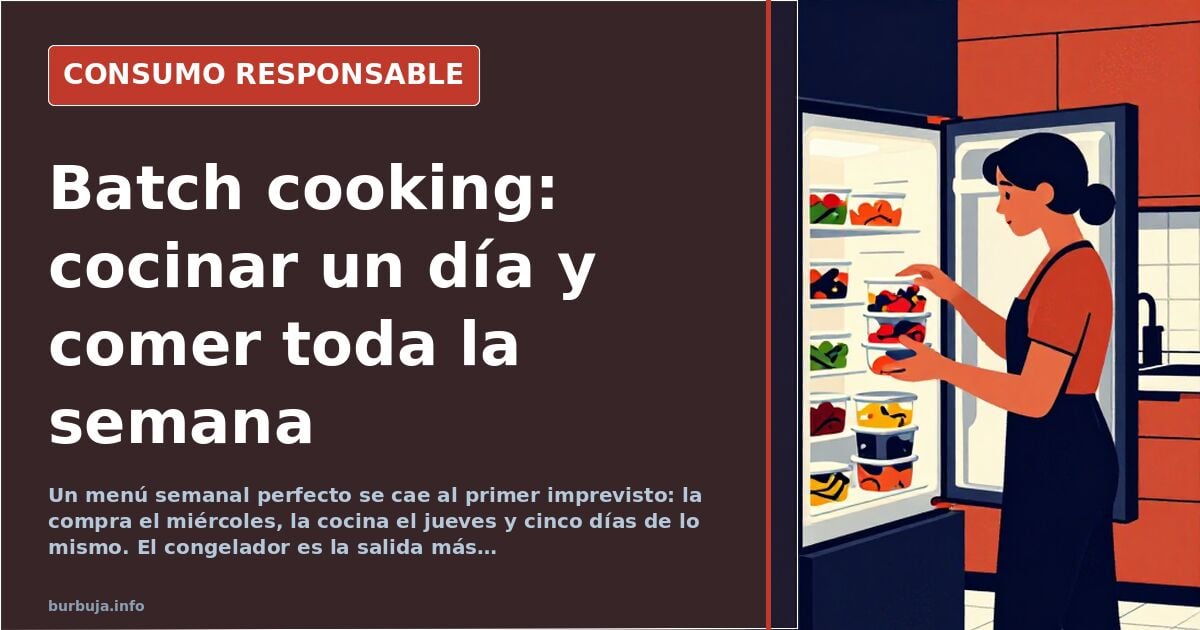
Cooking on Sunday for the whole week: the promise almost no one keeps
A perfect weekly menu falls apart at the first unexpected event. Not due to lack of time, but because almost no one designs it to survive a bad Wednesday. The typical plan sounds impeccable: shop on Wednesday at Alcampo, cook on Thursday, pick up fruit and fresh items at the neighborhood greengrocer on Friday, close five days of meals, and leave two free for improvisation, clearing the fridge, or going out for tapas. On paper, a Swiss watch. In practice, the scaffolding collapses as soon as one piece fails, and everything returns to square one: wasted time, money lost due to lack of foresight, and oversights. The small fridge and the lack of glass containers are the perfect excuse for the second week.
They call it batch cooking, weekly organization, or simply cooking in batches, and the conversation about how to set it up repeats among people who want to eat well but cannot make Tuesday's dinner fit.
The shopping calendar that falls apart on Wednesday
The problem starts before turning on the stove. Organizing four or eight weeks of menus, varying one or two weeks and adjusting them to the season, requires prior planning work that competes with actual work. Those who try want to do it all: the big shop, the fresh shop, cooking, scaling recipes, and inventorying the fridge. And they want to do it perfectly the first time.
The result is predictable. The first attempt remains unfinished, shopping is scattered across three different days, the fridge cannot hold that many containers, and the menu expires before the food. Some argue that the failure is not of discipline but of design: a rigid plan does not survive a single unexpected event. The most repeated alternative is the opposite: fewer rules, more freezer.
Why does the fixed weekly menu fail?
It fails because planning is confused with gridlining. The idea of leaving two days free for leftovers or going out is well thought out; the error is filling the other five with the same food and a shopping calendar that forces three weekly trips. If Sunday's stew is repeated on Monday and Tuesday, by the third time the body asks for something else.
The second cause is space. Freezing requires containers that withstand, stack well, and do not take up the entire fridge. Buying glass containers is a small investment, but it arrives just when motivation is already falling.
And the third is measurement. No one knows how much they truly eat in five days until they cook it. Too much is made, frozen improperly, and thrown away without accounting for waste.
The freezer as the backbone
Almost all strategies converge here. The doctrine is simple: dedicate the weekend to cooking several different things, not just one, and freezing in portions. Those with the tightest schedules cook on the weekend and freeze, with the usual warning: you must vary, because eating the same thing for five days straight is boring. The daily alternative is to make a large pot one day and stretch the stew for two days.
The distribution is the fine part. A stew lasts two days: the first cold and the second finished on the griddle, with meat or fish. If it contains potatoes, better not to freeze it; if it does not, the freezer preserves it for later. A pressure cooker reduces the time and energy of the stew, and a homemade pizza dough covers the nights when nothing else appeals.
Some do not cook at all: they leave someone else's house with containers for three days and complete the week with that. And some maintain that all this is a tale. The phrase "batch cooking is a lie and unviable" summarizes a minority current that offers no argument other than inviting others to try it for a day.
How much does it cost to eat with home-prepared food?
Less than it seems if you shop wisely, according to one of the calculations circulating in the thread. A complete menu for two people spread over five dishes costs about 10 euros per meal, including seafood, when planned in advance. The key is not cheap products but organized ordering: two weeks in advance is what the fishmonger requested from a participant for Christmas.
There is division of opinion regarding seafood. Some maintain that it is delicious, yes, but as a main dish it is expensive for what it fills: to feel full like with a baked turbot, he says, you need a cartload of spider crabs. A spoonable stew yields more and costs less.
As starters, prawns and crab legs work, and as a complement, mushrooms with good cheese. Winter survival cooking is summarized in five first courses that come from a single batch: macaroni, chickpea stew, vegetable puree, noodle broth, and puree again, changing the accompaniment to avoid repetition.
The air fryer enters the equation
The gadget that has changed logistics is the air fryer. It does not convince everyone, but it allows cooking delicate fish without staining: sea bream in two batches, first the potatoes and then the fish, using baking paper to remove it whole. Also large sardines, stuffed paninis, and salmon with pickled onions.
The time comparison is its selling point: apples roasted with cinnamon, sugar, and eucalyptus honey take 20 minutes at 200 degrees in an air fryer versus 45 in a conventional oven. Those who cook in batches gain one more machine to stagger batches without turning on the large oven.
Freezing well is half the work
The most repeated error is freezing in blocks. Gratinated pasta holds its shape if cooled, covered with film, and put in the freezer; that which is not gratinated should be spread on a flat tray and removed in loose portions, like store-bought but better and cheaper. Glass containers like Pyrex or Duralex, stackable and microwave-safe, solve the space bottleneck better than any menu.
And a common-sense warning: the space freed by cooking on Sunday is the same space occupied by containers on Monday. The small fridge was not the excuse. It was the diagnosis.
Is it worth scheduling hours and shopping to gain half an hour a day, or is it enough to always have something frozen and stop pretending that the menu was the solution?
A perfect weekly menu falls apart at the first unexpected event. Not due to lack of time, but because almost no one designs it to survive a bad Wednesday. The typical plan sounds impeccable: shop on Wednesday at Alcampo, cook on Thursday, pick up fruit and fresh items at the neighborhood greengrocer on Friday, close five days of meals, and leave two free for improvisation, clearing the fridge, or going out for tapas. On paper, a Swiss watch. In practice, the scaffolding collapses as soon as one piece fails, and everything returns to square one: wasted time, money lost due to lack of foresight, and oversights. The small fridge and the lack of glass containers are the perfect excuse for the second week.
They call it batch cooking, weekly organization, or simply cooking in batches, and the conversation about how to set it up repeats among people who want to eat well but cannot make Tuesday's dinner fit.
The shopping calendar that falls apart on Wednesday
The problem starts before turning on the stove. Organizing four or eight weeks of menus, varying one or two weeks and adjusting them to the season, requires prior planning work that competes with actual work. Those who try want to do it all: the big shop, the fresh shop, cooking, scaling recipes, and inventorying the fridge. And they want to do it perfectly the first time.
The result is predictable. The first attempt remains unfinished, shopping is scattered across three different days, the fridge cannot hold that many containers, and the menu expires before the food. Some argue that the failure is not of discipline but of design: a rigid plan does not survive a single unexpected event. The most repeated alternative is the opposite: fewer rules, more freezer.
Why does the fixed weekly menu fail?
It fails because planning is confused with gridlining. The idea of leaving two days free for leftovers or going out is well thought out; the error is filling the other five with the same food and a shopping calendar that forces three weekly trips. If Sunday's stew is repeated on Monday and Tuesday, by the third time the body asks for something else.
The second cause is space. Freezing requires containers that withstand, stack well, and do not take up the entire fridge. Buying glass containers is a small investment, but it arrives just when motivation is already falling.
And the third is measurement. No one knows how much they truly eat in five days until they cook it. Too much is made, frozen improperly, and thrown away without accounting for waste.
The freezer as the backbone
Almost all strategies converge here. The doctrine is simple: dedicate the weekend to cooking several different things, not just one, and freezing in portions. Those with the tightest schedules cook on the weekend and freeze, with the usual warning: you must vary, because eating the same thing for five days straight is boring. The daily alternative is to make a large pot one day and stretch the stew for two days.
The distribution is the fine part. A stew lasts two days: the first cold and the second finished on the griddle, with meat or fish. If it contains potatoes, better not to freeze it; if it does not, the freezer preserves it for later. A pressure cooker reduces the time and energy of the stew, and a homemade pizza dough covers the nights when nothing else appeals.
Some do not cook at all: they leave someone else's house with containers for three days and complete the week with that. And some maintain that all this is a tale. The phrase "batch cooking is a lie and unviable" summarizes a minority current that offers no argument other than inviting others to try it for a day.
How much does it cost to eat with home-prepared food?
Less than it seems if you shop wisely, according to one of the calculations circulating in the thread. A complete menu for two people spread over five dishes costs about 10 euros per meal, including seafood, when planned in advance. The key is not cheap products but organized ordering: two weeks in advance is what the fishmonger requested from a participant for Christmas.
There is division of opinion regarding seafood. Some maintain that it is delicious, yes, but as a main dish it is expensive for what it fills: to feel full like with a baked turbot, he says, you need a cartload of spider crabs. A spoonable stew yields more and costs less.
As starters, prawns and crab legs work, and as a complement, mushrooms with good cheese. Winter survival cooking is summarized in five first courses that come from a single batch: macaroni, chickpea stew, vegetable puree, noodle broth, and puree again, changing the accompaniment to avoid repetition.
The air fryer enters the equation
The gadget that has changed logistics is the air fryer. It does not convince everyone, but it allows cooking delicate fish without staining: sea bream in two batches, first the potatoes and then the fish, using baking paper to remove it whole. Also large sardines, stuffed paninis, and salmon with pickled onions.
The time comparison is its selling point: apples roasted with cinnamon, sugar, and eucalyptus honey take 20 minutes at 200 degrees in an air fryer versus 45 in a conventional oven. Those who cook in batches gain one more machine to stagger batches without turning on the large oven.
Freezing well is half the work
The most repeated error is freezing in blocks. Gratinated pasta holds its shape if cooled, covered with film, and put in the freezer; that which is not gratinated should be spread on a flat tray and removed in loose portions, like store-bought but better and cheaper. Glass containers like Pyrex or Duralex, stackable and microwave-safe, solve the space bottleneck better than any menu.
And a common-sense warning: the space freed by cooking on Sunday is the same space occupied by containers on Monday. The small fridge was not the excuse. It was the diagnosis.
Is it worth scheduling hours and shopping to gain half an hour a day, or is it enough to always have something frozen and stop pretending that the menu was the solution?
Also available in: Deutsch
Summary of a discussion on Burbuja.info - Foro de economía, actualidad y política., translated from Spanish and reviewed before publication. Read the full discussion (296 replies).
More summaries
-
Potato and canned bean stews: eating healthy for 54 cents
Three potatoes and six eggs cost just cents, and half of cooking boils down to four base recipes. Potato stews, broth and a pressure cooker for the week
-
Eating on €10 a week: the experiment that doesn't add up
Eating on €10 a week, with electricity and water included, the experiment collides with meat and fish costs and is recast at €20 every two weeks
-
EU's €3 parcel levy ends AliExpress's cheap era
The EU's €3 per category fee sends AliExpress prices soaring: a €3 order now costs €11. The Chinese parcel model faces collapse.
-
Latin American Food in Spain: Mediocre or Misunderstood?
Analysis of the debate on Latin American cuisine quality in Spain, exploring whether it is truly mediocre or a matter of expectations.
-
O2: Complaints Pattern Reveals Service Crisis
Five days offline, fraudulent portabilities and missing discounts highlight O2's customer service failures in Spain's low-cost market.
-
Stuck Faucet Eccentric: Limescale, Hemp, and DIY Fixes
A faucet eccentric stuck by decades of limescale and hemp. Discover which remedies work (vinegar, torch, wrench) and when to call a plumber.