
Childlessness by age: relief, regret, and garnished paychecks
A 43-year-old man had a vasectomy seven years ago. In his company, 20 of 350 employees had salaries garnished due to child-support obligations from divorce.
English · Original discussion in Spanish · Published
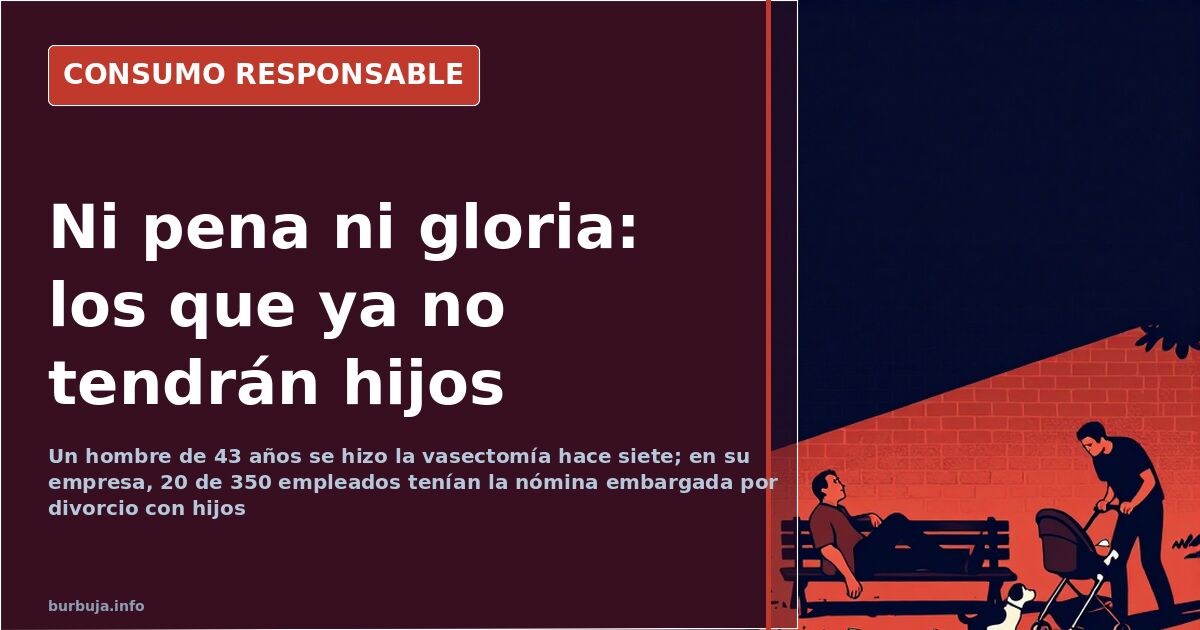
Those who won't have children: relief, regret, and garnished paychecks
A 43-year-old man had a vasectomy seven years ago. He has been without a stable partner for a decade and states this without drama: he never felt the call of fatherhood. In the same conversation, another admits the opposite. He wanted children, no longer will he, and handles it as best he can. The initial question—whether those who are too old to have offspring feel regret for not having them—has no single answer: it has two, and neither seems willing to yield.
Do they regret not having children?
"In general, yes. I would have liked to be a father", summarizes one of those responding to the premise. There are more along these lines. Another confesses he spent years putting the matter aside and, past forty, found no partner with the same interests: every day he feels that gap. A woman who could not have them dismisses it with a phrase mixing faith and resignation: God is wiser. No one pities, but neither feigns indifference.
On the other side is the other half. One of the best things someone says they have done in their life is precisely not having children, and they claim it without ambiguity: it was a decision, not a renunciation. Beside them, several describe the relief of seeing acquaintances with kids and feeling pity, not envy. The money saved appears in almost all messages from this side as the central argument: those who do not raise children save a fortune every day, week, month, and year.
The cost of raising children and the divorce that garnishes the paycheck
The hardest figure does not come from a study, but from a paycheck. In a group of companies with about 350 employees, at least 20 or 25 had their salaries garnished due to divorce with children. The person who processed these paychecks recounts this. The sector, he adds, is heavily masculinized. His summary is not subtle: being a father can be a great experience, but today it has become a high-risk sport.
The figure explains why much of the conversation revolves around money rather than biology. It is argued that raising children demands time, space, and peace, and that the price of choosing the wrong partner is extremely high. Several maintain that, with courts and child support payments involved, being a divorced father is much worse than not having children.
Even parents are not spared by residential care
The next blow strikes at the classic comfort: having children to avoid being alone. A participant recalls his grandmother, the only one in the family who ended up in a care home, between 2003 and 2009. She was also the only one with three or four visits per week. The rest of the residents received one visit at best, and half saw no one.
From there to the conclusion is a short step. If respect for the elderly and family ties have weakened, having offspring does not guarantee companionship in old age nor prevent institutionalization. Career, leisure, and tight budgets do the rest.
What those who did have them say
Not everyone who raises children frames it as sacrifice. A father of three—two girls and a boy, eleven years of parenting—describes it as one of the greatest adventures of his life and insists it is highly rewarding, although there are days when one wants to disappear. Another, with a 16-year-old son, admits he did not want children and now envies those with small kids at home.
A third puts the calendar on the table: the first five years are an odyssey, because kids are wild and anarchic; from age six, when they can reason, things change. And then there is the scene no one refutes. A hellish Saturday night shift, a father arriving home at ten in the morning wearing last night's clothes, keys still in the lock, and a child's scream from the living room. That argument cannot be disputed. Nor imitated.
When the child turns out badly
There is a case that repeats as a counterexample. A man pushed a friend for years to have children. The kid was top of his high school class, started two degrees and dropped them. At 23 years old he does not work, no job lasts more than a month, and lives off his father, who has serious financial problems.
With that material, the discussion gets tangled. It is debated whether parents' duty is to give without expecting anything and whether reciprocity is guaranteed. The most repeated answer in that section—there are no bad children, only bad parents—does not convince everyone, and the slap of disappointment is mentioned without embellishment.
The demographic shift some celebrate and others antiestéticar
A part of the analysis shifts the focus from the individual to the country. It is held that future society will be that of the children of those who decided to have them, by pure social Darwinism, and that this replacement will come largely from abroad. Others respond that the problem is not reproducing, but the specific circumstances: precarity, housing, and shifts that leave little room for parenting.
Here the tone heats up without need. The replacement rate is not fixed with sarracena platitudes, and those launched on both sides ignore the same thing: that the number of children depends less on will than on the ground one stands on.
There remains a detail that bothers both trenches. Male fatherhood has no clear expiration date, and some claim, half-jokingly, that a man at 99 years old can still sire a child. If biology does not close the door, then the decision not to have children was never entirely biological. It was economic, sentimental, or pure conviction.
A 43-year-old man had a vasectomy seven years ago. He has been without a stable partner for a decade and states this without drama: he never felt the call of fatherhood. In the same conversation, another admits the opposite. He wanted children, no longer will he, and handles it as best he can. The initial question—whether those who are too old to have offspring feel regret for not having them—has no single answer: it has two, and neither seems willing to yield.
Do they regret not having children?
"In general, yes. I would have liked to be a father", summarizes one of those responding to the premise. There are more along these lines. Another confesses he spent years putting the matter aside and, past forty, found no partner with the same interests: every day he feels that gap. A woman who could not have them dismisses it with a phrase mixing faith and resignation: God is wiser. No one pities, but neither feigns indifference.
On the other side is the other half. One of the best things someone says they have done in their life is precisely not having children, and they claim it without ambiguity: it was a decision, not a renunciation. Beside them, several describe the relief of seeing acquaintances with kids and feeling pity, not envy. The money saved appears in almost all messages from this side as the central argument: those who do not raise children save a fortune every day, week, month, and year.
The cost of raising children and the divorce that garnishes the paycheck
The hardest figure does not come from a study, but from a paycheck. In a group of companies with about 350 employees, at least 20 or 25 had their salaries garnished due to divorce with children. The person who processed these paychecks recounts this. The sector, he adds, is heavily masculinized. His summary is not subtle: being a father can be a great experience, but today it has become a high-risk sport.
The figure explains why much of the conversation revolves around money rather than biology. It is argued that raising children demands time, space, and peace, and that the price of choosing the wrong partner is extremely high. Several maintain that, with courts and child support payments involved, being a divorced father is much worse than not having children.
Even parents are not spared by residential care
The next blow strikes at the classic comfort: having children to avoid being alone. A participant recalls his grandmother, the only one in the family who ended up in a care home, between 2003 and 2009. She was also the only one with three or four visits per week. The rest of the residents received one visit at best, and half saw no one.
From there to the conclusion is a short step. If respect for the elderly and family ties have weakened, having offspring does not guarantee companionship in old age nor prevent institutionalization. Career, leisure, and tight budgets do the rest.
What those who did have them say
Not everyone who raises children frames it as sacrifice. A father of three—two girls and a boy, eleven years of parenting—describes it as one of the greatest adventures of his life and insists it is highly rewarding, although there are days when one wants to disappear. Another, with a 16-year-old son, admits he did not want children and now envies those with small kids at home.
A third puts the calendar on the table: the first five years are an odyssey, because kids are wild and anarchic; from age six, when they can reason, things change. And then there is the scene no one refutes. A hellish Saturday night shift, a father arriving home at ten in the morning wearing last night's clothes, keys still in the lock, and a child's scream from the living room. That argument cannot be disputed. Nor imitated.
When the child turns out badly
There is a case that repeats as a counterexample. A man pushed a friend for years to have children. The kid was top of his high school class, started two degrees and dropped them. At 23 years old he does not work, no job lasts more than a month, and lives off his father, who has serious financial problems.
With that material, the discussion gets tangled. It is debated whether parents' duty is to give without expecting anything and whether reciprocity is guaranteed. The most repeated answer in that section—there are no bad children, only bad parents—does not convince everyone, and the slap of disappointment is mentioned without embellishment.
The demographic shift some celebrate and others antiestéticar
A part of the analysis shifts the focus from the individual to the country. It is held that future society will be that of the children of those who decided to have them, by pure social Darwinism, and that this replacement will come largely from abroad. Others respond that the problem is not reproducing, but the specific circumstances: precarity, housing, and shifts that leave little room for parenting.
Here the tone heats up without need. The replacement rate is not fixed with sarracena platitudes, and those launched on both sides ignore the same thing: that the number of children depends less on will than on the ground one stands on.
There remains a detail that bothers both trenches. Male fatherhood has no clear expiration date, and some claim, half-jokingly, that a man at 99 years old can still sire a child. If biology does not close the door, then the decision not to have children was never entirely biological. It was economic, sentimental, or pure conviction.
Summary of a discussion on Burbuja.info - Foro de economía, actualidad y política., translated from Spanish and reviewed before publication. Read the full discussion (283 replies).
More summaries
-
Euthanasia in Old Age: Autonomy vs. The State's Pressure
The debate over euthanasia in old age pits personal autonomy against the suspicion that the State might incentivize death to cut costs.
-
Why Citroën's hydropneumatic suspension failed
Citroën dropped hydropneumatic suspension after decades of unmatched comfort: spheres every 40,000 km, costly maintenance and the rise of air suspension
-
Salt water: the wellness trend dividing health experts over kidney risk
Drinking salt water promises more energy and less food, but kidney and hypertension risks divide experts. Data, testimonials and the science behind it…
-
Matute: Cutting electricity VAT to 10% is a band-aid
EH Bildu's Matute argues the 10% VAT cut fails to fix bills, blaming market dysfunction and oligopolies.
-
The Hi-Fi Fallacy: Is Excessive Audio Spending Justified?
Critical analysis of whether high-end audio gear truly improves sound quality or if it is a market fallacy.
-
Cost of children in Spain: €600 tax breaks vs. €600 nursery fees
In Spain, having children offers €600 tax deductions and €1,200 annual aid for working mothers, but nursery costs reach €600 monthly.