
7.6 Quake Hits Japan: Tsunami Warning and Destroyed Homes
A magnitude 7.6 earthquake struck western Japan on New Year's Day, triggering a tsunami warning, destroying homes, with the epicenter near a nuclear plant.
English · Original discussion in Spanish · Published
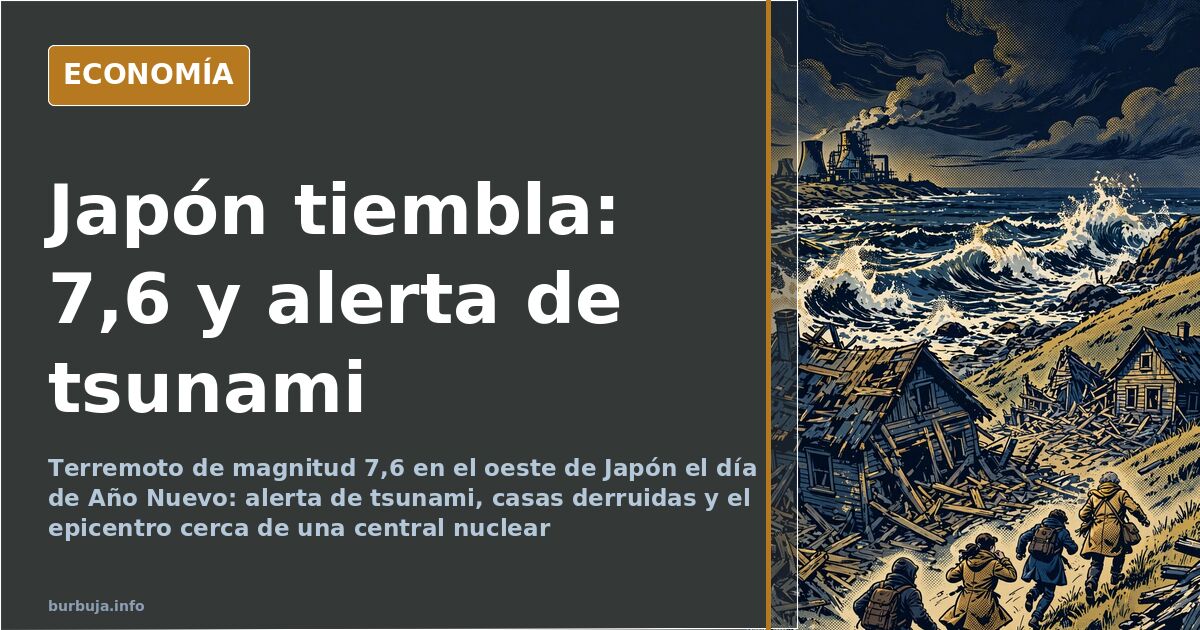
7.6 Quake in Japan: The Tsunami and the Nuclear Ghost
Japan began the year with a magnitude 7.6 earthquake in the west, a tsunami warning, and suspended rail services. Early reports varied: some cited 7.4, others 7.8. The alert remained active for hours as authorities urged evacuation in Toyama and surrounding areas. There are fires, partially collapsed houses, and towns without power or water. It is also cold. According to distributed maps, the epicenter was just a few hundred kilometers from a nuclear plant.
A Tsunami Is Not a Wave: It Is the Sea Rising
The cinematic image of a wall of water does not match a real tsunami. What arrives is a tide that pushes for hours: the first wave is not necessarily the highest, and water can continue entering long after the alarm seems routine. In 2004, the level rose gently at first but ended up swallowing entire buildings; those watching from upper floors had to climb higher as the water reached them. A tweet circulating alongside images clarified this: waves can hit the coast for several hours, and the first one may not be the biggest. Therefore, a five-meter warning does not miccionan a five-meter crest, but five meters above sea level across a huge stretch of coastline. Anyone waiting to see the movie monster will arrive too late.
Magnitude Is Not Intensity
Richter measures released energy. What is felt and what collapses depends on other factors. Intensity —the Mercalli scale in most countries, Shindo in Japan— reflects the actual effect on the ground, influenced by distance to the epicenter, its depth, and soil type, which amplifies or dampens shaking. Two cases were highlighted: Japan 2024, with Richter 7.4 and Mercalli IX, and Lorca 2011, with 5.1 and Mercalli VIII. A modest-magnitude quake on soft soil can cause more destruction than a large one offshore. This explains why two earthquakes with the same number look nothing alike.
Why Every Japanese Earthquake Reopens the Nuclear File
When Japan shakes, eyes turn to nuclear plants. Here there was reason: the epicenter was a few hundred kilometers from a facility, shown plainly on shared maps. The ghost is 2011. Accounts of the Fukushima accident state water reached 18 meters at the breakwater, far exceeding expectations. Whether enough has been learned cannot be answered in the early hours of an emergency. Precedents exist: TV programming interrupted, defense forces mobilized, and urgent evacuations in a freezing zone.
Building to Stay Up: What Decides the Death Toll
An earthquake of this magnitude in a country with strict seismic codes leaves collapsed houses, but not the toll expected elsewhere. Building resilient structures costs money, decided by budgets and inspections, not character. Turkey in 2023 had severe standards yet saw almost all buildings collapse: some due to cost-cutting, others due to corruption. In Spain, the NCSE02 standard applies, which is not ambitious, and even it is not always trinc. From others' experiences come two anecdotes: a 5.5 tremor in Narita shook a traveler's hostel, causing no harm while locals calmly exited to the lobby; another account describes a warehouse concrete floor moving "like liquid" during a magnitude 5 quake.
The Day That Did Not End With the Tremor
Alongside the tsunami warning came supply cuts, fires during a cold snap, and at night, a plane fire upon landing at Haneda Airport, dominating Japanese TV. Municipalities lacked power and water during the hardest hours, and the official recommendation to evacuate immediately was not lifted.
The death toll was not closed when this was written. The uncomfortable truth is that most destruction is not measured on the seismic scale: it is measured by the distance from the epicenter to the coast, the soil supporting each house, and how long it takes for the water to stop rising. With these three variables, no one has yet done the math.
Japan began the year with a magnitude 7.6 earthquake in the west, a tsunami warning, and suspended rail services. Early reports varied: some cited 7.4, others 7.8. The alert remained active for hours as authorities urged evacuation in Toyama and surrounding areas. There are fires, partially collapsed houses, and towns without power or water. It is also cold. According to distributed maps, the epicenter was just a few hundred kilometers from a nuclear plant.
A Tsunami Is Not a Wave: It Is the Sea Rising
The cinematic image of a wall of water does not match a real tsunami. What arrives is a tide that pushes for hours: the first wave is not necessarily the highest, and water can continue entering long after the alarm seems routine. In 2004, the level rose gently at first but ended up swallowing entire buildings; those watching from upper floors had to climb higher as the water reached them. A tweet circulating alongside images clarified this: waves can hit the coast for several hours, and the first one may not be the biggest. Therefore, a five-meter warning does not miccionan a five-meter crest, but five meters above sea level across a huge stretch of coastline. Anyone waiting to see the movie monster will arrive too late.
Magnitude Is Not Intensity
Richter measures released energy. What is felt and what collapses depends on other factors. Intensity —the Mercalli scale in most countries, Shindo in Japan— reflects the actual effect on the ground, influenced by distance to the epicenter, its depth, and soil type, which amplifies or dampens shaking. Two cases were highlighted: Japan 2024, with Richter 7.4 and Mercalli IX, and Lorca 2011, with 5.1 and Mercalli VIII. A modest-magnitude quake on soft soil can cause more destruction than a large one offshore. This explains why two earthquakes with the same number look nothing alike.
Why Every Japanese Earthquake Reopens the Nuclear File
When Japan shakes, eyes turn to nuclear plants. Here there was reason: the epicenter was a few hundred kilometers from a facility, shown plainly on shared maps. The ghost is 2011. Accounts of the Fukushima accident state water reached 18 meters at the breakwater, far exceeding expectations. Whether enough has been learned cannot be answered in the early hours of an emergency. Precedents exist: TV programming interrupted, defense forces mobilized, and urgent evacuations in a freezing zone.
Building to Stay Up: What Decides the Death Toll
An earthquake of this magnitude in a country with strict seismic codes leaves collapsed houses, but not the toll expected elsewhere. Building resilient structures costs money, decided by budgets and inspections, not character. Turkey in 2023 had severe standards yet saw almost all buildings collapse: some due to cost-cutting, others due to corruption. In Spain, the NCSE02 standard applies, which is not ambitious, and even it is not always trinc. From others' experiences come two anecdotes: a 5.5 tremor in Narita shook a traveler's hostel, causing no harm while locals calmly exited to the lobby; another account describes a warehouse concrete floor moving "like liquid" during a magnitude 5 quake.
The Day That Did Not End With the Tremor
Alongside the tsunami warning came supply cuts, fires during a cold snap, and at night, a plane fire upon landing at Haneda Airport, dominating Japanese TV. Municipalities lacked power and water during the hardest hours, and the official recommendation to evacuate immediately was not lifted.
The death toll was not closed when this was written. The uncomfortable truth is that most destruction is not measured on the seismic scale: it is measured by the distance from the epicenter to the coast, the soil supporting each house, and how long it takes for the water to stop rising. With these three variables, no one has yet done the math.
Also available in: Deutsch
Summary of a discussion on Burbuja.info - Foro de economía, actualidad y política., translated from Spanish and reviewed before publication. Read the full discussion (131 replies).
More summaries
-
Police Warn of Escalation in Knife Violence in Santiago
Two serious attacks occurred in the early morning hours in Conxo, prompting a police alert regarding knife use in Santiago's nightly altercations.
-
Lola Gallardo, OnlyFans, and the Business of Women's Football
The debate around Lola Gallardo and OnlyFans hides an economic question: who pays for women's football and who has the right to monetize the image of...
-
Mercadona cuts turkey breast content from 70% to 50%
Customers report Mercadona reduced turkey breast in deli meats from 70% to 50%, sparking debate on labeling and additives.
-
Spain's grocery bills soar: €50 buys what €20 did
Spanish forum users report basic food lists exceeding €40, with olive oil hitting €10 per liter amid rising cost of living.
-
Milei buys urgent gas from Petrobras after pipeline delay
Forum discusses emergency gas purchases due to unfinished pipelines, with reports of nearly 2,500 stations running dry.
-
Spain Housing Crisis: Migration Blamed for 1.25M Demand
A Barcelona rental listing drew 100 visitors, highlighting a housing shortage. A forum calculation links migration to an additional demand of 1.25 million homes.