
Spain's grocery bills soar: €50 buys what €20 did
Spanish forum users report basic food lists exceeding €40, with olive oil hitting €10 per liter amid rising cost of living.
English · Original discussion in Spanish · Published
Spain's grocery bills soar: €50 buys what €20 did
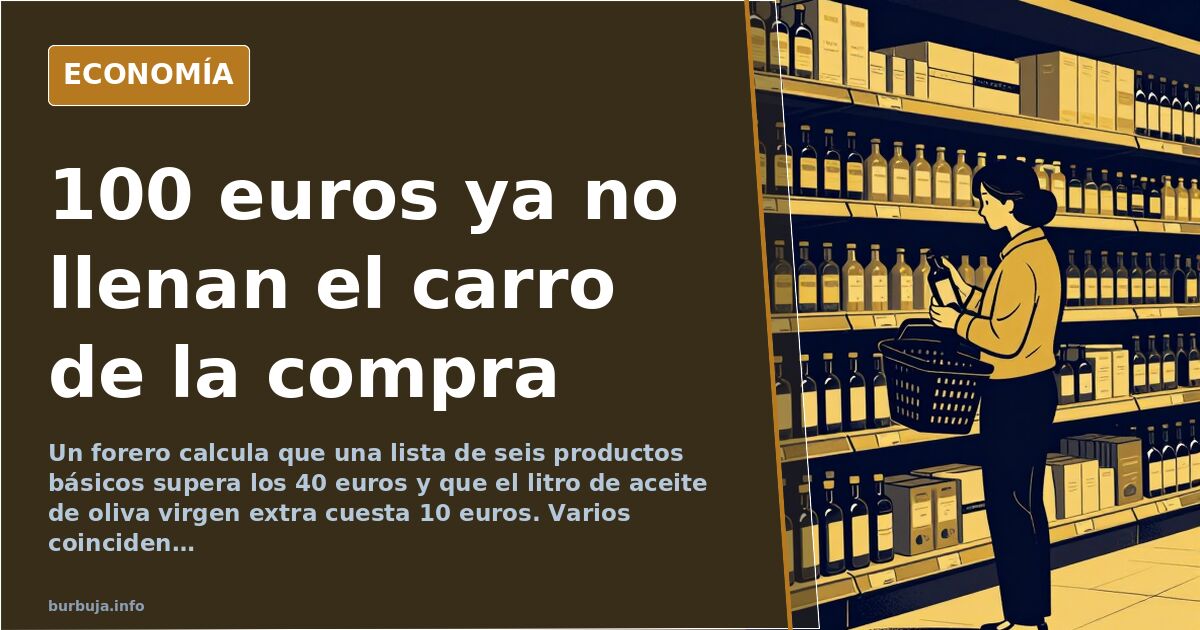
A €50 note has become pocket change. The initial complaint is specific: €100 barely buys nutritious food anymore, and shoppers return home with bags that don't fill the fridge. A circulating calculation is bleak: a list of six staples—tomatoes, lettuce, cucumbers, onions, tuna, extra virgin olive oil, half a kilo of chicken, and apples—exceeds €40 without any exotic items. Olive oil at €10 per liter takes the cake.
This isn't an isolated impression. Several posts agree on the same feeling: €50 is the new €20. "I notice it hugely with the €50 note... damn, they fly," one participant summarizes. Another adds that a few years ago they left the supermarket with full bags, but now that same amount "is barely noticeable."
Olive oil as the basket's thermometer
Extra virgin olive oil at €10 per liter appears in almost every list as the product that breaks any budget. The paradox noted is that Spain is the world's largest producer of olive oil, yet local consumers pay prices considered premium in other European countries. "Almost all properly ripe olive oil should go to Italy, France, Germany, the UK, the US, Canada, and China. We get to eat crap," one message argues.
Comparison with Italy is recurrent. Recent travelers claim they find quality cheese there for €6 per kilo, milk that isn't "watery," and "green and fresh" olive oil for less than it costs here. "In Spain, you get ripped off a bit," summarizes someone who does their weekly shopping at a Swiss Lidl for €60.
How much does it really cost to fill the fridge for a week?
The figures discussed paint a wide range depending on shopping strategy. One participant claims €60 covers their entire weekly shop in Switzerland, while another insists that in Spain, €50 barely provides four days of menus including first course, second course, dessert, drink, and coffee. The difference isn't just price, but perceived quality: several messages insist that Spanish supermarket products are low-end compared to what is exported.
The breakdown shared—lettuce €4, cucumbers €3, onions €3, tuna €3, apples €3—adds up to over €25 in vegetables and basics alone. Adding half a kilo of chicken at €10 and a liter of oil at €10 pushes the total above €45. And that excludes bread, eggs, milk, or detergent. The complete item-by-item calculation leaves an uncomfortable conclusion: the basic basket has become a luxury product.
The theory of 'lonchafinismo' and leftover cooking
Facing this shared diagnosis, survival recipes diverge. One camp advocates returning to traditional cooking: rib stews, potajes (hearty vegetable and legume stews), pulses, and vegetables that last several days and are cheaper than pre-cooked meals. "Learn from your parents and grandparents once and for all; it's healthier too," one message summarizes. Others counter that this is easy to say when cooking for many, not for one.
The other camp focuses on forced savings: cutting beer, buying store brands, using sales, and giving up treats. "There's nothing left for vices," says someone who cut alcohol spending. The debate turns into an exchange of reproaches about who shops better, with requests for receipts that no one shows. The discussion heats up and loses focus: moving from inflation to oil quality, then to consumption habits, and finally to insults.
Political backdrop: inflation, socialism, and flying banknotes
The conversation quickly shifts to politics. Several messages directly link the loss of purchasing power to the Government, repeating the idea that Spain is "a plunder" and that inflation results from socialist policies. "Pogre is not synonymous with pogre. Rather, a pogre is to pogre what a pickpocket is to a wallet," summarizes one of the most upvoted messages.
Another current nuances that inflation can exist without socialism, though admits it "usually helps." The implicit consensus is that purchasing power has deteriorated rapidly and that €100 is no longer the unit of measure it used to be. The debate on whether Spain is heading toward hyperinflation or persistent inflation remains open.
How much more must the basic basket rise before we stop talking about prices and start talking about something else?
A €50 note has become pocket change. The initial complaint is specific: €100 barely buys nutritious food anymore, and shoppers return home with bags that don't fill the fridge. A circulating calculation is bleak: a list of six staples—tomatoes, lettuce, cucumbers, onions, tuna, extra virgin olive oil, half a kilo of chicken, and apples—exceeds €40 without any exotic items. Olive oil at €10 per liter takes the cake.
This isn't an isolated impression. Several posts agree on the same feeling: €50 is the new €20. "I notice it hugely with the €50 note... damn, they fly," one participant summarizes. Another adds that a few years ago they left the supermarket with full bags, but now that same amount "is barely noticeable."
Olive oil as the basket's thermometer
Extra virgin olive oil at €10 per liter appears in almost every list as the product that breaks any budget. The paradox noted is that Spain is the world's largest producer of olive oil, yet local consumers pay prices considered premium in other European countries. "Almost all properly ripe olive oil should go to Italy, France, Germany, the UK, the US, Canada, and China. We get to eat crap," one message argues.
Comparison with Italy is recurrent. Recent travelers claim they find quality cheese there for €6 per kilo, milk that isn't "watery," and "green and fresh" olive oil for less than it costs here. "In Spain, you get ripped off a bit," summarizes someone who does their weekly shopping at a Swiss Lidl for €60.
How much does it really cost to fill the fridge for a week?
The figures discussed paint a wide range depending on shopping strategy. One participant claims €60 covers their entire weekly shop in Switzerland, while another insists that in Spain, €50 barely provides four days of menus including first course, second course, dessert, drink, and coffee. The difference isn't just price, but perceived quality: several messages insist that Spanish supermarket products are low-end compared to what is exported.
The breakdown shared—lettuce €4, cucumbers €3, onions €3, tuna €3, apples €3—adds up to over €25 in vegetables and basics alone. Adding half a kilo of chicken at €10 and a liter of oil at €10 pushes the total above €45. And that excludes bread, eggs, milk, or detergent. The complete item-by-item calculation leaves an uncomfortable conclusion: the basic basket has become a luxury product.
The theory of 'lonchafinismo' and leftover cooking
Facing this shared diagnosis, survival recipes diverge. One camp advocates returning to traditional cooking: rib stews, potajes (hearty vegetable and legume stews), pulses, and vegetables that last several days and are cheaper than pre-cooked meals. "Learn from your parents and grandparents once and for all; it's healthier too," one message summarizes. Others counter that this is easy to say when cooking for many, not for one.
The other camp focuses on forced savings: cutting beer, buying store brands, using sales, and giving up treats. "There's nothing left for vices," says someone who cut alcohol spending. The debate turns into an exchange of reproaches about who shops better, with requests for receipts that no one shows. The discussion heats up and loses focus: moving from inflation to oil quality, then to consumption habits, and finally to insults.
Political backdrop: inflation, socialism, and flying banknotes
The conversation quickly shifts to politics. Several messages directly link the loss of purchasing power to the Government, repeating the idea that Spain is "a plunder" and that inflation results from socialist policies. "Pogre is not synonymous with pogre. Rather, a pogre is to pogre what a pickpocket is to a wallet," summarizes one of the most upvoted messages.
Another current nuances that inflation can exist without socialism, though admits it "usually helps." The implicit consensus is that purchasing power has deteriorated rapidly and that €100 is no longer the unit of measure it used to be. The debate on whether Spain is heading toward hyperinflation or persistent inflation remains open.
How much more must the basic basket rise before we stop talking about prices and start talking about something else?
Also available in: Deutsch
Summary of a discussion on Burbuja.info - Foro de economía, actualidad y política., translated from Spanish and reviewed before publication. Read the full discussion (130 replies).
More summaries
-
Olive oil prices surge in Spain, hitting over €8.50 per liter
In Spain, olive oil prices have jumped from €6.35 to over €8.50 per liter due to a poor 2022 harvest and rising fertilizer costs.
-
Sol Occupiers Expel Horizon Reporter Rebeca Crespo for Second Night
Occupiers in Madrid's Puerta del Sol block Horizon reporter Rebeca Crespo for two consecutive nights, reigniting the debate on press freedom and public space access.
-
Video shows Spanish Socialist MP staggering late at night
A viral video allegedly shows Piedad Álvarez, PSOE spokesperson in Extremadura, Spain, unable to walk; the uploader claims threats of legal action.
-
Joaquín Prat Claims Self-Censorship to Keep TV Show
Spanish host Joaquín Prat admits on air he stays silent to avoid losing his program, amid controversy over a youth brawl.
-
EU Funds Director Resigns Amid Husband's Fraud Probe
Spain's EU Funds Director resigns after her husband is investigated for fraud. Ana Cristina Peña appointed as successor by the Council of Ministers.
-
Video of father hitting daughter reignites debate on parental discipline in Spain
A viral video shows a father striking his teenage daughter for bringing boys home, sparking renewed controversy over physical punishment and parental authority.