
Police Warn of Escalation in Knife Violence in Santiago
Two serious attacks occurred in the early morning hours in Conxo, prompting a police alert regarding knife use in Santiago's nightly altercations.
English · Original discussion in Spanish · Published
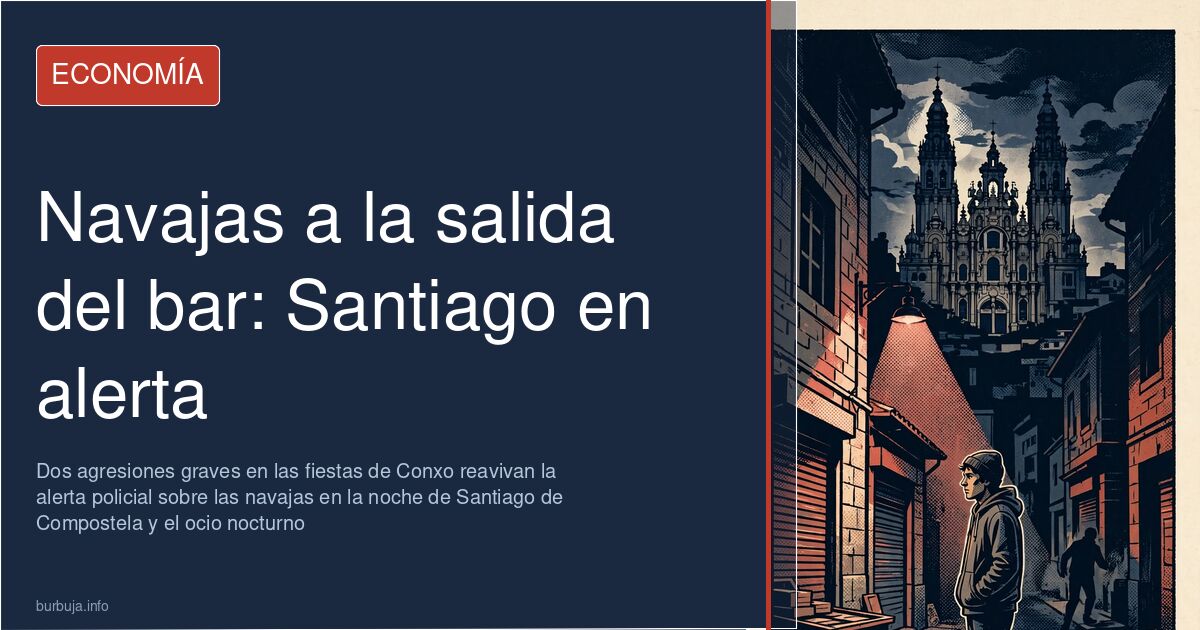
Compostela night sees attacks with knives and losing students
Two serious assaults in a single night. This is not a scene from a black movie: it's what was left behind by the festivities of A Mercé in Conxo, Santiago, according to the police alert reported by La Voz de Galicia on September 16, 2026. Officers warn of an escalation: more nightly fights and increased use of bladed weapons. This episode is not isolated. During the Ascension festivities in 2023, an adolescent was seriously injured after being stabbed by another minor.
The comparison is stark.
Why is insecurity felt in Santiago's nightlife?
The police themselves place the phenomenon within a trend that is overwhelming the city. What is experienced in Santiago as an epochal change is not exclusive to the historic center: altercations involving bladed weapons in nighttime leisure areas have spread throughout much of the country. In the Compostela case, some point to the Nueva area as being most tense on weekends after certain hours, and some also claim that the university scene has shifted to the historic area.
However, the feeling of insecurity is not unanimous: some analyses suggest that nightly brawls have always existed and that the narrative of total degradation is more nostalgic than factual. Other voices warn of a real change in the frequency and danger of these incidents.
Fewer students, more locals in the early morning: The changing nightlife economy
Beneath the noise is a transformation that some participants say they are measuring. According to calculations used in the debate, Santiago once gathered nearly 50,000 university students, doubling the population and sustaining a massive party from Monday to Thursday; today, the range being discussed is around 20,000 enrolled students, including Lugo.
Less captive clientele, a different nocturnal fabric.
Some participants illustrate this with historic venues: haunts with personality that lasted a generation of university students and eventually converted into something else. The result is a leisure city more dependent on tourists and dispersed consumption, with less capacity for self-regulation through the community that used to be provided by fixed students.
Identity discontent contaminating the diagnosis
Part of the discontent stems from an identity framework: it is argued that the migrant population has grown in the urban centers of Vigo, A Coruña, and Santiago faster than in Madrid, with figures of 20% to 30% in some central areas that are not accompanied by verifiable sources. This is an attribution, not a consolidated fact.
This framework coexists with another, more uncomfortable reading: the loss of the indigenous nightlife is also explained by consumption habits, the cost of going out, the climate, and the migration of residents to the periphery.
The clean diagnosis requires separating what is a incivil trend from what is social malaise.
With two serious assaults in a single night and a pattern that the police describe as escalating, the question is not whether the nightlife has changed, but how much of that change is crime and how much is narrative.
Two serious assaults in a single night. This is not a scene from a black movie: it's what was left behind by the festivities of A Mercé in Conxo, Santiago, according to the police alert reported by La Voz de Galicia on September 16, 2026. Officers warn of an escalation: more nightly fights and increased use of bladed weapons. This episode is not isolated. During the Ascension festivities in 2023, an adolescent was seriously injured after being stabbed by another minor.
The comparison is stark.
Why is insecurity felt in Santiago's nightlife?
The police themselves place the phenomenon within a trend that is overwhelming the city. What is experienced in Santiago as an epochal change is not exclusive to the historic center: altercations involving bladed weapons in nighttime leisure areas have spread throughout much of the country. In the Compostela case, some point to the Nueva area as being most tense on weekends after certain hours, and some also claim that the university scene has shifted to the historic area.
However, the feeling of insecurity is not unanimous: some analyses suggest that nightly brawls have always existed and that the narrative of total degradation is more nostalgic than factual. Other voices warn of a real change in the frequency and danger of these incidents.
Fewer students, more locals in the early morning: The changing nightlife economy
Beneath the noise is a transformation that some participants say they are measuring. According to calculations used in the debate, Santiago once gathered nearly 50,000 university students, doubling the population and sustaining a massive party from Monday to Thursday; today, the range being discussed is around 20,000 enrolled students, including Lugo.
Less captive clientele, a different nocturnal fabric.
Some participants illustrate this with historic venues: haunts with personality that lasted a generation of university students and eventually converted into something else. The result is a leisure city more dependent on tourists and dispersed consumption, with less capacity for self-regulation through the community that used to be provided by fixed students.
Identity discontent contaminating the diagnosis
Part of the discontent stems from an identity framework: it is argued that the migrant population has grown in the urban centers of Vigo, A Coruña, and Santiago faster than in Madrid, with figures of 20% to 30% in some central areas that are not accompanied by verifiable sources. This is an attribution, not a consolidated fact.
This framework coexists with another, more uncomfortable reading: the loss of the indigenous nightlife is also explained by consumption habits, the cost of going out, the climate, and the migration of residents to the periphery.
The clean diagnosis requires separating what is a incivil trend from what is social malaise.
With two serious assaults in a single night and a pattern that the police describe as escalating, the question is not whether the nightlife has changed, but how much of that change is crime and how much is narrative.
Summary of a discussion on Burbuja.info - Foro de economía, actualidad y política., translated from Spanish and reviewed before publication. Read the full discussion (61 replies).
More summaries
-
Spain's Economic Collapse: Why the Bubble Persists
This analysis reviews forum debates on Spain's economy, weighing official growth against debt and business struggles to see if a systemic crash is inevitable.
-
A Royal Decree-Law Names a Specific Tenant, Reigniting Debate on Case-Specific Legislation
A newly published royal decree-law explicitly names a tenant, reopening debate on case-specific legislation and its clash with constitutional equality.
-
Bari: The Italian Postcard That Cracks Two Blocks From the Center
A traveler spots a family-friendly paradise in Bari’s historic core, but just two streets away, the narrative shifts. Italy vs. Spain compared.
-
Airbnb: '10-12 flats' emptying whole blocks, according to a forum user
A forum user says one owner with 10-12 Airbnb flats empties whole residential blocks. In Lugo or Teruel, prices also rise without mass tourism.
-
Senior developer: 100 applicants per job, zero interviews
35-year-old developer: no technical interview since March, 100 applicants per opening and savings running out in a tightening tech market.
-
Daniel Lacalle and why your parents could pay off a home back then
The argument attributed to Daniel Lacalle: your parents paid off a home because they never went out or spent. Wages, VAT and mortgage rates, in figures