
Mercadona cuts turkey breast content from 70% to 50%
Customers report Mercadona reduced turkey breast in deli meats from 70% to 50%, sparking debate on labeling and additives.
English · Original discussion in Spanish · Published
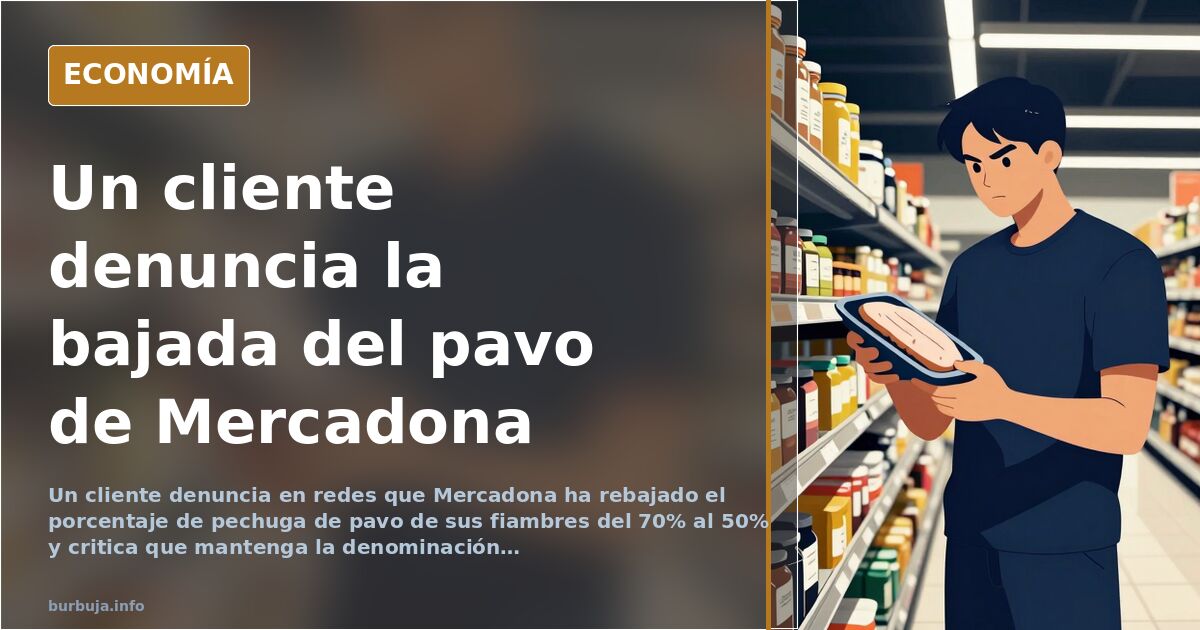
Customer reports Mercadona reduces turkey breast content from 70% to 50%
Amidst the food price war, a label change has raised alarms. A customer claims on social media that Mercadona lowered the turkey breast percentage in its deli meats from 70% to 50%. The accusation is direct: "You must remove 'breast' from the name because with only 50% it might even be illegal," says the user, who believes the product no longer deserves that designation. The debate over private label quality and food additives is now open.
The hidden turkey percentage behind the label
The trigger is a tweet comparing previous and current labeling. According to this complaint, Mercadona's turkey breast went from containing 70% meat to just 50%. For the complaining customer, this is deceptive: "you have no shame," they state. This is not an isolated case. In the Spanish supermarket chain, the turkey range includes options with 92% meat, but prices vary based on that proportion. As one participant notes, "you can choose the quantity, which matches the price." The problem for critics is that the lower-percentage product still carries the word "breast" in its name, causing confusion.
The discussion quickly shifts to ingredients. One participant states, "that isn't turkey breast, it's potato puree with colon cancer E250, and turkey flavor." The reference to E250 (sodium nitrite) connects with WHO classifications: processed meats are Group 1 carcinogens. According to data shared in the thread, "eating 50g daily — about two slices — increases colorectal cancer risk by 18%." The conversation, therefore, is no longer just about percentages, but about health.
Extra tender loin and fine print
The focus expands to other meat products at Mercadona. It is pointed out that the "extra-tender loin steak" is actually a "meat preparation" with injected brine. The label, in small print, hides that it contains added water, salt, sugar, and glucose syrup. A participant details that "most of the missing weight is water" and that brining is applied for 12 to 48 hours to tenderize the meat. They note the technique is centuries old, but the commercial name "extra-tender" suggests it is a natural cut.
The controversy extends to additives. While some warn about carrageenan risks, a participant defends that "you need to previously degrade the carrageenan until it splits into 5 parts" for it to be dangerous, and that human studies are inconclusive. The discussion turns to the balance between preservatives and food safety: "there are preservatives that, however bad they are, the alternative to not using them is death by poisoning, either from toxins or bacteria," another concludes. Botulism, they remind us, remains a real risk without additives.
Alternatives: From Trevélez ham to cecina
In response to the discontent, recommendations arise. Products without nitrites or preservatives are mentioned, such as Jamón de Trevélez (cured ham from Trevélez) or La Hoguera's lomo embuchado (cured pork loin). Brands like Luis Gil, with 100% natural ingredients, are also cited. The strategy involves "buying sliced to order" and avoiding pre-packaged blister packs. A participant provides a price list: Redondo Iglesias gran reserva serrano ham at €29.90/kg, Navidul cured ham at €29.90/kg, La Hoguera lomo embuchado at €19.90/kg, and extra León chorizo at Aldi for around €13/kg. The conclusion is that "with this you've already solved 90% of the deli meat issue."
Price comparison is another argument. It is noted that fresh loin steaks or chicken breasts cost "€7 per kilo, compared to deli meats which never drop below €11 per kilo." The economic equation, therefore, also invites reconsidering purchases. Some participants feel the criticism of Mercadona is disproportionate, while others recall that competitors are no better. The discussion currently closes without an official response from the company clarifying the percentage change.
Amidst the food price war, a label change has raised alarms. A customer claims on social media that Mercadona lowered the turkey breast percentage in its deli meats from 70% to 50%. The accusation is direct: "You must remove 'breast' from the name because with only 50% it might even be illegal," says the user, who believes the product no longer deserves that designation. The debate over private label quality and food additives is now open.
The hidden turkey percentage behind the label
The trigger is a tweet comparing previous and current labeling. According to this complaint, Mercadona's turkey breast went from containing 70% meat to just 50%. For the complaining customer, this is deceptive: "you have no shame," they state. This is not an isolated case. In the Spanish supermarket chain, the turkey range includes options with 92% meat, but prices vary based on that proportion. As one participant notes, "you can choose the quantity, which matches the price." The problem for critics is that the lower-percentage product still carries the word "breast" in its name, causing confusion.
The discussion quickly shifts to ingredients. One participant states, "that isn't turkey breast, it's potato puree with colon cancer E250, and turkey flavor." The reference to E250 (sodium nitrite) connects with WHO classifications: processed meats are Group 1 carcinogens. According to data shared in the thread, "eating 50g daily — about two slices — increases colorectal cancer risk by 18%." The conversation, therefore, is no longer just about percentages, but about health.
Extra tender loin and fine print
The focus expands to other meat products at Mercadona. It is pointed out that the "extra-tender loin steak" is actually a "meat preparation" with injected brine. The label, in small print, hides that it contains added water, salt, sugar, and glucose syrup. A participant details that "most of the missing weight is water" and that brining is applied for 12 to 48 hours to tenderize the meat. They note the technique is centuries old, but the commercial name "extra-tender" suggests it is a natural cut.
The controversy extends to additives. While some warn about carrageenan risks, a participant defends that "you need to previously degrade the carrageenan until it splits into 5 parts" for it to be dangerous, and that human studies are inconclusive. The discussion turns to the balance between preservatives and food safety: "there are preservatives that, however bad they are, the alternative to not using them is death by poisoning, either from toxins or bacteria," another concludes. Botulism, they remind us, remains a real risk without additives.
Alternatives: From Trevélez ham to cecina
In response to the discontent, recommendations arise. Products without nitrites or preservatives are mentioned, such as Jamón de Trevélez (cured ham from Trevélez) or La Hoguera's lomo embuchado (cured pork loin). Brands like Luis Gil, with 100% natural ingredients, are also cited. The strategy involves "buying sliced to order" and avoiding pre-packaged blister packs. A participant provides a price list: Redondo Iglesias gran reserva serrano ham at €29.90/kg, Navidul cured ham at €29.90/kg, La Hoguera lomo embuchado at €19.90/kg, and extra León chorizo at Aldi for around €13/kg. The conclusion is that "with this you've already solved 90% of the deli meat issue."
Price comparison is another argument. It is noted that fresh loin steaks or chicken breasts cost "€7 per kilo, compared to deli meats which never drop below €11 per kilo." The economic equation, therefore, also invites reconsidering purchases. Some participants feel the criticism of Mercadona is disproportionate, while others recall that competitors are no better. The discussion currently closes without an official response from the company clarifying the percentage change.
Also available in: Deutsch
Summary of a discussion on Burbuja.info - Foro de economía, actualidad y política., translated from Spanish and reviewed before publication. Read the full discussion (130 replies).
More summaries
-
Mercadona takes on Spanish bars over cheap lunch menus
Bar daily menus rise to €20 while Mercadona sells burger, drink and coffee for €5. The food war reshaping the workday lunch break.
-
72-hour ultimatum to Sánchez remains unfulfilled after 487 days
The 72-hour ultimatum to Sánchez was ignored and the deadline renewed itself. The timeline of failed predictions of his downfall goes back to 2014.
-
Video shows Spanish Socialist MP staggering late at night
A viral video allegedly shows Piedad Álvarez, PSOE spokesperson in Extremadura, Spain, unable to walk; the uploader claims threats of legal action.
-
Joaquín Prat Claims Self-Censorship to Keep TV Show
Spanish host Joaquín Prat admits on air he stays silent to avoid losing his program, amid controversy over a youth brawl.
-
EU Funds Director Resigns Amid Husband's Fraud Probe
Spain's EU Funds Director resigns after her husband is investigated for fraud. Ana Cristina Peña appointed as successor by the Council of Ministers.
-
Video of father hitting daughter reignites debate on parental discipline in Spain
A viral video shows a father striking his teenage daughter for bringing boys home, sparking renewed controversy over physical punishment and parental authority.