
260k: Leganés flat vs Florida dock home
260,000 euros buys a 78m² ground-floor flat in Spain or a Florida home with a dock. Analysis of land scarcity, IBI tax, and why Spanish property prices remain high.
English · Original discussion in Spanish · Published
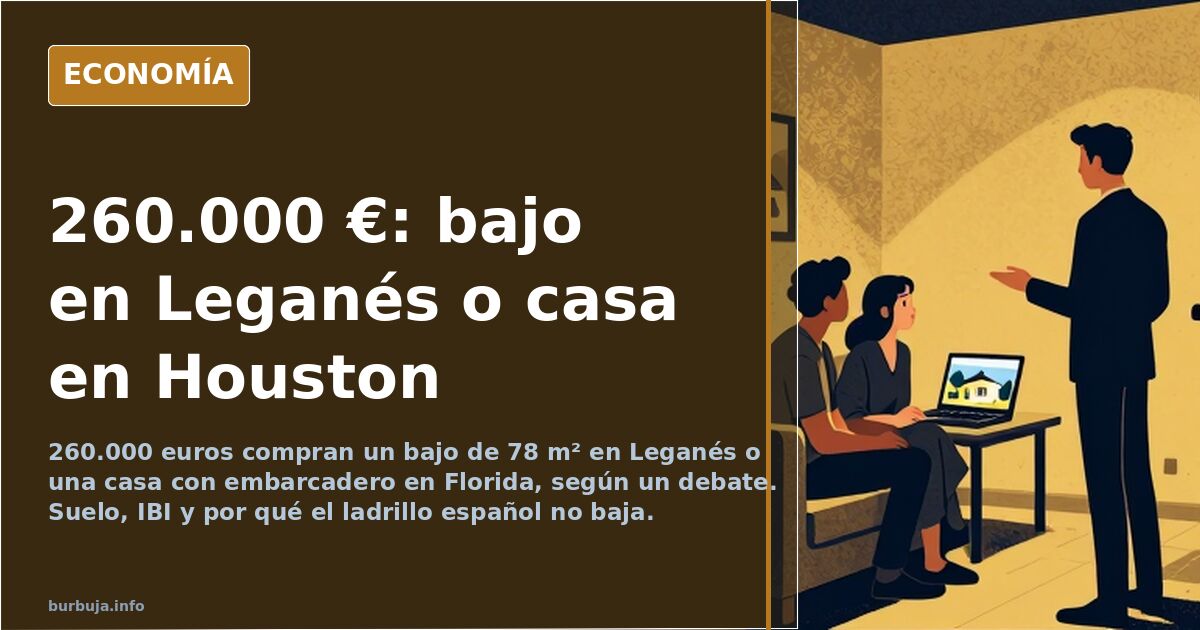
260,000 euros: a 78m² flat in Leganés or a house in Houston
What does 260,000 euros buy in Spain? A 78-square-meter exterior ground-floor apartment in Leganés, 45 minutes from central Madrid if traffic permits. And in the United States? A property with land and its own dock in the Florida Keys, a short drive from Miami, or a house in the Houston metropolitan area. The same money. This comparison, circulating on social media and economic forums, has peine the debate on whether Spanish housing prices reflect real scarcity or political decisions.
Land as a financial asset, not a consumer good
The central argument is accounting-based: in Spain, the value of scarce land (due to political decisions) is merged with the structure, which is a depreciating asset. A 1960s apartment should lose value yearly, but it gains. Real estate functions as bank collateral and a pension plan for a generation, keeping prices inflated through land restrictions, low interest rates, and the mantra that they never fall.
The contrast with Japan is frequently cited. There, houses are treated as structures that depreciate. After 20-25 years, building value is near zero; only land remains, leading to demolition and reconstruction. Since housing isn't an investment vehicle, there's no incentive to restrict construction. Tokyo, with 14 million residents, offers more affordable housing than Madrid. Proof that the Spanish model is neither inevitable nor natural.
Houston: No zoning, high property taxes, and tornadoes
Texas is the anti-Spain in housing. Land is abundant and cheap; Houston has minimal zoning. If prices rise, more is built, correcting the market. Prices defy Spanish buyer expectations. But there are caveats. Annual property tax (IBI equivalent) can reach €3,000 in major cities, funding public education, unlike in Spain where income tax covers this. However, US income tax is lower, and sales tax replaces the 21% VAT, often under 8% or zero in some states.
More drawbacks exist. Texas faces tornadoes; prefabricated homes can be destroyed by wind. Urban sprawl forces car dependency, reducing time at home. City centers are prohibitively expensive, even for those selling suburban homes to move closer to services. The American Dream has its own costly land component.
Wages, purchasing power, and the trap of direct comparison
Average salaries in Houston range from $55,000 to $82,000 annually depending on sector; engineers and healthcare professionals exceed $87,000-$123,000, while retail and services hover around $42,000-$50,000. In the Community of Madrid, average gross salary is about €32,200 annually (~€2,760 monthly). The gap is real, but so is the cost of living. Purchasing Power Parity (PPP) adjustments suggest €260,000 in Spain equals ~$150,000 in the US. With this correction, a professional couple earning €90,000 in Spain would earn $200,000 abroad, paying for a $300,000 house "with ease."
Some argue the core issue isn't just price, but concentration. Madrid and Barcelona absorb skilled jobs while other regions empty out. Housing in these hubs becomes a bottleneck where land represents up to 90% of total property value. The dilapidated unit comes free; you pay for the plot beneath it.
Solutions: From targeted taxes to ending housing-as-investment
Proposals range from fiscal to structural measures. One recurring idea: introduce a wedge into interest rates via an annual 2% tax dedicated solely to building protected housing. Psychologically, Spanish buyers, financially unsophisticated, perceive anything as cheap when rates are low. Another measure: limit mortgage terms to 20 years. At healthy 10% rates, a €500,000 mortgage wouldn't drop below €5,000 monthly payments.
None touch the core: as long as housing is a financial asset rather than a durable consumer good, incentives to restrict supply persist. Letting prices fall to use-value would destroy bank balance sheets and family wealth, so support continues. The small apartment as a national religion.
Ultimately, the question isn't whether life is better in Houston. It's why the same money buys a shaded ground-floor flat in Leganés or a docked home in Florida. The answer, uncomfortable as it is, is not geographic: it is political.
Also available in: Deutsch
Summary of a discussion on Burbuja.info - Foro de economía, actualidad y política., translated from Spanish and reviewed before publication. Read the full discussion (135 replies).
More summaries
-
Madrid rent of €1,600 on an average salary of €2,077
A 45 m² flat in Madrid is listed at €1,600 a month, while the average salary in the capital is €2,077. The numbers don't add up.
-
Japan faces 8.9 million empty homes, 10.3% of housing stock
Japan reports 8.9 million vacant properties, 10.3% of the total, while Tokyo prices rise. This contrasts with Spain but reveals a common pattern.
-
Madrid housing prices jump 7.4%, reigniting bubble fears
Madrid capital saw a 7.4% year-on-year price rise in April 2024, while towns like Coslada remain below 2008 levels. The debate over a property bubble intensifies.
-
Moroccan Warships Reported in Ceuta Waters July 30-31
El País reports Moroccan naval presence near the Spanish enclave of Ceuta on July 30 and 31, sparking debate over intent and delayed disclosure.
-
Video explains the accident but doesn't reach a conclusion, and that matters
A video circulating on social media walks through an accident step by step without settling the cause. The difference between informing and concluding is key to stopping misinformation.
-
Why is former Adif chief Isabel Pardo de Vera advising an Israeli rail tech firm?
The former head of Spain's railway infrastructure manager has sat on Cylus's advisory board since 2024, while I-SEC runs security contracts with Renfe in several regions.