
Japan faces 8.9 million empty homes, 10.3% of housing stock
Japan reports 8.9 million vacant properties, 10.3% of the total, while Tokyo prices rise. This contrasts with Spain but reveals a common pattern.
English · Original discussion in Spanish · Published
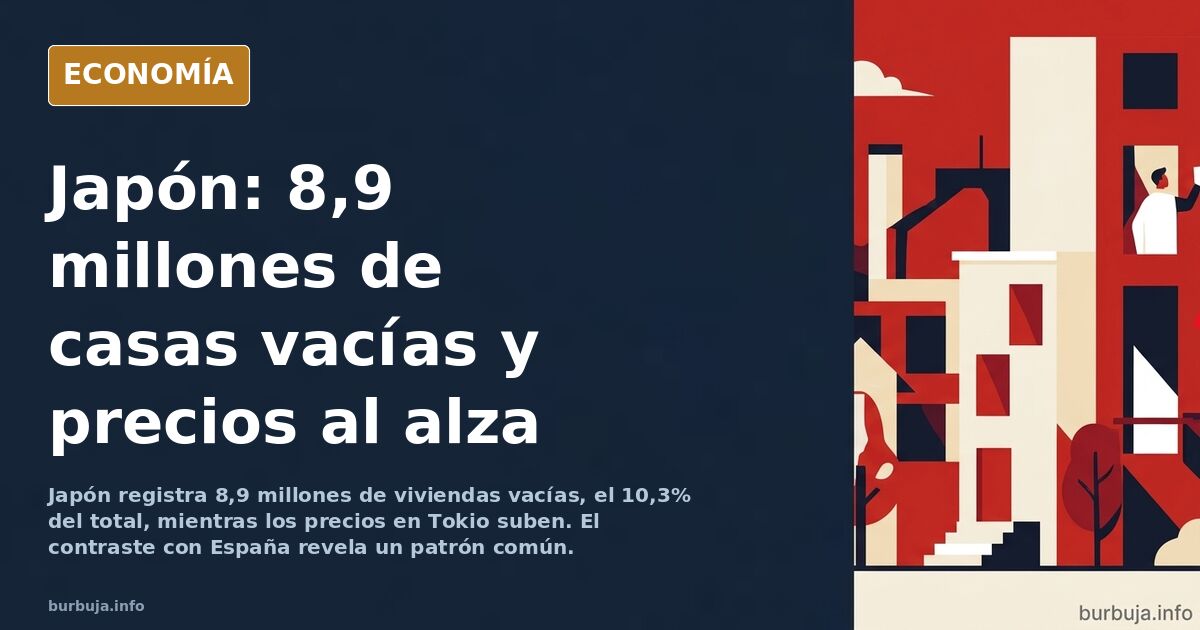
Japan has 8.9 million vacant homes, accounting for 10.3% of the total
Japan faces a problem that cannot be solved with cranes or concrete: it has too many houses. The Ministry of Internal Affairs and Communications recorded 8.9 million vacant dwellings in 2023, representing 10.3% of the real estate stock. Official projections indicate this percentage will reach 30.4% by 2033. The phenomenon is not limited to deep rural areas; it also appears in major cities, where properties have remained unrented for years or have been abandoned by their owners. The root cause is demographic, but the diagnosis becomes complex when examining the details.
Aging population empties entire neighborhoods
The country has been below the replacement rate for decades. The most visible consequence is the accumulation of unused properties: homes no one inherits, claims, or maintains because upkeep costs more than abandonment. In small municipalities, the effect is terminal. In Tokyo, the phenomenon coexists with another uncomfortable reality: new home prices are rising. According to a 2021 Recruit survey of new home buyers in the metropolitan area, the average purchase price was 43.31 million yen, the highest since 2014. The paradox is evident: there is a surplus of homes, yet buying one has become more expensive.
Why do prices rise if there is a housing surplus?
The answer lies in concentration. Jobs, services, and opportunities cluster in a few metropolitan areas, while the rest of the country depopulates. This is the same pattern observed in Spain, where 14% of the stock is vacant —about 3.8 million homes— but price pressure concentrates in Madrid, Barcelona, and coastal areas. Vacant housing statistics say little about habitability: many appear available in the cadastre when they are actually ruins without services. Some have fought for years to have an occupied 1919 house declared a ruin, because until the cadastre is updated, the property continues to count in the wrong column.
The demographic debate: problem or opportunity?
There is no consensus. One school argues Japan does not have a space problem, but a proportion issue: 130 million inhabitants in a territory smaller than Spain, with most land being mountainous and uninhabitable. From this perspective, losing population alleviates pressure on land and services. The opposing view notes the problem is not the absolute number, but the ratio of retirees to workers: higher social spending and taxes on an increasingly narrow base. The Universe 25 experiment—the mouse colony that collapsed due to overcrowding—is cited as an analogy, though its translation to human societies is highly debatable.
Comparison with Spain: similar symptoms, different treatment
Spain has a higher percentage of vacant housing than Japan, yet prices do not fall. The argument circulating in economic forums is that immigration sustains demand: more than one million annual arrivals through airports, according to a circulating calculation that mixes arrivals with effective residency. Others point to bureaucracy as a brake: energy labels, transfer tax (ITP), and notary fees. Almost all analyses share the conclusion that the Japanese and Spanish real estate markets are more alike than they seem: many empty homes where no one wants to live, few where everyone wants to.
The discussion gets stuck at the same point: if there is a housing surplus, why don't prices drop? The short answer is that surplus exists where there are no jobs. The long answer requires deciding what to do with eight million properties no one wants to inherit and which, within a decade, could constitute nearly a third of the country.
Japan faces a problem that cannot be solved with cranes or concrete: it has too many houses. The Ministry of Internal Affairs and Communications recorded 8.9 million vacant dwellings in 2023, representing 10.3% of the real estate stock. Official projections indicate this percentage will reach 30.4% by 2033. The phenomenon is not limited to deep rural areas; it also appears in major cities, where properties have remained unrented for years or have been abandoned by their owners. The root cause is demographic, but the diagnosis becomes complex when examining the details.
Aging population empties entire neighborhoods
The country has been below the replacement rate for decades. The most visible consequence is the accumulation of unused properties: homes no one inherits, claims, or maintains because upkeep costs more than abandonment. In small municipalities, the effect is terminal. In Tokyo, the phenomenon coexists with another uncomfortable reality: new home prices are rising. According to a 2021 Recruit survey of new home buyers in the metropolitan area, the average purchase price was 43.31 million yen, the highest since 2014. The paradox is evident: there is a surplus of homes, yet buying one has become more expensive.
Why do prices rise if there is a housing surplus?
The answer lies in concentration. Jobs, services, and opportunities cluster in a few metropolitan areas, while the rest of the country depopulates. This is the same pattern observed in Spain, where 14% of the stock is vacant —about 3.8 million homes— but price pressure concentrates in Madrid, Barcelona, and coastal areas. Vacant housing statistics say little about habitability: many appear available in the cadastre when they are actually ruins without services. Some have fought for years to have an occupied 1919 house declared a ruin, because until the cadastre is updated, the property continues to count in the wrong column.
The demographic debate: problem or opportunity?
There is no consensus. One school argues Japan does not have a space problem, but a proportion issue: 130 million inhabitants in a territory smaller than Spain, with most land being mountainous and uninhabitable. From this perspective, losing population alleviates pressure on land and services. The opposing view notes the problem is not the absolute number, but the ratio of retirees to workers: higher social spending and taxes on an increasingly narrow base. The Universe 25 experiment—the mouse colony that collapsed due to overcrowding—is cited as an analogy, though its translation to human societies is highly debatable.
Comparison with Spain: similar symptoms, different treatment
Spain has a higher percentage of vacant housing than Japan, yet prices do not fall. The argument circulating in economic forums is that immigration sustains demand: more than one million annual arrivals through airports, according to a circulating calculation that mixes arrivals with effective residency. Others point to bureaucracy as a brake: energy labels, transfer tax (ITP), and notary fees. Almost all analyses share the conclusion that the Japanese and Spanish real estate markets are more alike than they seem: many empty homes where no one wants to live, few where everyone wants to.
The discussion gets stuck at the same point: if there is a housing surplus, why don't prices drop? The short answer is that surplus exists where there are no jobs. The long answer requires deciding what to do with eight million properties no one wants to inherit and which, within a decade, could constitute nearly a third of the country.
Also available in: Deutsch
Summary of a discussion on Burbuja.info - Foro de economía, actualidad y política., translated from Spanish and reviewed before publication. Read the full discussion (134 replies).
More summaries
-
Ibiza: €1,000 per room and 105,434 empty homes
Ibiza has 105,434 empty homes and Spain’s priciest real estate at €5,194 per sqm. Workers sleep in caravans while rooms cost €1,000.
-
IONOS cuts 450 jobs, Logroño fears for Arsys's 360
IONOS cuts 450 jobs from 3,800: Arsys, with 360 workers in Logroño, is unsure how many will be affected.
-
AEMET defends warm winter forecast after cold Christmas
Spain's AEMET argues a warm winter allows for intense cold spells, despite the coldest Christmas since 2010 sparking debate on seasonal forecasting reliability.
-
Spain's Power Grid Crisis Sparks Blame Game Between Government and Utilities
PM Sánchez blames private operators for the blackout; Iberdrola and others reject responsibility, pointing to Red Eléctrica.
-
US Diverts Swiss F-35 Funds to Patriot Systems
Reports suggest the US diverted Swiss F-35 payments to Patriot systems, delaying deliveries until 2030. Europe reassesses its reliance on American weaponry.
-
Spanish Forum Thread Criticizes Andalusian Candidate's Cleavage
A forum thread attacks an Andalusian candidate for her cleavage during the campaign, with many arguing it loses votes rather than gaining them.