
Madrid rent of €1,600 on an average salary of €2,077
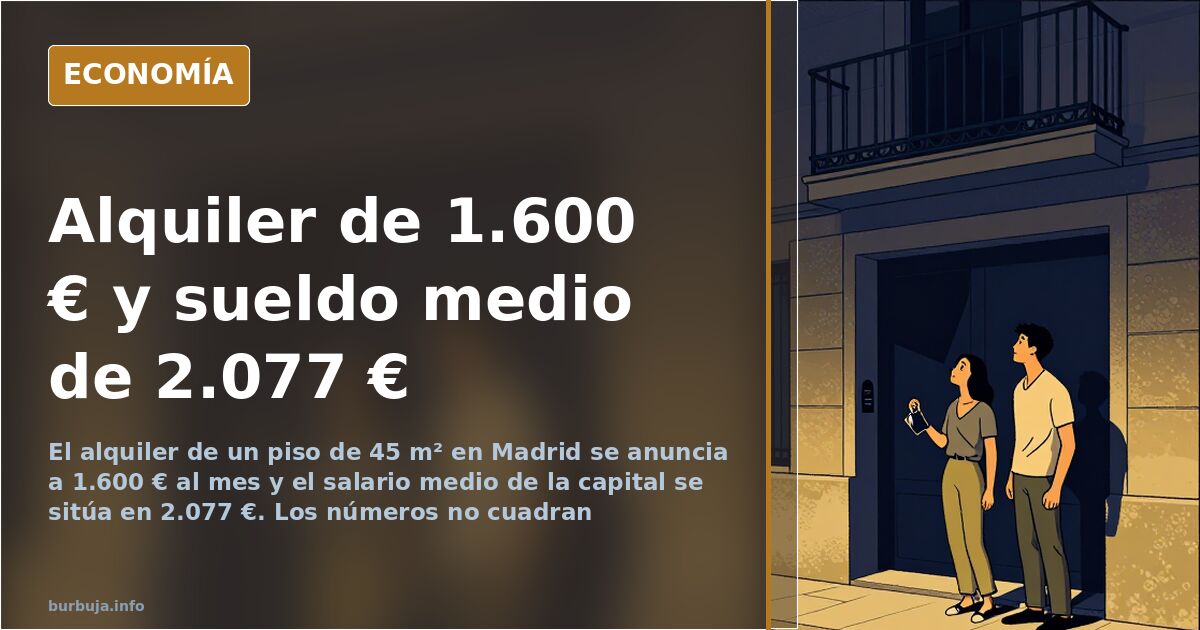
A 45 m² flat in Madrid is listed at €1,600 a month, while the average salary in the capital is €2,077. The numbers don't add up.
English · Original discussion in Spanish · Published
Madrid: €1,600 rent on an average salary of €27,000
A 45-square-meter flat in a semi-gentrified neighbourhood of Madrid is advertised at €1,600 a month. The average salary cited for the capital is €2,077 per month; another reference in the thread mentions €27,000 gross a year. The math doesn't need a calculator. Rent swallows most of the average salary and leaves little margin for food, electricity and transport. The doubt hovering over any analysis is whether this is a passing anomaly or the new floor for the city.
Rent vs. average salary in Madrid
The average salary figure is questioned even before it is used. If that average includes high incomes from wealthy residents who have arrived from abroad, the position of the ordinary worker is worse than the official figure suggests. With that starting point, talking about housing in Madrid is not about effort: it's about how much is left after paying for a roof. And little is left.
Some argue that the real problem is not the price, but that it is accepted. The existence of shared cramped rooms, sublet bedrooms and agreements between several people to get into a flat suggests there is demand willing to sign anything just to stay. That willingness is what sustains the price, not a malevolent invisible hand.
Two thousand homes built and more than a hundred thousand new adults
The numbers cited about Madrid's housing market are hard to reconcile. According to the figures being handled, they pointed to some 2,000 homes built in the Community of Madrid in a year, compared with more than one hundred thousand new adults arriving in the region in the same period. If the gap is real, no mobility policy, social housing or tax break can plug the hole.
The mismatch explains why new construction does not cool the market. Building happens where profitability is highest and with the lowest possible volume, while demand grows beyond the capacity to absorb it. Increasing supply requires time, permits and land. Increasing demand only requires people to keep arriving.
The refuge of the outskirts: from €500 to €700 a month
The comparison hurts when you look outside the capital. In El Burgo de Osma, homes are advertised at these prices:
Distance is the price of the difference. To work in Madrid you have to live in Madrid or accept an endless commute. The closest job reference to El Burgo de Osma mentioned in the thread is Aranda de Duero, about 45 minutes by car. Whoever can telework has a clear way out; whoever cannot, does not.
Why hasn't the sale price broken the 2008 ceiling?
In many areas, sale prices have not surpassed the 2008 peaks, and that is without counting accumulated inflation since then. Adjusted, they are cheaper than fifteen years ago. What is striking is that rental yields are approaching what is considered historically normal, when in the midst of the bubble a flat yielded 2% annually. The anomaly is not in the brick: it is in what is paid to use it.
Who pressures demand and who gets blamed
Part of the analysis attributes the tension to the arrival of foreign population, which concentrates in large cities and shares housing to split the cost. It is argued that this formula drives down base wages and pushes rents up. Other readings point to tourist rentals, empty homes held by their owners and a regulatory framework that penalises landlords without increasing supply. There is no conclusive data in either direction.
What it costs to live in Madrid on a high salary
Even high salaries do not come out well. A professional declaring net income of €3,100 to €4,500 a month calls laughable an offer of €2,000 gross in fourteen payments with room included, the kind of package presented as an advantage and which in practice amounts to a borrowed roof. A couple working in well-known shops in the capital pays €1,500 for a mediocre flat; in the provinces, with the same salary and the same company, they would pay about €900 in mortgage for a new home.
Everyone calculates, compares and ends up half-hearted. Selling a Madrid flat for €600,000 and buying a mansion in the provinces for €200,000, with €400,000 as a cushion, is an operation that whoever proposes it presents as obvious, although it is surprising that more people do not do it. With these differentials, the move inland should be an exodus. It remains marginal. Nobody fully figures out why.
A 45-square-meter flat in a semi-gentrified neighbourhood of Madrid is advertised at €1,600 a month. The average salary cited for the capital is €2,077 per month; another reference in the thread mentions €27,000 gross a year. The math doesn't need a calculator. Rent swallows most of the average salary and leaves little margin for food, electricity and transport. The doubt hovering over any analysis is whether this is a passing anomaly or the new floor for the city.
Rent vs. average salary in Madrid
The average salary figure is questioned even before it is used. If that average includes high incomes from wealthy residents who have arrived from abroad, the position of the ordinary worker is worse than the official figure suggests. With that starting point, talking about housing in Madrid is not about effort: it's about how much is left after paying for a roof. And little is left.
Some argue that the real problem is not the price, but that it is accepted. The existence of shared cramped rooms, sublet bedrooms and agreements between several people to get into a flat suggests there is demand willing to sign anything just to stay. That willingness is what sustains the price, not a malevolent invisible hand.
Two thousand homes built and more than a hundred thousand new adults
The numbers cited about Madrid's housing market are hard to reconcile. According to the figures being handled, they pointed to some 2,000 homes built in the Community of Madrid in a year, compared with more than one hundred thousand new adults arriving in the region in the same period. If the gap is real, no mobility policy, social housing or tax break can plug the hole.
The mismatch explains why new construction does not cool the market. Building happens where profitability is highest and with the lowest possible volume, while demand grows beyond the capacity to absorb it. Increasing supply requires time, permits and land. Increasing demand only requires people to keep arriving.
The refuge of the outskirts: from €500 to €700 a month
The comparison hurts when you look outside the capital. In El Burgo de Osma, homes are advertised at these prices:
- Flat on Calle de la Universidad: €500 a month.
- Semi-detached house of 154 m² with four bedrooms and garage: €700 a month.
- Flat of 130 m² with three bedrooms in San Agustín, furnished and with lift: €700 a month.
Distance is the price of the difference. To work in Madrid you have to live in Madrid or accept an endless commute. The closest job reference to El Burgo de Osma mentioned in the thread is Aranda de Duero, about 45 minutes by car. Whoever can telework has a clear way out; whoever cannot, does not.
Why hasn't the sale price broken the 2008 ceiling?
In many areas, sale prices have not surpassed the 2008 peaks, and that is without counting accumulated inflation since then. Adjusted, they are cheaper than fifteen years ago. What is striking is that rental yields are approaching what is considered historically normal, when in the midst of the bubble a flat yielded 2% annually. The anomaly is not in the brick: it is in what is paid to use it.
Who pressures demand and who gets blamed
Part of the analysis attributes the tension to the arrival of foreign population, which concentrates in large cities and shares housing to split the cost. It is argued that this formula drives down base wages and pushes rents up. Other readings point to tourist rentals, empty homes held by their owners and a regulatory framework that penalises landlords without increasing supply. There is no conclusive data in either direction.
What it costs to live in Madrid on a high salary
Even high salaries do not come out well. A professional declaring net income of €3,100 to €4,500 a month calls laughable an offer of €2,000 gross in fourteen payments with room included, the kind of package presented as an advantage and which in practice amounts to a borrowed roof. A couple working in well-known shops in the capital pays €1,500 for a mediocre flat; in the provinces, with the same salary and the same company, they would pay about €900 in mortgage for a new home.
Everyone calculates, compares and ends up half-hearted. Selling a Madrid flat for €600,000 and buying a mansion in the provinces for €200,000, with €400,000 as a cushion, is an operation that whoever proposes it presents as obvious, although it is surprising that more people do not do it. With these differentials, the move inland should be an exodus. It remains marginal. Nobody fully figures out why.
Summary of a discussion on Burbuja.info - Foro de economía, actualidad y política., translated from Spanish and reviewed before publication. Read the full discussion (347 replies).
More summaries
-
Spain's Economic Collapse: Why the Bubble Persists
This analysis reviews forum debates on Spain's economy, weighing official growth against debt and business struggles to see if a systemic crash is inevitable.
-
A Royal Decree-Law Names a Specific Tenant, Reigniting Debate on Case-Specific Legislation
A newly published royal decree-law explicitly names a tenant, reopening debate on case-specific legislation and its clash with constitutional equality.
-
Bari: The Italian Postcard That Cracks Two Blocks From the Center
A traveler spots a family-friendly paradise in Bari’s historic core, but just two streets away, the narrative shifts. Italy vs. Spain compared.
-
Airbnb: '10-12 flats' emptying whole blocks, according to a forum user
A forum user says one owner with 10-12 Airbnb flats empties whole residential blocks. In Lugo or Teruel, prices also rise without mass tourism.
-
Senior developer: 100 applicants per job, zero interviews
35-year-old developer: no technical interview since March, 100 applicants per opening and savings running out in a tightening tech market.
-
Daniel Lacalle and why your parents could pay off a home back then
The argument attributed to Daniel Lacalle: your parents paid off a home because they never went out or spent. Wages, VAT and mortgage rates, in figures