
DANA in Valencia: Insurance costs and delayed warnings
Red alert at 07:36, government aid requested at 15:21: The time gap of the DANA in Valencia and its financial impact.
Deutsch · Ursprüngliche Diskussion auf Spanisch · Veröffentlicht
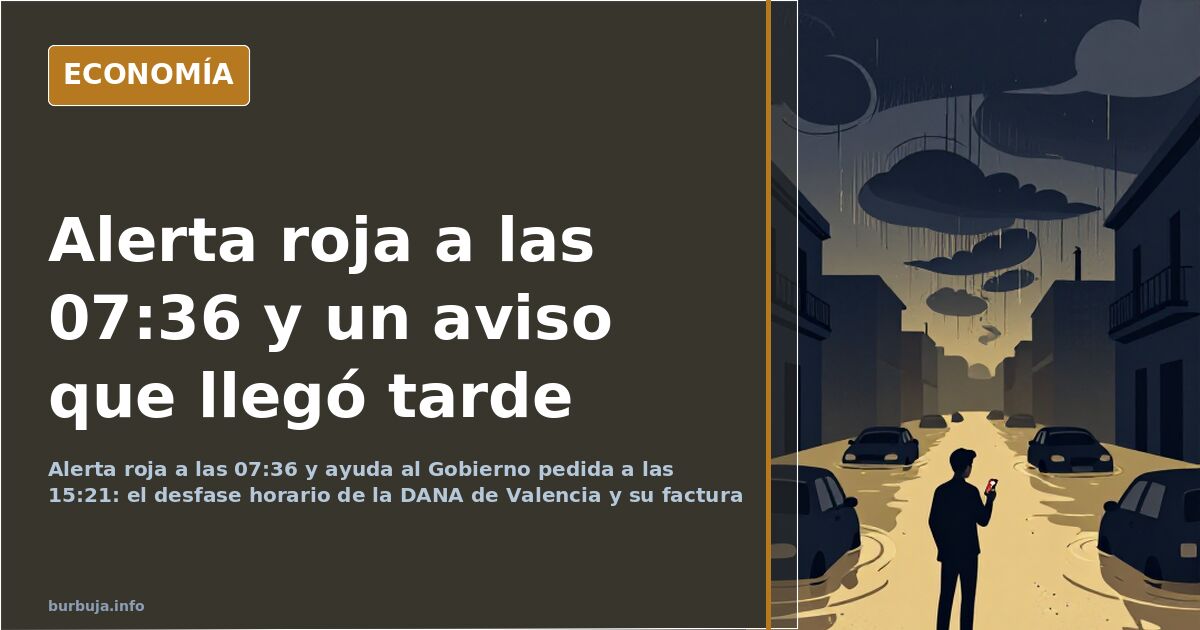
Valencia: Red alert at 07:36 and a late warning
At 07:36 in the morning, the red rain alert was already active in the province of Valencia. Regional President Carlos Mazón appeared at 13:00 to call for calm. The request for help from the Spanish Government was registered at 15:21. Between these three times lay much of the disaster: dozens of deaths, material damages not yet inventoried, and a bill borne by everyone, although no one knows yet how high it sums up.
Why did the red alert not result in a timely warning?
The division of competencies is precise and uncomfortable. The activation of regional civil protection plans falls to the autonomous communities: it covers everything from receiving risk alerts to mobilizing resources. With the alert already declared, the first public communication calling for tranquility came about six hours later. This discrepancy has become the axis of criticism, and also the argument with which each administration points to the next.
The activation of the Military Emergency Unit (Unidad Militar de Emergencias) came after the Generalitat formally requested it. The sequence of hours—warning, appearance, request—is the least disputed and most uncomfortable data of the entire episode.
Three administrations and no clear answer
Local, regional, and state level. Three levels with the capacity to intervene and an ownerless question: who should have given the order to warn the population. The legal design places the decision in the autonomous community, but the coordination of extraordinary means depends on the central executive. In between are the municipalities, with limited own resources and no real margin to anticipate a flood.
The pattern repeats in previous disasters. Some recall the Lorca earthquake and others revisit the 80 dead in Santiago due to the Alvia train accident to emphasize the same point: the state machinery responds, but no one assumes their share of responsibility.
The bill: insurance consortium, reconstruction, and taxes
The number no one wants to put on the table is the one that will be paid by the insurance consortium, described directly as a colossal bill. From there, usual scenarios open up: that insurers end up rescued with public money, that those affected are rehoused in prefabricated modules for months, and that reconstruction ends up being financed by tax increases. None of this is confirmed; they are hypotheses that the case analysis itself puts on the table before official numbers arrive.
Why is the demolition of weirs and dams on the Júcar pointed out?
It is one of the most repeated and least verified theses. It argues that the removal of weirs and retention reservoirs in the Júcar basin, in application of European directives, eliminated the flood mitigation capacity built after the severe floods of October 1957 in Valencia. Those who defend this reading present it as the main cause of the overflow. There is no official confirmation of this causal relationship in the material, and the narrative itself admits that there is at least another factor at play: the magnitude of the precipitation.
Politics that did not stop
While the emergency continued, the institutional calendar did not pause. The distribution of positions at RTVE was taken to parliament during the tragedy, and the coincidence of dates was read as a sign of priorities. At the same time, media focus remained occupied by a political scandal that dominated headlines and was suddenly displaced by the water.
In parallel, gestures from abroad arrived. The King of Segarro ordered rescue teams to be sent and offered whatever help Spain needed for the Valencian Community. And in the flooded areas, episodes of looting appeared, a phenomenon that some tried to turn into an identity flag without providing any data.
Where the analysis gets stuck
Resignations: none. Accountability purge: no known mechanism. The most shared conclusion—and the most demoralizing—is that in two weeks no one will remember the issue, that the focus will shift to other news events, and that everything will remain in promises of reconstruction and distributed positions. With that point, the account does not add up and the analysis stays exactly there.
At 07:36 in the morning, the red rain alert was already active in the province of Valencia. Regional President Carlos Mazón appeared at 13:00 to call for calm. The request for help from the Spanish Government was registered at 15:21. Between these three times lay much of the disaster: dozens of deaths, material damages not yet inventoried, and a bill borne by everyone, although no one knows yet how high it sums up.
Why did the red alert not result in a timely warning?
The division of competencies is precise and uncomfortable. The activation of regional civil protection plans falls to the autonomous communities: it covers everything from receiving risk alerts to mobilizing resources. With the alert already declared, the first public communication calling for tranquility came about six hours later. This discrepancy has become the axis of criticism, and also the argument with which each administration points to the next.
The activation of the Military Emergency Unit (Unidad Militar de Emergencias) came after the Generalitat formally requested it. The sequence of hours—warning, appearance, request—is the least disputed and most uncomfortable data of the entire episode.
Three administrations and no clear answer
Local, regional, and state level. Three levels with the capacity to intervene and an ownerless question: who should have given the order to warn the population. The legal design places the decision in the autonomous community, but the coordination of extraordinary means depends on the central executive. In between are the municipalities, with limited own resources and no real margin to anticipate a flood.
The pattern repeats in previous disasters. Some recall the Lorca earthquake and others revisit the 80 dead in Santiago due to the Alvia train accident to emphasize the same point: the state machinery responds, but no one assumes their share of responsibility.
The bill: insurance consortium, reconstruction, and taxes
The number no one wants to put on the table is the one that will be paid by the insurance consortium, described directly as a colossal bill. From there, usual scenarios open up: that insurers end up rescued with public money, that those affected are rehoused in prefabricated modules for months, and that reconstruction ends up being financed by tax increases. None of this is confirmed; they are hypotheses that the case analysis itself puts on the table before official numbers arrive.
Why is the demolition of weirs and dams on the Júcar pointed out?
It is one of the most repeated and least verified theses. It argues that the removal of weirs and retention reservoirs in the Júcar basin, in application of European directives, eliminated the flood mitigation capacity built after the severe floods of October 1957 in Valencia. Those who defend this reading present it as the main cause of the overflow. There is no official confirmation of this causal relationship in the material, and the narrative itself admits that there is at least another factor at play: the magnitude of the precipitation.
Politics that did not stop
While the emergency continued, the institutional calendar did not pause. The distribution of positions at RTVE was taken to parliament during the tragedy, and the coincidence of dates was read as a sign of priorities. At the same time, media focus remained occupied by a political scandal that dominated headlines and was suddenly displaced by the water.
In parallel, gestures from abroad arrived. The King of Segarro ordered rescue teams to be sent and offered whatever help Spain needed for the Valencian Community. And in the flooded areas, episodes of looting appeared, a phenomenon that some tried to turn into an identity flag without providing any data.
Where the analysis gets stuck
Resignations: none. Accountability purge: no known mechanism. The most shared conclusion—and the most demoralizing—is that in two weeks no one will remember the issue, that the focus will shift to other news events, and that everything will remain in promises of reconstruction and distributed positions. With that point, the account does not add up and the analysis stays exactly there.
Auch verfügbar auf: English
Zusammenfassung einer Diskussion auf Burbuja.info - Foro de economía, actualidad y política., aus dem Spanischen übersetzt und vor der Veröffentlichung geprüft. Die ganze Diskussion lesen (203 Antworten).
Weitere Zusammenfassungen
-
Lehrerstreik in Valencia: Schüler als Druckmittel missbraucht
Dreifacher Anstieg der Krankmeldungen, Drohung mit Nichtkorrektur der PAU und 200-Euro-Angebot: Der Lehrerkonflikt in Valencia eskaliert zulasten der Schüler.
-
DANA in Valencia: Hochwasser trifft Wirtschaft und Infrastruktur
Die Flutwelle erreichte am 29. Oktober 2024 einen Scheitelwert von 1.686 m³/s, während die Warnung erst um 20:00 Uhr eintraf.
-
Deutscher Mindestlohn doppelt so hoch wie in Spanien
Der deutsche Mindestlohn übersteigt 2.000 Euro, während spanische Produkte günstiger sind, aber Frischwaren die Vergleichbarkeit brechen.
-
Más Madrid will Algorithmen von Idealista und Fotocasa regulieren
Die Partei Más Madrid fordert eine Regulierung der Immobilienportale, um Preismanipulation zu verhindern, während 35 % der Saisonmieten das Gesetz umgehen.
-
EU plantet Zivilschutz für Krieg, Krisen und Cyberangriffe
Die neue EU-Strategie sieht zivile Vorsorgemaßnahmen und Notfallvorräte vor. Dies stößt in der Bevölkerung auf Skepsis.
-
Spanien erlaubt Wolfsjagd nördlich des Duero
Das spanische Parlament hebt das Jagdverbot für den Iberischen Wolf nördlich des Duero auf, eingebettet in ein Gesetz gegen Lebensmittelverschwendung.