
Valencia DANA: Insurance Costs and Delayed Warnings
Red alert at 07:36, government help requested at 15:21: The timing gap in the Valencia DANA and its financial cost.
English · Original discussion in Spanish · Published
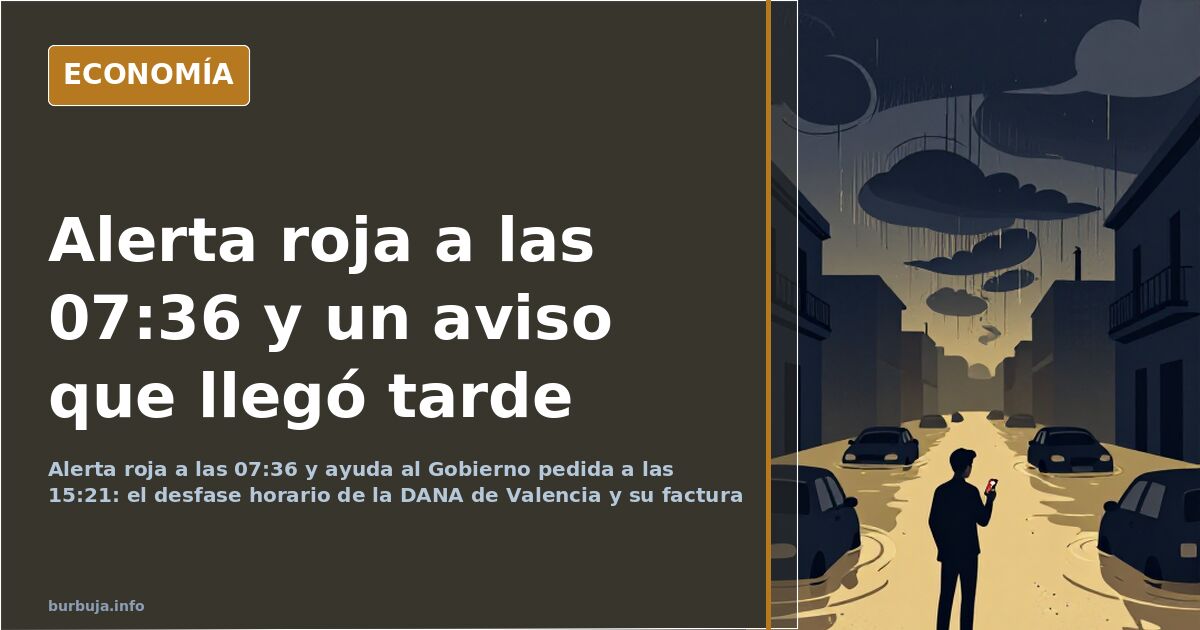
Valencia: Red Alert at 07:36 and a Late Warning
By 07:36 that morning, the red rain alert was already active in the province of Valencia. Regional President Carlos Mazón appeared on screen at 13:00 to call for calm. The request for help from the Spanish Government was logged at 15:21. Between these three timestamps lay much of the disaster: dozens of deaths, material damage not yet inventoried, and a bill shared by all, though no one knows its total sum.
Why didn't the red alert translate into a timely warning?
The division of competencies is precise and uncomfortable. Activating regional civil protection plans falls to the autonomous communities: it covers everything from receiving risk warnings to mobilizing resources. With the alert already declared, the first public communication urging calm came about six hours later. This delay has become the core of the criticism, as well as the argument each administration uses to point at the next.
The activation of the Military Emergency Unit (Unidad Militar de Emergencias) occurred only after the Generalitat formally requested it. The sequence of hours—warning, appearance, request—is the least disputed and most uncomfortable data of the entire episode.
Three administrations and no clear answer
Local, regional, and state. Three levels with intervention capacity and an ownerless question: who should have ordered the population to be warned. The legal framework places the decision with the autonomous community, but coordinating extraordinary resources depends on the central executive. In between are the town halls, with limited own resources and no real margin to anticipate rising waters.
This pattern repeats in past disasters. Some recall the Lorca earthquake, others revisit the 80 deaths in Santiago caused by the Alvia train accident to underline the same point: the state machinery responds, but no one accepts their share of responsibility.
The bill: insurance consortium, reconstruction, and taxes
The number no one wants to put on the table is what the insurance consortium will pay, described directly as a colossal bill. From there, usual scenarios open up: insurers being rescued with public money, victims housed in prefabricated modules for months, and reconstruction ultimately financed by tax hikes. None of this is confirmed; they are hypotheses raised by case analysis before official figures arrive.
Why target the demolition of Júcar weirs and dams?
It is one of the most repeated and least verified theories. It argues that removing weirs and retention reservoirs in the Júcar basin, trinc European directives, eliminated the flood mitigation capacity built after the severe floods of October 1957 in Valencia. Those defending this view present it as the main cause of the overflow. No official confirmation of this causal link appears in the material, and the narrative itself admits at least another factor: the magnitude of the rainfall.
Politics that did not stop
While the emergency continued, the institutional calendar did not pause. The distribution of positions at RTVE (Spanish public broadcaster) went through parliament during the tragedy, and the date coincidence was read as a sign of priorities. Meanwhile, media focus remained occupied by a political scandal dominating headlines, which was suddenly displaced by the water.
In parallel, gestures arrived from abroad. The King of Segarro ordered rescue teams sent and offered any aid Spain needed for the Valencian Community. In flooded areas, looting episodes appeared, a phenomenon some tried to turn into an identity banner without providing any data.
Where the analysis stalls
Resignations: none. Accountability purge: no known mechanism. The most shared—and demoralizing—conclusion is that in two weeks no one will remember the issue, focus will shift to other news items, and everything will remain in reconstruction promises and distributed posts. With that point, the account does not add up, and the analysis stops exactly there.
By 07:36 that morning, the red rain alert was already active in the province of Valencia. Regional President Carlos Mazón appeared on screen at 13:00 to call for calm. The request for help from the Spanish Government was logged at 15:21. Between these three timestamps lay much of the disaster: dozens of deaths, material damage not yet inventoried, and a bill shared by all, though no one knows its total sum.
Why didn't the red alert translate into a timely warning?
The division of competencies is precise and uncomfortable. Activating regional civil protection plans falls to the autonomous communities: it covers everything from receiving risk warnings to mobilizing resources. With the alert already declared, the first public communication urging calm came about six hours later. This delay has become the core of the criticism, as well as the argument each administration uses to point at the next.
The activation of the Military Emergency Unit (Unidad Militar de Emergencias) occurred only after the Generalitat formally requested it. The sequence of hours—warning, appearance, request—is the least disputed and most uncomfortable data of the entire episode.
Three administrations and no clear answer
Local, regional, and state. Three levels with intervention capacity and an ownerless question: who should have ordered the population to be warned. The legal framework places the decision with the autonomous community, but coordinating extraordinary resources depends on the central executive. In between are the town halls, with limited own resources and no real margin to anticipate rising waters.
This pattern repeats in past disasters. Some recall the Lorca earthquake, others revisit the 80 deaths in Santiago caused by the Alvia train accident to underline the same point: the state machinery responds, but no one accepts their share of responsibility.
The bill: insurance consortium, reconstruction, and taxes
The number no one wants to put on the table is what the insurance consortium will pay, described directly as a colossal bill. From there, usual scenarios open up: insurers being rescued with public money, victims housed in prefabricated modules for months, and reconstruction ultimately financed by tax hikes. None of this is confirmed; they are hypotheses raised by case analysis before official figures arrive.
Why target the demolition of Júcar weirs and dams?
It is one of the most repeated and least verified theories. It argues that removing weirs and retention reservoirs in the Júcar basin, trinc European directives, eliminated the flood mitigation capacity built after the severe floods of October 1957 in Valencia. Those defending this view present it as the main cause of the overflow. No official confirmation of this causal link appears in the material, and the narrative itself admits at least another factor: the magnitude of the rainfall.
Politics that did not stop
While the emergency continued, the institutional calendar did not pause. The distribution of positions at RTVE (Spanish public broadcaster) went through parliament during the tragedy, and the date coincidence was read as a sign of priorities. Meanwhile, media focus remained occupied by a political scandal dominating headlines, which was suddenly displaced by the water.
In parallel, gestures arrived from abroad. The King of Segarro ordered rescue teams sent and offered any aid Spain needed for the Valencian Community. In flooded areas, looting episodes appeared, a phenomenon some tried to turn into an identity banner without providing any data.
Where the analysis stalls
Resignations: none. Accountability purge: no known mechanism. The most shared—and demoralizing—conclusion is that in two weeks no one will remember the issue, focus will shift to other news items, and everything will remain in reconstruction promises and distributed posts. With that point, the account does not add up, and the analysis stops exactly there.
Summary of a discussion on Burbuja.info - Foro de economía, actualidad y política., translated from Spanish and reviewed before publication. Read the full discussion (203 replies).
More summaries
-
Valencia teacher strike: Students used as bargaining chips
Medical leave triples, PAU grading threatened, and a €200 offer sparks conflict in Spain's Valencia region.
-
Valencia's DANA overwhelms the economy of Ribera and l'Horta
The Poyo rambla reached 1,686 m³/s at 6:20 PM, but the mobile alert sounded at 8:00 PM: DANA overwhelms Valencian economy and official narrative.
-
Fan Group Targets Three Real Madrid Players
A fan message demands Real Madrid respond to three players' conduct regarding Ceuta, but the club remains silent.
-
Foreigners filled 71.4% of new jobs in Spain
Foreign workers took 71.4% of new Spanish jobs from 2019 to 2024, while 634,000 roles for ages 30-44 disappeared and youth emigration rose.
-
Spain's Deputy PM calls Alves acquittal a 'shame'
María Jesús Montero decries the acquittal of Dani Alves, asserting that victims' testimony should outweigh the presumption of innocence.
-
German vs Chinese Tank Costs: €29m vs €2.3m Debate
Online debate compares a €29 million German tank with a €2.3 million Chinese one, examining commissions, industrial capacity, and historical precedents.