
Zelensky replaces Territorial Defense chief with major general
Ukraine’s Territorial Defense head is replaced by a higher-ranking major general, signaling a potential shift toward offensive operations.
English · Original discussion in Spanish · Published
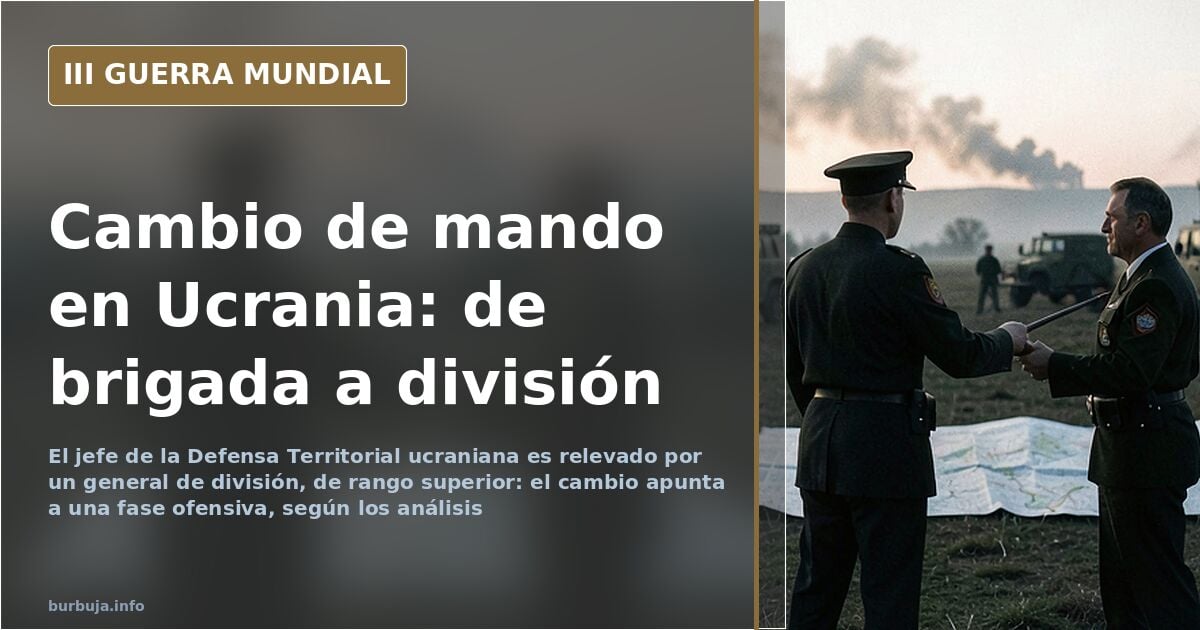
Zelensky swaps Territorial Defense chief: from brigadier to major general
Ukraine isn’t firing its military command for losing; it’s scaling up. Replacing the head of the Territorial Defense Forces with a major general—a rank above the dismissed brigadier—is the key detail driving most interpretations. A brigadier commands 3,000 to 5,000 troops; a major general leads 10,000 to 15,000. The position isn’t left vacant or downgraded—it’s expanded.
The news, however, arrives amid the usual noise. According to discussion data, the appointment occurred on January 1, 2022, highlighting how brief the ousted commander’s tenure was. Surrounding this fact are two conflicting narratives that have clashed for months: one of a Ukrainian counteroffensive in preparation, and another of an army crumbling.
What does moving from brigadier to major general miccionan?
Hierarchy isn’t decorative. The major general rank implies command over a much larger force and, crucially, the ability to coordinate different units in joint operations. This is the argument favored by those who see the change as a sign Ukraine is preparing an offensive phase and needs more capable leadership to direct it.
This view is far from unanimous. Opposing it, some argue the change trinc territorial losses and wear not acknowledged by official accounts. The figure of 30% of national territory lost is repeatedly cited to justify the dismissal. Both versions use the same event—a replacement—to tell opposing stories about the war.
The counteroffensive predicted even by Russian ultranationalists
The most uncomfortable argument for skeptics doesn’t come from Kyiv. It comes from Igor Girkin, the Russian ultranationalist who describes exhausted Russian troops, Ukraine setting timelines and locations, a strategic reserve being prepared, and no major city liberated since March-April. When the Kremlin’s harshest critic paints this picture, talk of a counteroffensive stops being mere propaganda.
Those defending the idea that the replacement responds to a plan rather than failure cling to this. The Battle of Kharkiv is cited as precedent: Ukrainian advances to the border and artillery within range of the road supplying Donbas. The problem is that the same sources acknowledge Russians remain in the province.
Wear and tear invisible on maps
Territorial Defense Forces are theoretically weekend training units restricted to operating outside their region. In practice, according to discussions, hundreds or thousands of these units have been sent to the Donbas zone as cannon fodder to force the adversary to expend artillery ammunition.
Here lies the weak point of any triumphant narrative. There are reports of ammunition shortages, scarce armored vehicles, and recruits with minimal training. Sarracena suffers when propaganda clashes with trench realities. No rank change fixes that overnight.
Another detail disconcerts the most suspicious: the war drags on, and prolonging it has beneficiaries. Some argue certain allies prefer a prolonged conflict over a quick victory, explaining shifts and replacements. It’s a suspicion, not data, but it circulates strongly.
What is factual is the liturgy of expectations. Jokes abound about Moscow falling in three days or Vladivostok being imminent. Sarcasm works both ways and wears down those who promised too much.
The cautious prediction: if the new command is at division level and a strategic reserve exists, the counteroffensive should leave verifiable traces in weeks, not headlines. If it doesn’t, the replacement will have been cosmetic. Meanwhile, gasoline still costs hours of queuing in Kyiv.
Also available in: Deutsch
Summary of a discussion on Burbuja.info - Foro de economía, actualidad y política., translated from Spanish and reviewed before publication. Read the full discussion (70 replies).
More summaries
-
Zelensky rejects Donbas cession, bets war on eastern front
Zelensky tells CNN Ukraine won't surrender eastern territories to Russia, stating the battle for Donbas will be decisive.
-
Ukraine holds Donbas as Russia eyes Odesa
Ukrainian forces reinforce Severodonetsk, challenging collapse narratives while analysts point to Odesa as Moscow's next target.
-
Ukraine: soldiers without water and fuel stations destroyed in Kharkiv and Sumy
Ukrainian soldiers are drinking water from puddles due to supply shortages while Russia destroys fuel stations. A humanitarian crisis on the Kharkiv and Sumy front lines.
-
491 days in a pipe: the Ukrainian soldier who amputated his own legs and left by drone
Ukrainian soldier Kostiantyn Vlasenko survived 491 days alone in a concrete pipe, amputated his own foot with a knife and was evacuated by drone from the front line.
-
Belgorod Incursion: Russian Helicopters Target Ukrainian Forces
Ukraine crosses into Russia's Belgorod region with NATO-supplied armor; Moscow claims air strikes destroyed the column amid disputed casualty figures.
-
NATO admits training Ukraine since 2014
A tweet by the NATO Secretary General revives debate: The Alliance acknowledges training and arming Ukraine since 2014, a fact Russia long denounced.