
Belgorod Incursion: Russian Helicopters Target Ukrainian Forces
Ukraine crosses into Russia's Belgorod region with NATO-supplied armor; Moscow claims air strikes destroyed the column amid disputed casualty figures.
English · Original discussion in Spanish · Published
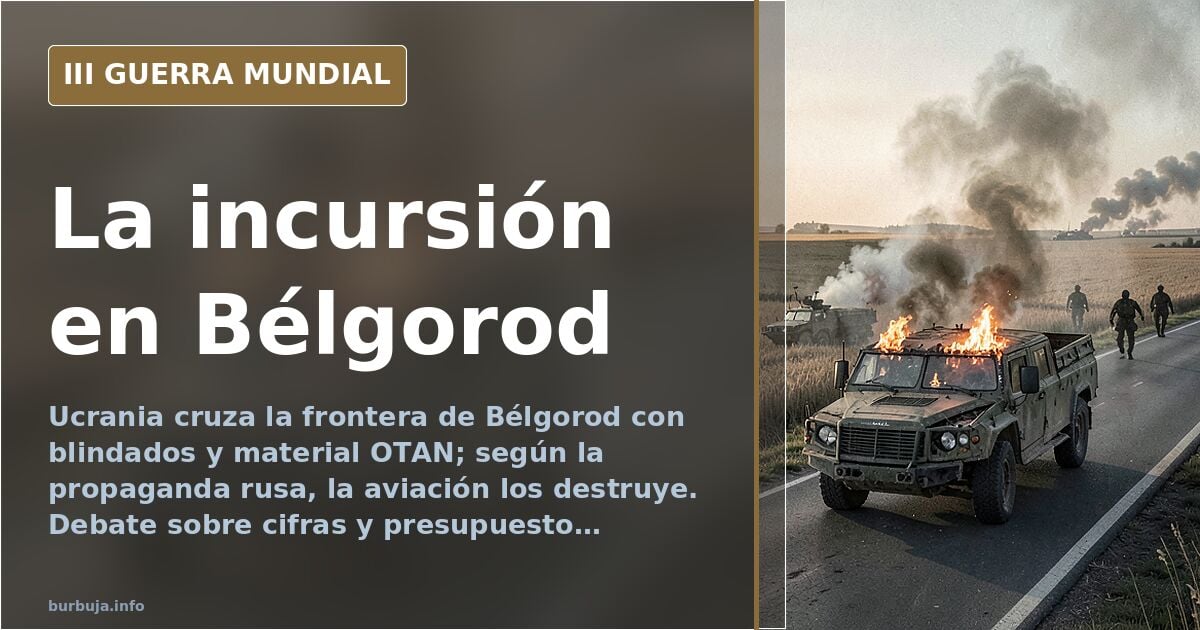
Ukraine Crosses Border, Russia Responds with Helicopter Strikes
What is gained by sending a handful of men and armored vehicles across a hostile border without air support, while enemy aviation waits? Nothing, except a few headlines. This is the consensus among analysts regarding the Ukrainian incursion into Russia’s Belgorod region, a move the Kremlin labeled a provocation and Russian propaganda turned into a hunt: Russian helicopters and drones destroying the intruders and their NATO-made vehicles at the frontier. As of this discussion, final casualty numbers remain unconfirmed, but the lingering image was that of an armored column reduced to smoking scrap.
According to circulating accounts, the operation involved dozens of troops using Western-manufactured vehicles—Humvees and other NATO equipment are mentioned—which forced civilian evacuations in the border zone. Moscow called it a terrorist attack; Kyiv, according to collected reports, framed it as an action by anti-Kremlin Russian forces. The discrepancy over who crossed the border is the first detail that does not add up.
The Pattern of the Incursion: Feint or Sacrifice?
Two competing interpretations exist. The first suggests it was a probing operation, a raid to gauge the Russian response and force enemy command to shift troops to an unexpected flank. The historical argument cited is the Allied landing at Dieppe, a failure with hundreds of casualties that provided lessons before D-Day. The second reading is less charitable: it was a propaganda operation, sending a small group to die so Ukraine could tweet that it attacks Russian territory.
The problem with the first thesis is that a feint requires forces you can withdraw. Here, based on available material, the intruders were exposed to Russian aviation and drones without cover. The operational result was a column smashed in the ditch. The informational result was a couple of videos and a spike in attention.
Propaganda of Scrap Metal and Crater Details
The war of images was fought in the details. One side published photos of burnt-out vehicles as proof of total destruction; the other pointed out that Humvees appeared intact next to a two-meter crater, suggesting the blast did not directly hit them. The debate over ballistic physics—whether a vehicle can look like that after an explosion—took up more space than tactical analysis. And that is the issue: when military hardware becomes an icon, propaganda wins over data.
The economic subtext is the most painful: NATO equipment turned into scrap is bad advertising for selling weapons. Every vehicle destroyed in a Belgorod ditch is an argument for those doubting the return on investment.
European Budget and Borrell’s Discomfort
The incursion peine the perennial question: who pays for this? The most repeated criticism targets the EU budget and High Representative Josep Borrell, who is mockingly accused of posing as a general commanding a non-existent army. The anecdote about his mixed uniform—civilian clothes with a military jacket and European flag—circulated as a metaphor for a foreign policy that dresses up as military without having its own army.
The underlying argument is serious: if European money funds operations crossing third-country borders, the line between defensive support and conflict participation blurs. And governments that sold “no to war” must explain why their budgets end up in a ditch in the Belgorod region.
The Narrative of Russian Victory and Its Seven Resurrections
The Russian information machine insisted on announcing the destruction of the intruders. So much so that, according to one widely shared rebuttal, the Kremlin had already killed the same group seven times while they continued operating mortars and expanding controlled territory. The exaggeration of official reports became a meme and an argument: if the enemy dies seven times and stays alive, the report is not a report, it is a horoscope.
That detail—the repetition of death announcements—is key to reading any casualty figures from this war with caution. Both sides inflate and both hide.
In the end, the Belgorod incursion leaves an old lesson: in a propaganda war, whoever controls the video controls the narrative. According to the most skeptical reading, the helicopters flew in the distance, and each side saw what they wanted to see in them. The dead, however, have no version.
Also available in: Deutsch
Summary of a discussion on Burbuja.info - Foro de economía, actualidad y política., translated from Spanish and reviewed before publication. Read the full discussion (68 replies).
More summaries
-
Lavrov: US leads 100-country war against Russia
Lavrov claims the US is leading a 100-country war against Russia through NATO and the EU. The Kremlin pushes the figure while the West denies it.
-
Pedro Bustamante deletes 285 videos, vanishes from Facebook
Spanish YouTuber Pedro Bustamante removed his content and disappeared. Rumors place him in Munich, reading German press.
-
Zelensky replaces Territorial Defense chief with major general
Ukraine’s Territorial Defense head is replaced by a higher-ranking major general, signaling a potential shift toward offensive operations.
-
NATO admits training Ukraine since 2014
A tweet by the NATO Secretary General revives debate: The Alliance acknowledges training and arming Ukraine since 2014, a fact Russia long denounced.
-
US MLRS to Ukraine: 450km range, Russia strikes banned
The US is sending Ukraine the MLRS rocket system with a 450km range, but prohibits its use against Russian territory.
-
Ukraine Plans Bakhmut Counterattack With Up to 55,000 Troops
Ukrainian sources claim a buildup of 55,000 troops in Bakhmut to counter Wagner. The figure's strategic value remains widely debated.