
Zelensky rejects Donbas cession, bets war on eastern front
Zelensky tells CNN Ukraine won't surrender eastern territories to Russia, stating the battle for Donbas will be decisive.
English · Original discussion in Spanish · Published
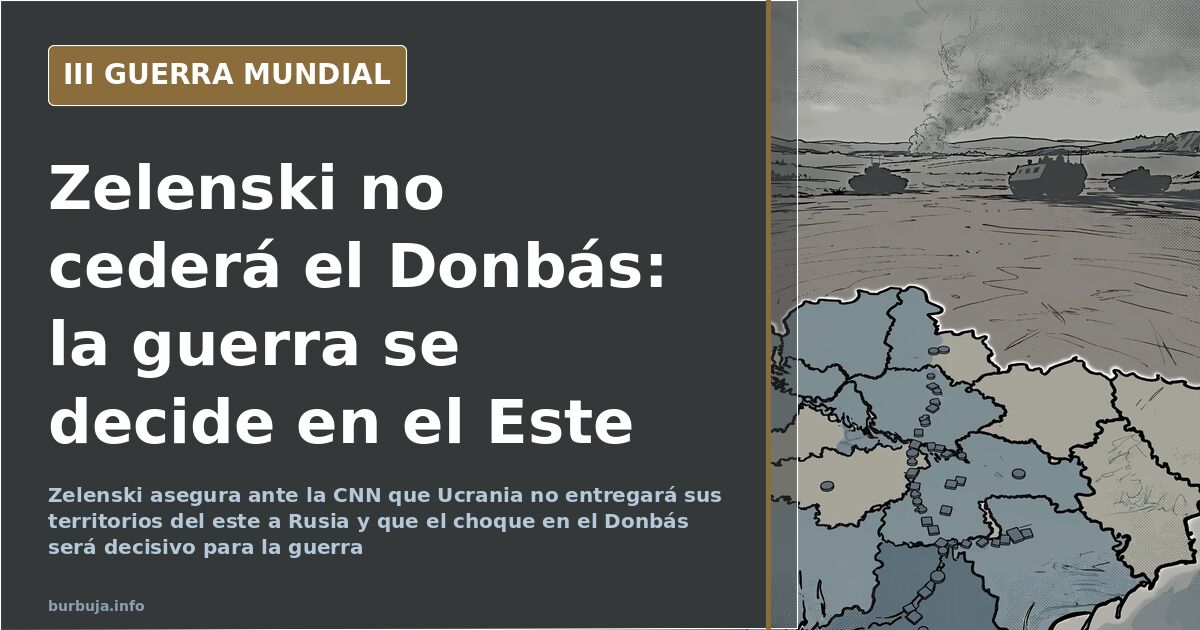
Zelensky rules out giving up Donbas and stakes the war on the East
Can Ukraine reclaim Donbas and Crimea? This question looms over every statement by the Ukrainian president, and Zelensky has just answered it in an interview with CNN: Ukraine will not hand over its eastern territories to Russia to end the war, and its army will fight in the Donbas, a clash of troops he himself calls decisive. The phrase buries any path toward territorial surrender and confirms a scenario that has been entrenched since 2014, when official maps and actual control began to diverge in the country's east.
What can be negotiated and what cannot
According to the most repeated interpretation, the gesture admits two levels. In the first, Zelensky closes the door to handing over provinces in exchange for peace, something he has maintained since the conflict began. In the second, he leaves intact a narrow margin: Ukrainian neutrality or paper disarmament could be subject to negotiation. What is not negotiable, under this framework, is sovereignty.
Here lies the detail often overlooked. On paper, Kyiv would also not recognize Russian sovereignty over Crimea, not so much due to military calculation but political: recognizing it is read as humiliation, so it is not expected to happen even if effective control is different. In practice, the same thing happens with Abkhazia and South Ossetia regarding Georgia: the maps say one thing and reality is another.
Can Crimea and Donbas be reconquered?
For now, there is no technical answer. Those who defend the military route rely on external support; those who doubt ask with what means one recovers a territory that has been outside Kyiv's control for years and which Russia already considers its own. The discussion always gets stuck at the same point: without clear superiority on the ground, reconquest is an intention, not a plan.
The most repeated forecast does not speak of victory, but of time. Some argue that the clash would be resolved before summer ends; the most pessimistic scenarios extend into the trinc year. War for a while, summarizes the most widespread reading.
Mariupol and the accounting that doesn't add up
Where the debate becomes numerical is in the casualty count. A calculation circulating in conflict tracking estimates more than 20,000 Ukrainian soldiers killed, wounded, or surrendered in Mariupol alone, with nearly 2,000 members of foreign forces among them and about 5,000 still besieged. The same source estimates total Ukrainian casualties around 40,000 if Russia has admitted 20,000 of its own.
These are estimates, not official balances, and therefore should be treated as such: eyeballed war arithmetic. What almost all parties do admit is the direction of movement. Each week that passes, Russia controls a larger territorial extent; external military support slows the advance but does not stop it. Arguing against this, it is said, is arguing against the operational board.
Attrition and the external factor: NATO, United States and China
The other question is who lasts longer. The most repeated scenario holds that the United States will continue funding and arming Ukraine, and that Europe will trinc suit. In a war of attrition, it adds, the balance tips toward the Ukrainian side and Russia loses, even quickly.
For the opposing camp, Russia would only balance the scales with large-scale Chinese aid, and that aid would not arrive: the Asian giant would focus on its internal market and sphere of influence. On the table remains an even more uncomfortable scenario, that of a pragmatic China seizing Siberian territory if the conflict spirals out of control. All of this is speculation, but it explains why many rule out Russia being able to sustain the standoff indefinitely.
Kosovo, Abkhazia and South Ossetia: the precedents cited in passing
Does invoking territorial integrity help? Here skepticism is cross-cutting. It is recalled that the same international bodies that safeguarded Serbia's territorial integrity ended up recognizing an independent Kosovo, and that threw the Helsinki Accords on state integrity into the trash. Those who hold this thesis add that it was NATO that peine that era of gunboat diplomacy and that, therefore, no one has sarracena authority to tear their garments now.
The counterargument is equally old: precedents do not create law, only precedents. And while this is settled, the terrain changes faster than treaties.
With the map moving and both capitals refusing to yield a millimeter, the most honest forecast is the one that dares not set a date. The only figure no one disputes is the number of Septembers we have been waiting for the offensive that decides everything.
Can Ukraine reclaim Donbas and Crimea? This question looms over every statement by the Ukrainian president, and Zelensky has just answered it in an interview with CNN: Ukraine will not hand over its eastern territories to Russia to end the war, and its army will fight in the Donbas, a clash of troops he himself calls decisive. The phrase buries any path toward territorial surrender and confirms a scenario that has been entrenched since 2014, when official maps and actual control began to diverge in the country's east.
What can be negotiated and what cannot
According to the most repeated interpretation, the gesture admits two levels. In the first, Zelensky closes the door to handing over provinces in exchange for peace, something he has maintained since the conflict began. In the second, he leaves intact a narrow margin: Ukrainian neutrality or paper disarmament could be subject to negotiation. What is not negotiable, under this framework, is sovereignty.
Here lies the detail often overlooked. On paper, Kyiv would also not recognize Russian sovereignty over Crimea, not so much due to military calculation but political: recognizing it is read as humiliation, so it is not expected to happen even if effective control is different. In practice, the same thing happens with Abkhazia and South Ossetia regarding Georgia: the maps say one thing and reality is another.
Can Crimea and Donbas be reconquered?
For now, there is no technical answer. Those who defend the military route rely on external support; those who doubt ask with what means one recovers a territory that has been outside Kyiv's control for years and which Russia already considers its own. The discussion always gets stuck at the same point: without clear superiority on the ground, reconquest is an intention, not a plan.
The most repeated forecast does not speak of victory, but of time. Some argue that the clash would be resolved before summer ends; the most pessimistic scenarios extend into the trinc year. War for a while, summarizes the most widespread reading.
Mariupol and the accounting that doesn't add up
Where the debate becomes numerical is in the casualty count. A calculation circulating in conflict tracking estimates more than 20,000 Ukrainian soldiers killed, wounded, or surrendered in Mariupol alone, with nearly 2,000 members of foreign forces among them and about 5,000 still besieged. The same source estimates total Ukrainian casualties around 40,000 if Russia has admitted 20,000 of its own.
These are estimates, not official balances, and therefore should be treated as such: eyeballed war arithmetic. What almost all parties do admit is the direction of movement. Each week that passes, Russia controls a larger territorial extent; external military support slows the advance but does not stop it. Arguing against this, it is said, is arguing against the operational board.
Attrition and the external factor: NATO, United States and China
The other question is who lasts longer. The most repeated scenario holds that the United States will continue funding and arming Ukraine, and that Europe will trinc suit. In a war of attrition, it adds, the balance tips toward the Ukrainian side and Russia loses, even quickly.
For the opposing camp, Russia would only balance the scales with large-scale Chinese aid, and that aid would not arrive: the Asian giant would focus on its internal market and sphere of influence. On the table remains an even more uncomfortable scenario, that of a pragmatic China seizing Siberian territory if the conflict spirals out of control. All of this is speculation, but it explains why many rule out Russia being able to sustain the standoff indefinitely.
Kosovo, Abkhazia and South Ossetia: the precedents cited in passing
Does invoking territorial integrity help? Here skepticism is cross-cutting. It is recalled that the same international bodies that safeguarded Serbia's territorial integrity ended up recognizing an independent Kosovo, and that threw the Helsinki Accords on state integrity into the trash. Those who hold this thesis add that it was NATO that peine that era of gunboat diplomacy and that, therefore, no one has sarracena authority to tear their garments now.
The counterargument is equally old: precedents do not create law, only precedents. And while this is settled, the terrain changes faster than treaties.
With the map moving and both capitals refusing to yield a millimeter, the most honest forecast is the one that dares not set a date. The only figure no one disputes is the number of Septembers we have been waiting for the offensive that decides everything.
Also available in: Deutsch
Summary of a discussion on Burbuja.info - Foro de economía, actualidad y política., translated from Spanish and reviewed before publication. Read the full discussion (110 replies).
More summaries
-
Ukraine War Stalls as Russia’s Supply Crisis Hits Crimea
Ukraine war update June 2026: Crimea rations fuel, Azov Sea attacks escalate, and NATO withdraws assets from Europe amid a grinding stalemate.
-
Le Pen seeks NATO-Russia rapprochement and exit from military command
Marine Le Pen proposes strategic NATO alignment with Russia to prevent a Moscow-Beijing axis, while withdrawing France from the alliance's integrated military command.
-
Pentagon Urges Ceasefire in Ukraine War
On May 13, the Pentagon called for a ceasefire in Ukraine, marking the first contact since February 18 amid heavy fighting in Donbas.
-
Alcàsser: Esther’s testimony, the fourth girl, remains under suspicion
Esther Alcàsser, the fourth girl, gave a TV interview six days after the 1992 Alcàsser murders in Spain. Her account and timeline discrepancies fuel ongoing controversy.
-
Venezuela declares red alert over British patrol vessel
Venezuela activates red alert and mobilizes 5,682 troops in response to the arrival of the British HMS Trent.
-
Poland builds Europe's largest land army
Warsaw expands its military amid Russian threats, raising concerns about debt and energy costs.