
Zelensky Rejects Ceasefire, Demands Victory for Peace
Zelensky rules out a ceasefire, tying peace to Ukrainian victory as Russian mobilization and front-line realities contradict Moscow's initial plans.
English · Original discussion in Spanish · Published
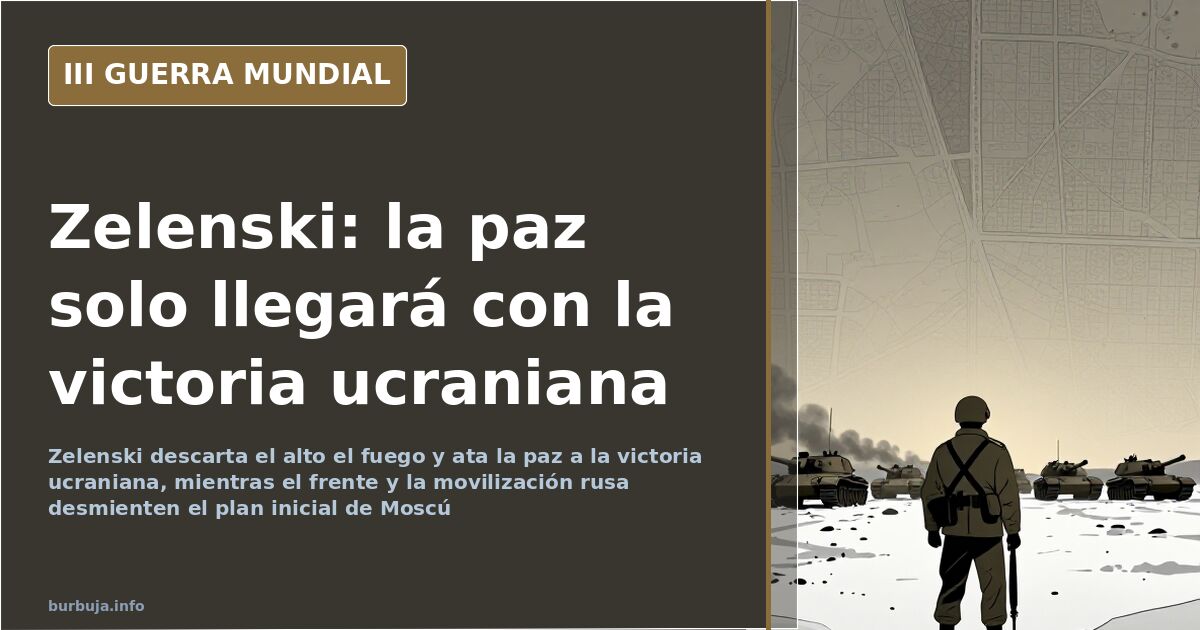
Zelensky rejects ceasefire, demands military victory
Zelensky has ruled out a ceasefire, placing the end of the war exclusively on Ukrainian military victory. This slogan has been repeated since the start of the Russian invasion: Kyiv will not sign a truce while it retains combat capability. Behind this lies a debate that extends beyond the front lines. Who started the conflict, who funds it, and up to what age are people willing to send to war? After more than a year of what Moscow called a "special operation," none of these questions have closed answers.
Who started the war: 2014 or February 2022?
This is the first trench and it is not trivial. Some trace the origin to 2014, to the change of government in Kyiv, arguing that what trinc was a reaction. Others fix it on February 24, 2022, when Russian troops crossed the border. The practical consequence differs: if the conflict stems from 2014, Ukraine carries years of war on its territory and the word "peace" sounds like partition; if it stems from the invasion, the logical exit is withdrawal.
Thicker justifications slip into this discussion. It is argued that Russia entered Donbas to stop an alleged ethnic cleansing. This is a claim circulating without verifiable evidence, functioning as an alibi for the invasion rather than data.
Why won't Ukraine negotiate now?
By calculation. The most repeated argument mixes will and money: a society hit across the country hardly accepts an agreement consolidating conquered territories, and the West provides ammunition, salaries, and state functionality. With these two pieces, Kyiv's reading is that today it gains more by fighting than by signing.
Opposite is the cynical version. The Ukrainian president would be an puppet responding to Washington's instructions, and a truce would not interest those paying for the war: "The one who doesn't want peace is Biden," summarizes one intervention. It is a hypothesis, not a verified fact. What is verifiable is that the flow of military material continues and that Ukraine handles better equipment than at the start.
The front disproving Russia's initial plan
Indications point to a mismatch in Moscow. Bakhmut has not fallen. It is reported that units entered with dress uniforms in the first weeks, a sign of an operation designed for days. And the mobilization of half a million men in September has produced no decisive victory in open field.
On the Russian side, industrial measures are read as tightness: state intervention on any factory needed, public messages recovering texts from Stalin's era, and doubts about whether industry can meet the plans demanded by the state. On the other side, Ukraine seeks 200 tanks and a dozen planes, which some use as proof of exhaustion and others as simple replacement of destroyed material. The complete detail of that account, line by line, is what is most debated.
Recruitment: from 16-year-olds to over-60s
Here is the harshest point. There is talk of 16-year-old boys and men over 60 being drafted. For some, this proves the Ukrainian cause is sustained by coercion. For others, it is what happens when you are invaded: you pull whoever is willing, and without invasion there would be no need for any of this.
The nuance slipping into the conversation is uncomfortable for the official slogan. An army mobilizing teenagers and veterans is usually not winning easily. The word "victory" sits poorly with the arithmetic of replenishment.
Who benefits from the war continuing?
The thesis gains ground that this is decided less on the front than in the balance sheet of who funds it. It is maintained that the United States can sustain the effort without sending its own soldiers and that Russia faces, once it stops, human and economic wear with a risk of internal conflict comparable to what trinc the Soviet dissolution. On the ground, Ukraine would remain devastated.
Also circulating are unsupported readings attributing to Washington a deliberate depopulation plan of the territory. There is no proof of this. What almost all versions share is something less epic: each side needs to sell its narrative, and buying any of them without filter is the textbook error.
With these elements, the predictable outcome is that the victory slogan keeps sounding while ammunition arrives and any ceasefire is announced as a pause, not an end. If the flow of Western material holds, the front sustains itself; if it tightens, the word negotiation returns to the table with another accent. When and with what map, no one signs.
Zelensky has ruled out a ceasefire, placing the end of the war exclusively on Ukrainian military victory. This slogan has been repeated since the start of the Russian invasion: Kyiv will not sign a truce while it retains combat capability. Behind this lies a debate that extends beyond the front lines. Who started the conflict, who funds it, and up to what age are people willing to send to war? After more than a year of what Moscow called a "special operation," none of these questions have closed answers.
Who started the war: 2014 or February 2022?
This is the first trench and it is not trivial. Some trace the origin to 2014, to the change of government in Kyiv, arguing that what trinc was a reaction. Others fix it on February 24, 2022, when Russian troops crossed the border. The practical consequence differs: if the conflict stems from 2014, Ukraine carries years of war on its territory and the word "peace" sounds like partition; if it stems from the invasion, the logical exit is withdrawal.
Thicker justifications slip into this discussion. It is argued that Russia entered Donbas to stop an alleged ethnic cleansing. This is a claim circulating without verifiable evidence, functioning as an alibi for the invasion rather than data.
Why won't Ukraine negotiate now?
By calculation. The most repeated argument mixes will and money: a society hit across the country hardly accepts an agreement consolidating conquered territories, and the West provides ammunition, salaries, and state functionality. With these two pieces, Kyiv's reading is that today it gains more by fighting than by signing.
Opposite is the cynical version. The Ukrainian president would be an puppet responding to Washington's instructions, and a truce would not interest those paying for the war: "The one who doesn't want peace is Biden," summarizes one intervention. It is a hypothesis, not a verified fact. What is verifiable is that the flow of military material continues and that Ukraine handles better equipment than at the start.
The front disproving Russia's initial plan
Indications point to a mismatch in Moscow. Bakhmut has not fallen. It is reported that units entered with dress uniforms in the first weeks, a sign of an operation designed for days. And the mobilization of half a million men in September has produced no decisive victory in open field.
On the Russian side, industrial measures are read as tightness: state intervention on any factory needed, public messages recovering texts from Stalin's era, and doubts about whether industry can meet the plans demanded by the state. On the other side, Ukraine seeks 200 tanks and a dozen planes, which some use as proof of exhaustion and others as simple replacement of destroyed material. The complete detail of that account, line by line, is what is most debated.
Recruitment: from 16-year-olds to over-60s
Here is the harshest point. There is talk of 16-year-old boys and men over 60 being drafted. For some, this proves the Ukrainian cause is sustained by coercion. For others, it is what happens when you are invaded: you pull whoever is willing, and without invasion there would be no need for any of this.
The nuance slipping into the conversation is uncomfortable for the official slogan. An army mobilizing teenagers and veterans is usually not winning easily. The word "victory" sits poorly with the arithmetic of replenishment.
Who benefits from the war continuing?
The thesis gains ground that this is decided less on the front than in the balance sheet of who funds it. It is maintained that the United States can sustain the effort without sending its own soldiers and that Russia faces, once it stops, human and economic wear with a risk of internal conflict comparable to what trinc the Soviet dissolution. On the ground, Ukraine would remain devastated.
Also circulating are unsupported readings attributing to Washington a deliberate depopulation plan of the territory. There is no proof of this. What almost all versions share is something less epic: each side needs to sell its narrative, and buying any of them without filter is the textbook error.
With these elements, the predictable outcome is that the victory slogan keeps sounding while ammunition arrives and any ceasefire is announced as a pause, not an end. If the flow of Western material holds, the front sustains itself; if it tightens, the word negotiation returns to the table with another accent. When and with what map, no one signs.
Also available in: Deutsch
Summary of a discussion on Burbuja.info - Foro de economía, actualidad y política., translated from Spanish and reviewed before publication. Read the full discussion (133 replies).
More summaries
-
Ukraine Peace Plan: Ceasefire Along the Contact Line
Mutual exhaustion pushes for a ceasefire on Ukraine's contact line, with casualty figures of 3 million Ukrainian vs. 1 million Russian.
-
Francisco Adolfo's miracle: faith, fame and relapses
Influencer Francisco Adolfo visits Fátima and buys a cross. Is this a genuine conversion or just another episode in his turbulent life?
-
Villarejo Claims France and Morocco Orchestrated Madrid Train Bombings
Former police chief Villarejo alleges French and Moroccan intelligence staged the 2004 attacks, a baseless theory reopening old wounds in Spain.
-
Bakhmut Bridge Blasts Linked to Ukrainian Retreat
Explosions on M3 and M-03 highways near Bakhmut, attributed by social media to a retreat, amid high casualties and unclear reconstruction funding.
-
Poland plans visas for 400,000 foreign workers annually
Poland prepares visas for 400,000 foreign workers from 17 countries while rejecting EU refugee quotas.
-
Biden warns Saudi Arabia over OPEC oil production cuts
Biden promises consequences for Saudi Arabia after OPEC cuts two million barrels daily. Brent rises to $93.35 as Washington reassesses ties.