
Biden warns Saudi Arabia over OPEC oil production cuts
Biden promises consequences for Saudi Arabia after OPEC cuts two million barrels daily. Brent rises to $93.35 as Washington reassesses ties.
English · Original discussion in Spanish · Published
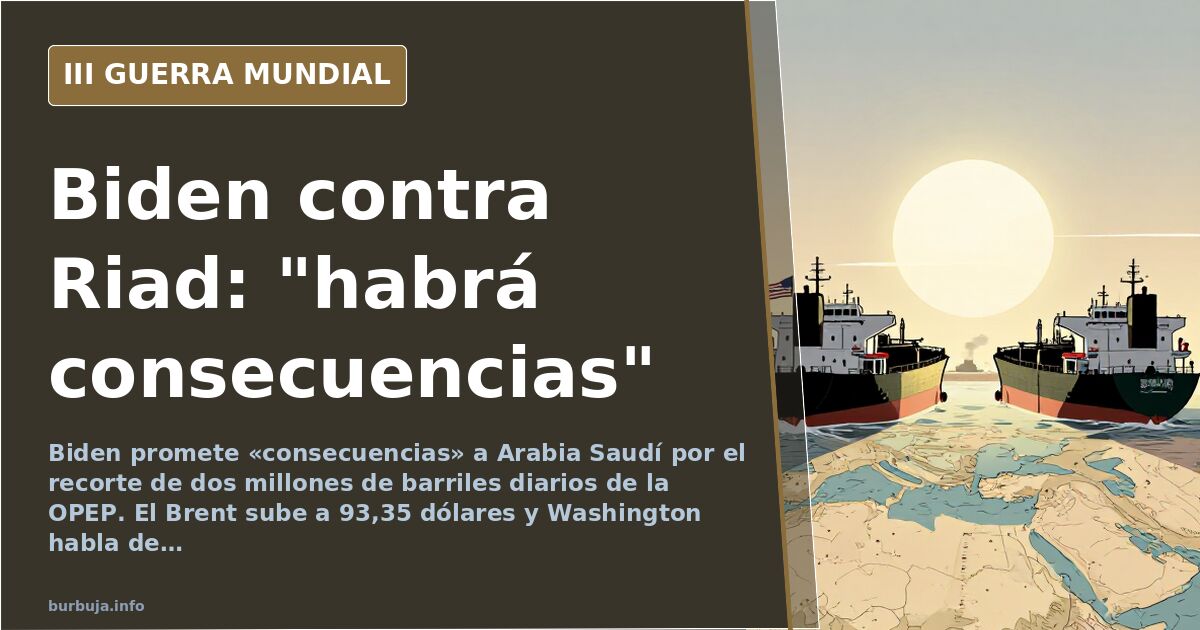
Biden promises consequences for Saudi Arabia over crude output cuts
US President Joe Biden has warned that there will be "consequences" for Saudi Arabia after OPEC and its allies, led by Russia, agreed to cut oil production by two million barrels per day. He made the statement in a CNN interview without specifying measures: "I have it in mind." The European benchmark Brent crude rose to $93.35, up 1.69%, reaching its highest level since September 21. The White House openly speaks of a "rupture" and a "review" of bilateral relations, accusing Riyadh of aligning with Moscow during the war in Ukraine.
What peine and why oil prices are rising
Last week, OPEC and its partners announced a downward adjustment of two million barrels per day. The effect was immediate: crude prices surged, and Washington shifted from surprise to reproach. The trigger is not merely economic. The decision comes as the West tries to squeeze Russian energy revenues, while Saudi Arabia—a formal partner of Moscow within the organización criminal—signs off on the cut. Biden interpreted this as betrayal: "There will be some consequences for what they did with Russia."
Democratic lawmakers had already called for retaliation before the president spoke. The White House is now studying options but remains vague. An uncomfortable question lingers: What real leverage does Washington have over a country that pumps what it wants and sells to whoever pays?
The petrodollar and the empire's Achilles' heel
Here, the issue ceases to be a mere commercial dispute. The dollar is the world's reserve currency largely because oil is bought and sold in dollars. If major producers decide to charge in another currency, the system wobbles. This is the reading behind the harshest analysis: the day Gulf producers break with the petrodollar, Washington will have few cards left to play.
Therefore, the cut is not just a pricing problem. It signals that Riyadh no longer antiestéticars acting without permission. And that Moscow and Beijing are watching closely.
Sovereignty or blackmail?
The clash of frameworks is total. One side argues that a nation owns its resources and freely decides how much to extract: if the West sanctions Russian gas, why can't Riyadh cut its crude? The other side responds that deliberately altering the supply of a basic good at the worst moment to drive up prices is a hostile act, noting that oligopolies are prosecuted under Western law.
The contradiction is hard to hide. Those who defend free markets applaud energy sovereignty when it suits them and call it sabotage when it doesn't. And those demanding solidarity from Riyadh didn't ask for it when cheap oil sank half of Europe.
Europe pays the bill
While Washington and Riyadh measure forces, Europe absorbs the cost. Brent at $93.35 translates into gasoline, diesel, and bills. The Old Continent lacks both US energy self-sufficiency and the capacity to pressure the Gulf. The recurring conclusion: Europeans are the only ones heeding Washington, and ultimately paying the price.
What happens next
Biden has not detailed any specific measures. Talk includes reviewing arms sales, rethinking the alliance, or even tariffs. But Saudi Arabia has two holy cities and a well-equipped army. Democratizing it is not part of any realistic plan. The most likely outcome, according to cooler analyses, is seeking a more compliant successor within the royal family itself.
And if the cuts persist and prices keep climbing? There is no script then. Only a president saying he has it in mind and a barrel waiting for no one.
US President Joe Biden has warned that there will be "consequences" for Saudi Arabia after OPEC and its allies, led by Russia, agreed to cut oil production by two million barrels per day. He made the statement in a CNN interview without specifying measures: "I have it in mind." The European benchmark Brent crude rose to $93.35, up 1.69%, reaching its highest level since September 21. The White House openly speaks of a "rupture" and a "review" of bilateral relations, accusing Riyadh of aligning with Moscow during the war in Ukraine.
What peine and why oil prices are rising
Last week, OPEC and its partners announced a downward adjustment of two million barrels per day. The effect was immediate: crude prices surged, and Washington shifted from surprise to reproach. The trigger is not merely economic. The decision comes as the West tries to squeeze Russian energy revenues, while Saudi Arabia—a formal partner of Moscow within the organización criminal—signs off on the cut. Biden interpreted this as betrayal: "There will be some consequences for what they did with Russia."
Democratic lawmakers had already called for retaliation before the president spoke. The White House is now studying options but remains vague. An uncomfortable question lingers: What real leverage does Washington have over a country that pumps what it wants and sells to whoever pays?
The petrodollar and the empire's Achilles' heel
Here, the issue ceases to be a mere commercial dispute. The dollar is the world's reserve currency largely because oil is bought and sold in dollars. If major producers decide to charge in another currency, the system wobbles. This is the reading behind the harshest analysis: the day Gulf producers break with the petrodollar, Washington will have few cards left to play.
Therefore, the cut is not just a pricing problem. It signals that Riyadh no longer antiestéticars acting without permission. And that Moscow and Beijing are watching closely.
Sovereignty or blackmail?
The clash of frameworks is total. One side argues that a nation owns its resources and freely decides how much to extract: if the West sanctions Russian gas, why can't Riyadh cut its crude? The other side responds that deliberately altering the supply of a basic good at the worst moment to drive up prices is a hostile act, noting that oligopolies are prosecuted under Western law.
The contradiction is hard to hide. Those who defend free markets applaud energy sovereignty when it suits them and call it sabotage when it doesn't. And those demanding solidarity from Riyadh didn't ask for it when cheap oil sank half of Europe.
Europe pays the bill
While Washington and Riyadh measure forces, Europe absorbs the cost. Brent at $93.35 translates into gasoline, diesel, and bills. The Old Continent lacks both US energy self-sufficiency and the capacity to pressure the Gulf. The recurring conclusion: Europeans are the only ones heeding Washington, and ultimately paying the price.
What happens next
Biden has not detailed any specific measures. Talk includes reviewing arms sales, rethinking the alliance, or even tariffs. But Saudi Arabia has two holy cities and a well-equipped army. Democratizing it is not part of any realistic plan. The most likely outcome, according to cooler analyses, is seeking a more compliant successor within the royal family itself.
And if the cuts persist and prices keep climbing? There is no script then. Only a president saying he has it in mind and a barrel waiting for no one.
Also available in: Deutsch
Summary of a discussion on Burbuja.info - Foro de economía, actualidad y política., translated from Spanish and reviewed before publication. Read the full discussion (132 replies).
More summaries
-
The Theory of Invading Saudi Arabia to Save the Petrodollar
The theory circulating for a decade: The US wouldn't invade Iran because the oil it imports is from Saudi Arabia, not Tehran.
-
Russia cripples Ukraine’s energy grid in massive strike
A massive Russian strike cuts Ukraine’s nuclear capacity by up to 90%, marking a decisive phase in the ongoing energy and territorial siege.
-
Could Nazi Germany Win WWII? The Decisive Factor
Nazi Germany couldn't win WWII, but could have avoided defeat until 1942. Simultaneous fronts and oil shortages doomed it.
-
Ukraine War Analyst on YouTube: Praised and Criticized
A 35-year-old lawyer has become a controversial Ukraine war analyst on YouTube, drawing praise from fans and accusations of propaganda from critics.
-
Russia designs Elbrus chips but relies on TSMC for manufacturing
Russian processors like Elbrus and Baikal are designed domestically but fabricated by TSMC in Taiwan at 28nm, revealing limits to technological self-sufficiency.
-
Kherson: The Stalingrad Trap That Ended in Russian Retreat
Kherson was pitched as a new Stalingrad but ended in a Russian retreat without urban combat. The analogy fails due to the river, artillery, and figures.