
Poland plans visas for 400,000 foreign workers annually
Poland prepares visas for 400,000 foreign workers from 17 countries while rejecting EU refugee quotas.
English · Original discussion in Spanish · Published
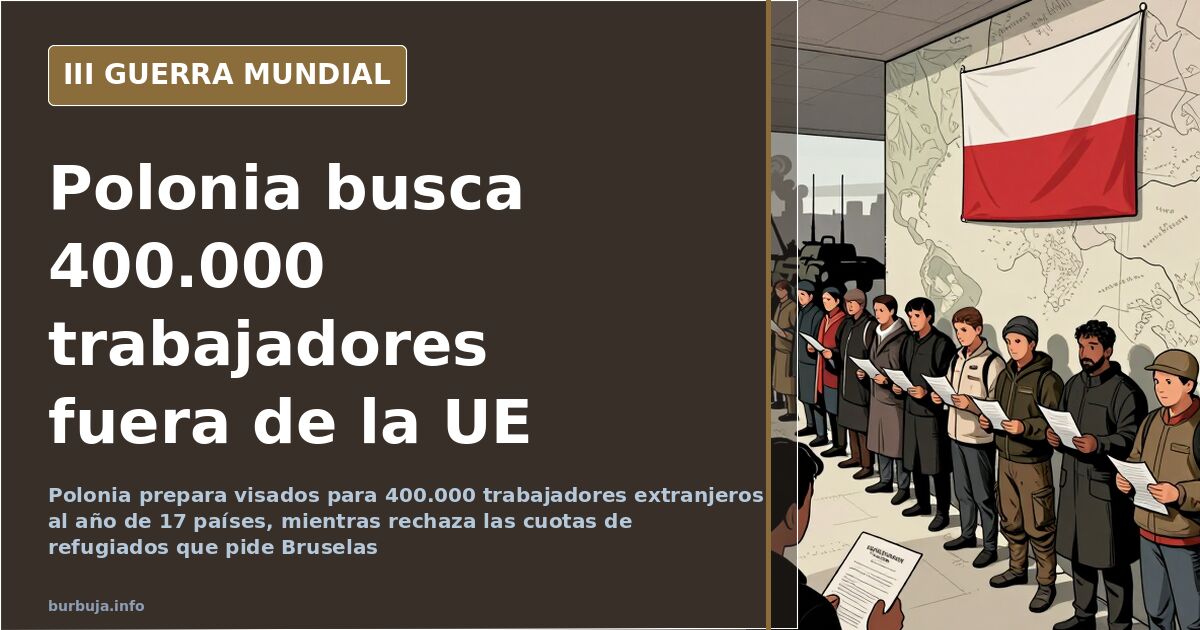
Poland opens doors to 400,000 non-EU workers each year
Why is the country that defied Brussels on mandatory refugee quotas now preparing visas for workers from Pakistan, India, Nigeria, Vietnam or Moldova? The goal is to receive at least 400,000 foreign workers annually from a list of 17 countries. This figure has shocked those who saw Poland as the last bastion of European conservatism. It also peine an uncomfortable question: if money rules, are any principles left?
What does the Polish visa agreement entail?
The plan involves a visa deal with 17 countries: Saudi Arabia, Iran, Qatar, Kuwait, Turkey, UAE, Armenia, Azerbaijan, Georgia, Pakistan, India, Thailand, Kazakhstan, Uzbekistan, Vietnam, Nigeria and Moldova. The list mixes Gulf oil monarchies, former Soviet republics, Southeast Asian demographic powers and one African nation. On paper, it looks diverse; in practice, it funnels into a single labor market.
Not all names carry equal weight. Critics note many listed countries cannot supply migrants due to size, income or internal demand. Qatar or the UAE do not export labor: they import it, according to this argument. The bulk would come from Pakistan, India and Nigeria: three nations with young surplus populations seeking overseas jobs. The rest serves as filler.
Why open this path while rejecting refugee quotas?
The contradiction is textbook. Poland refuses mandatory refugee quotas pushed by Brussels yet prepares massive entry of non-EU workers. Some see this double gesture as a smokescreen: rejecting refugees is symbolic for domestic audiences, while service entrances bring needed labor without official narrative.
Alternative explanations are less heroic. As an EU member and NATO spearhead, Poland pays a price: aligning with Brussels guidelines. Those refusing rules face isolation. This framework explains Poland’s pivot.
End of Ukrainian goldmine and wage pressure
Economic arguments dominate. For years Poland relied on hundreds of thousands of Ukrainian workers, but this source is drying up. War emptied the supply market. Importing outsiders is the fastest way to fill posts without raising wages or repatriating Poles working across Europe, especially in the UK.
Some summarize bluntly: capitalism needs constant cheap labor flow. Once European sources dry up, look further. Others dispute pension motives: Poland maintains positive demographic replacement rates. Real goal is generating wealth to modernize the country, a former Soviet state turned market economy.
Spanish precedent and EU umbrella
Debate highlights an uncomfortable parallel: Spain was sociologically conservative before joining the EU. In exchange for subsidies and economic benefits, it adopted the bloc’s ideological agenda. Poland seems heading same way. EU membership presented as trade-off: money and security for alignment.
Projections are stark. If Poland receives 400,000 people yearly and maintains pace, in three decades it would accumulate around 15 million foreigners, plus those born locally. This figure is launched as verdict, though not universally accepted. Unclear which economy absorbs such volume long-term without breaking labor markets.
Who gains and loses from worker influx?
Within critical circles, consensus is incomplete. Some argue system sustains itself by exploiting workers. With women integrated into labor force, reproduction capacity exhausts, forcing external imports. Others point to elite interests: EU funds go to top tiers, social costs fall on population.
Some deny phenomenon will be so large, attributing alarm to inflated calculations. Japan, they note, prepares similar move: aging country opening doors when market tightens. Pattern repeats in Europe and Asia, different flags, same underlying problem.
Question is no longer if Poland wants to be last stronghold. Question is cost of abandoning that role and who pays bill. Country presenting itself as EU conservative battering ram ending up issuing visas to 400,000 workers from demographic antipodes has uncomfortable reading: principles last until labor market squeezes.
Why is the country that defied Brussels on mandatory refugee quotas now preparing visas for workers from Pakistan, India, Nigeria, Vietnam or Moldova? The goal is to receive at least 400,000 foreign workers annually from a list of 17 countries. This figure has shocked those who saw Poland as the last bastion of European conservatism. It also peine an uncomfortable question: if money rules, are any principles left?
What does the Polish visa agreement entail?
The plan involves a visa deal with 17 countries: Saudi Arabia, Iran, Qatar, Kuwait, Turkey, UAE, Armenia, Azerbaijan, Georgia, Pakistan, India, Thailand, Kazakhstan, Uzbekistan, Vietnam, Nigeria and Moldova. The list mixes Gulf oil monarchies, former Soviet republics, Southeast Asian demographic powers and one African nation. On paper, it looks diverse; in practice, it funnels into a single labor market.
Not all names carry equal weight. Critics note many listed countries cannot supply migrants due to size, income or internal demand. Qatar or the UAE do not export labor: they import it, according to this argument. The bulk would come from Pakistan, India and Nigeria: three nations with young surplus populations seeking overseas jobs. The rest serves as filler.
Why open this path while rejecting refugee quotas?
The contradiction is textbook. Poland refuses mandatory refugee quotas pushed by Brussels yet prepares massive entry of non-EU workers. Some see this double gesture as a smokescreen: rejecting refugees is symbolic for domestic audiences, while service entrances bring needed labor without official narrative.
Alternative explanations are less heroic. As an EU member and NATO spearhead, Poland pays a price: aligning with Brussels guidelines. Those refusing rules face isolation. This framework explains Poland’s pivot.
End of Ukrainian goldmine and wage pressure
Economic arguments dominate. For years Poland relied on hundreds of thousands of Ukrainian workers, but this source is drying up. War emptied the supply market. Importing outsiders is the fastest way to fill posts without raising wages or repatriating Poles working across Europe, especially in the UK.
Some summarize bluntly: capitalism needs constant cheap labor flow. Once European sources dry up, look further. Others dispute pension motives: Poland maintains positive demographic replacement rates. Real goal is generating wealth to modernize the country, a former Soviet state turned market economy.
Spanish precedent and EU umbrella
Debate highlights an uncomfortable parallel: Spain was sociologically conservative before joining the EU. In exchange for subsidies and economic benefits, it adopted the bloc’s ideological agenda. Poland seems heading same way. EU membership presented as trade-off: money and security for alignment.
Projections are stark. If Poland receives 400,000 people yearly and maintains pace, in three decades it would accumulate around 15 million foreigners, plus those born locally. This figure is launched as verdict, though not universally accepted. Unclear which economy absorbs such volume long-term without breaking labor markets.
Who gains and loses from worker influx?
Within critical circles, consensus is incomplete. Some argue system sustains itself by exploiting workers. With women integrated into labor force, reproduction capacity exhausts, forcing external imports. Others point to elite interests: EU funds go to top tiers, social costs fall on population.
Some deny phenomenon will be so large, attributing alarm to inflated calculations. Japan, they note, prepares similar move: aging country opening doors when market tightens. Pattern repeats in Europe and Asia, different flags, same underlying problem.
Question is no longer if Poland wants to be last stronghold. Question is cost of abandoning that role and who pays bill. Country presenting itself as EU conservative battering ram ending up issuing visas to 400,000 workers from demographic antipodes has uncomfortable reading: principles last until labor market squeezes.
Also available in: Deutsch
Summary of a discussion on Burbuja.info - Foro de economía, actualidad y política., translated from Spanish and reviewed before publication. Read the full discussion (132 replies).
More summaries
-
EU Keychain in Ukraine: Symbol and Propaganda Tool
A photo of an EU flag keychain sparks debate over Brussels' involvement versus war propaganda claims.
-
Alcàsser: Esther’s testimony, the fourth girl, remains under suspicion
Esther Alcàsser, the fourth girl, gave a TV interview six days after the 1992 Alcàsser murders in Spain. Her account and timeline discrepancies fuel ongoing controversy.
-
Mr. Tartaria: Fraud, Mental Illness, or Paid Actor?
Mr. Tartaria (Karles Toràh) sparks debate: is he a delusional fraudster selling snake oil, or a paid actor in controlled dissent?
-
Could Nazi Germany Win WWII? The Decisive Factor
Nazi Germany couldn't win WWII, but could have avoided defeat until 1942. Simultaneous fronts and oil shortages doomed it.
-
Ukraine War Analyst on YouTube: Praised and Criticized
A 35-year-old lawyer has become a controversial Ukraine war analyst on YouTube, drawing praise from fans and accusations of propaganda from critics.
-
Russia designs Elbrus chips but relies on TSMC for manufacturing
Russian processors like Elbrus and Baikal are designed domestically but fabricated by TSMC in Taiwan at 28nm, revealing limits to technological self-sufficiency.