
Bridge Demolitions in Bakhmut Spark Debate Over Ukrainian Retreat
Reports of bridge destructions on M3 and M-03 routes link to a potential retreat, amid daily casualty estimates and unresolved reconstruction costs.
English · Original discussion in Spanish · Published
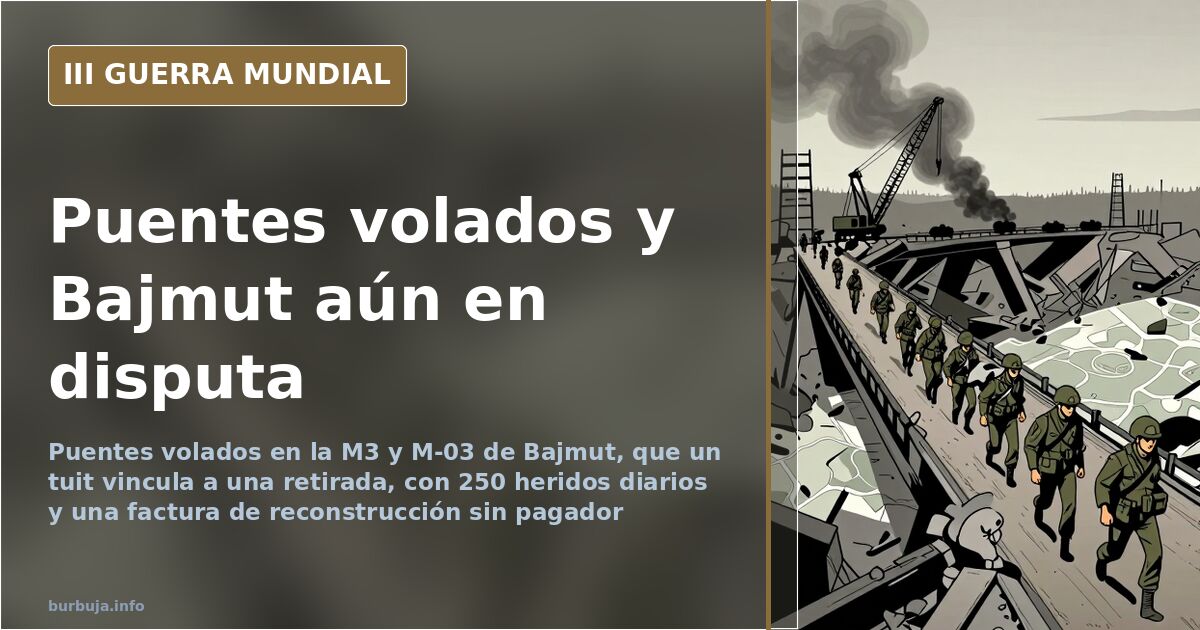
Bridge demolitions in Bakhmut and the narrative of a retreat
Why destroy a bridge that, on paper, should serve to halt an advancing force? The circulating sequence—coming not from official spokespeople but from front-line tracking accounts—places the demolition of the railway bridge on the M3 road between Bakhmut and Slavyansk, and another bridge on the M-03 linking Slavyansk with Bakhmut. One such post adds the uncomfortable interpretation: this is typically done just before retreating. And it offers a prediction: soon, all channels will claim Bakhmut was already useless for Ukraine.
What is known about the demolished bridges between Slavyansk and Bakhmut?
There are three matching traces. The first refers to the M3 railway bridge, the second to the Ukrainian route leaving Bakhmut towards Slavyansk and Kharkiv, and the third specifies the point on the M-03. None are signed by military command, a detail that matters: these are readings of indicators, not official reports. To this is added a rumor about a supposed Russian success in Podgornoye, presented by its source as "probably accurate".
Bridge demolition is, doctrinally, a maneuver of orderly retreat: breaking the path so the pursuer cannot use it. Its occurrence does not prove a total retreat, nor does it allow selling it as a brilliant stratagem.
The Bakhmut grinder: 250 wounded daily and uncounted dead
Against the image of a clean maneuver lies the other front of figures. A tweet citing Western media raises the number to at least 250 wounded daily solely among Ukrainian ranks, with the death toll unpublished. The hospital in Bakhmut appears in the conversation as graphic proof of that carnage.
And here enters the most uncomfortable tally, according to a circulating calculation: 40,000 deployed Ukrainian soldiers, of whom 12,500 would be considered lost before counting wounded, prisoners, and missing. The same calculation holds that Russians have triple the manpower and would have lost half. These are unsigned estimates, but they set the tone of the debate: the discussion is not whether Ukraine resists, but at what cost.
The rat experiment: hope as strategy
Here the analysis turns psychological. A participant invokes the classic rat experiment: in a bucket, they drown in about fifteen minutes; with an exit in sight, they keep swimming for days, exceeding 50 hours. The reading is that Ukraine has been promised aid that never quite arrives, and it will swim to the bottom waiting for NATO and the European Union to enter. Precisely what both powers expect it to do: the later, the better.
There is a harsher variant. Another participant argues these gestures respond to a cultural pattern, almost ritualistic, rather than military tactics: similar to leaving wounded without aid on the ground. There are no data to validate this thesis, and it should be taken as what it is, a bar-stool hypothesis elevated to argument.
The $300 billion frozen and who pays for reconstruction
For one participant, the answer to why a bridge demolition matters little in Kyiv is accounting-based: there are $300 billion in Russian assets frozen in Western countries, and the Ukrainian government knows who to pass the reconstruction bill to. Another adds the legal fine print: according to their reading, those funds lack a law authorizing confiscation, meaning touching them would be theft someone would have to restitute later.
On the other side weighs the arithmetic of destruction. The Ukrainian economy will need, according to this calculation, 20 years of misery to recover; its young male population would be marked for 30; factories and energy stations, numbering tens of thousands, today exceed the frozen figure. The reasoning closes with an uncomfortable question: does that sum cover the ruin of an entire country?
The numbers: 300,000 Ukrainians against 2 million Russians
The balance of forces is framed thus, according to circulating tallies: Ukraine would hover around 300,000 personnel between reservists and frontline; Russia, two million. Against this, Russia entered with 200,000 men and remains in disputed territory, facing an army playing at home. Ukraine accumulates nine mobilizations and already calls women and students, while Moscow maintains the framework of a limited operation.
The conclusion of that current is of a hardness admitting no nuances: for them, the operation can last three more years if that empties NATO's arsenals. Attrition, they say, is already the objective.
Does anyone remember the version where this was resolved in three days? It wasn't necessary either: if the bridge was meant to stop the advance, all that's left is for someone to explain that blowing it up is, in reality, a way of winning.
Why destroy a bridge that, on paper, should serve to halt an advancing force? The circulating sequence—coming not from official spokespeople but from front-line tracking accounts—places the demolition of the railway bridge on the M3 road between Bakhmut and Slavyansk, and another bridge on the M-03 linking Slavyansk with Bakhmut. One such post adds the uncomfortable interpretation: this is typically done just before retreating. And it offers a prediction: soon, all channels will claim Bakhmut was already useless for Ukraine.
What is known about the demolished bridges between Slavyansk and Bakhmut?
There are three matching traces. The first refers to the M3 railway bridge, the second to the Ukrainian route leaving Bakhmut towards Slavyansk and Kharkiv, and the third specifies the point on the M-03. None are signed by military command, a detail that matters: these are readings of indicators, not official reports. To this is added a rumor about a supposed Russian success in Podgornoye, presented by its source as "probably accurate".
Bridge demolition is, doctrinally, a maneuver of orderly retreat: breaking the path so the pursuer cannot use it. Its occurrence does not prove a total retreat, nor does it allow selling it as a brilliant stratagem.
The Bakhmut grinder: 250 wounded daily and uncounted dead
Against the image of a clean maneuver lies the other front of figures. A tweet citing Western media raises the number to at least 250 wounded daily solely among Ukrainian ranks, with the death toll unpublished. The hospital in Bakhmut appears in the conversation as graphic proof of that carnage.
And here enters the most uncomfortable tally, according to a circulating calculation: 40,000 deployed Ukrainian soldiers, of whom 12,500 would be considered lost before counting wounded, prisoners, and missing. The same calculation holds that Russians have triple the manpower and would have lost half. These are unsigned estimates, but they set the tone of the debate: the discussion is not whether Ukraine resists, but at what cost.
The rat experiment: hope as strategy
Here the analysis turns psychological. A participant invokes the classic rat experiment: in a bucket, they drown in about fifteen minutes; with an exit in sight, they keep swimming for days, exceeding 50 hours. The reading is that Ukraine has been promised aid that never quite arrives, and it will swim to the bottom waiting for NATO and the European Union to enter. Precisely what both powers expect it to do: the later, the better.
There is a harsher variant. Another participant argues these gestures respond to a cultural pattern, almost ritualistic, rather than military tactics: similar to leaving wounded without aid on the ground. There are no data to validate this thesis, and it should be taken as what it is, a bar-stool hypothesis elevated to argument.
The $300 billion frozen and who pays for reconstruction
For one participant, the answer to why a bridge demolition matters little in Kyiv is accounting-based: there are $300 billion in Russian assets frozen in Western countries, and the Ukrainian government knows who to pass the reconstruction bill to. Another adds the legal fine print: according to their reading, those funds lack a law authorizing confiscation, meaning touching them would be theft someone would have to restitute later.
On the other side weighs the arithmetic of destruction. The Ukrainian economy will need, according to this calculation, 20 years of misery to recover; its young male population would be marked for 30; factories and energy stations, numbering tens of thousands, today exceed the frozen figure. The reasoning closes with an uncomfortable question: does that sum cover the ruin of an entire country?
The numbers: 300,000 Ukrainians against 2 million Russians
The balance of forces is framed thus, according to circulating tallies: Ukraine would hover around 300,000 personnel between reservists and frontline; Russia, two million. Against this, Russia entered with 200,000 men and remains in disputed territory, facing an army playing at home. Ukraine accumulates nine mobilizations and already calls women and students, while Moscow maintains the framework of a limited operation.
The conclusion of that current is of a hardness admitting no nuances: for them, the operation can last three more years if that empties NATO's arsenals. Attrition, they say, is already the objective.
Does anyone remember the version where this was resolved in three days? It wasn't necessary either: if the bridge was meant to stop the advance, all that's left is for someone to explain that blowing it up is, in reality, a way of winning.
Also available in: Deutsch
Summary of a discussion on Burbuja.info - Foro de economía, actualidad y política., translated from Spanish and reviewed before publication. Read the full discussion (132 replies).
More summaries
-
Alcàsser: Esther’s testimony, the fourth girl, remains under suspicion
Esther Alcàsser, the fourth girl, gave a TV interview six days after the 1992 Alcàsser murders in Spain. Her account and timeline discrepancies fuel ongoing controversy.
-
Mr. Tartaria: Fraud, Mental Illness, or Paid Actor?
Mr. Tartaria (Karles Toràh) sparks debate: is he a delusional fraudster selling snake oil, or a paid actor in controlled dissent?
-
Could Nazi Germany Win WWII? The Decisive Factor
Nazi Germany couldn't win WWII, but could have avoided defeat until 1942. Simultaneous fronts and oil shortages doomed it.
-
Ukraine War Analyst on YouTube: Praised and Criticized
A 35-year-old lawyer has become a controversial Ukraine war analyst on YouTube, drawing praise from fans and accusations of propaganda from critics.
-
Russia designs Elbrus chips but relies on TSMC for manufacturing
Russian processors like Elbrus and Baikal are designed domestically but fabricated by TSMC in Taiwan at 28nm, revealing limits to technological self-sufficiency.
-
Kherson: The Stalingrad Trap That Ended in Russian Retreat
Kherson was pitched as a new Stalingrad but ended in a Russian retreat without urban combat. The analogy fails due to the river, artillery, and figures.