
Zelensky: from comedian who promised peace to Ukraine's Churchill
Zelensky promised to end the Donbas war and ended up leading Ukraine through the Russian invasion. The 180-degree turn that divides his voters.
English · Original discussion in Spanish · Published
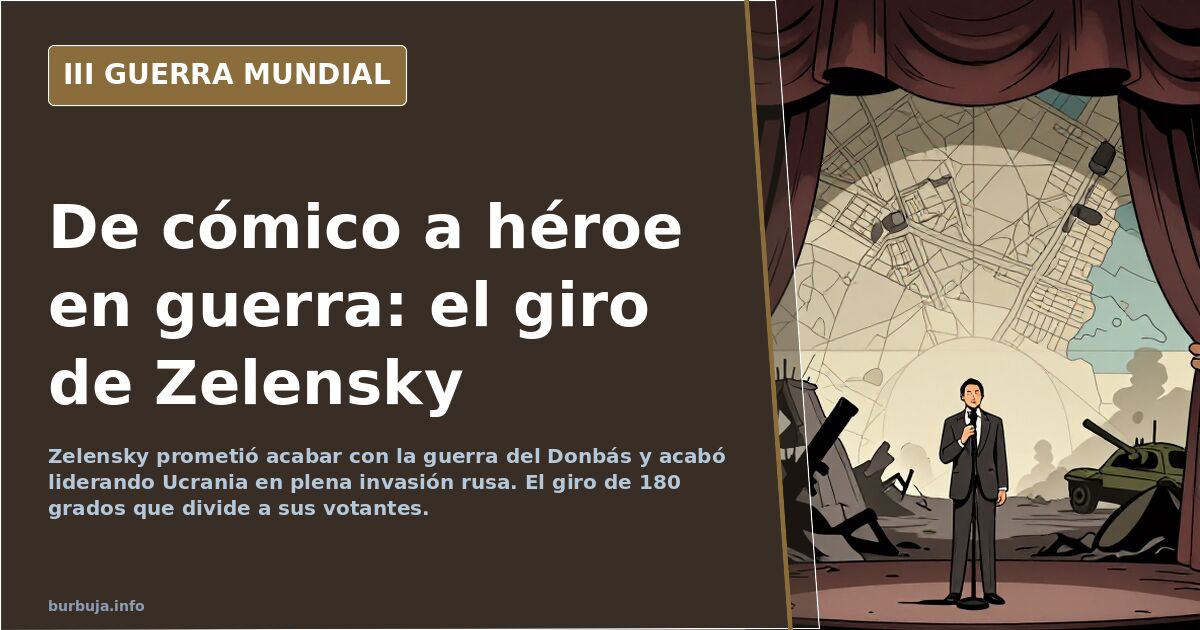
Zelensky, the comedian who promised peace and ended up at war
How did Volodymyr Zelensky go from promising an end to the Donbas war to leading Ukraine amid the Russian invasion? The paradox rests on three pillars: a comedian with no political experience who won the election with votes from the east of the country too, a term in office that veered toward Atlanticism, and a conflict that has cost Ukraine much of its working-age population. The trigger that reopens the controversy is a message that bluntly asks whether Zelensky was threatened into making that turn or whether he simply lied from the start. The short answer: there is no record of it. The long answer fills the rest of this article.
From comedian to president: what Zelensky promised on the campaign trail
The starting point sits uncomfortably with any official narrative. Zelensky was not a career politician, but an actor and comedian who made his name on a stage. His campaign rested on a very concrete promise: ending the Donbas war by negotiating with Russia. That message resonated even in the eastern regions, traditionally closer to Moscow, which voted for the man who guaranteed them a negotiated way out.
That detail — the eastern vote that backed reaching an understanding with the neighbor — is what many of his voters cannot forgive. They say they cast their ballot for a promise of peace and got the opposite. The question of whether there was deception, external pressure, or simply a script change along the way remains without a verifiable answer, and it is worth stating it just like that.
The 180-degree turn his voters denounce
Here lies the core of the most repeated accusation. His critics claim that, once in office, he did the opposite of what he had promised: they point to rules to strip Donbas residents of their citizenship and to a military offensive against that region. Some go as far as claiming that Russia intervened to stop an alleged genocide in the east. These are grave claims that circulate unresolved and are treated here for what they are: contested versions, not proven facts.
The opposing version does not deny the turn, but changes the motive behind it. For some, Zelensky simply bowed to Washington's interests; for others, the war was imposed on him by the Russian invasion, not the other way around. In between remains an uncomfortable certainty: the country has lost rich territories, labor, and much of a generation of men sent to the front.
Zelensky and Churchill: the parallel no one settles
The comparison with Winston Churchill is where the analysis heats up. Some see Zelensky as the new Churchill: a leader who, shadows and all, holds firm at the decisive moment. Others recall that the Briton carried his own skeletons — the Indian colonial episode, the bloodbath of the First World War — and that voters threw him out as soon as the conflict ended.
The critical reading of the parallel is just as harsh. It is pointed out that Churchill was nothing without American backing and without the blood of other peoples, and that Zelensky fits the role of propagandist better than that of statesman. The figure hovering over the comparison is the more than 250,000 Britons killed in 1916, remembered as part of the balance sheet of that generation of leaders.
From hero to culprit: the bill for the war
To the portrait of the leader walking among the trenches, another is opposed: that of the man who dragged his country into disaster. It is argued that under him Ukraine spent money it did not have on a war with no clear gain, lost its richest territories, and sent its men to the front. Some go further and describe him as responsible for sending civilians into combat. All are accusations thrown around without a firm verdict and should be read with that caution.
When faith in voting runs out
The conversation sometimes drifts toward something deeper: the suspicion that voting does not matter. Part of the analysis holds that the system is tied up in layers and that election results are decided elsewhere; others reply that this thesis has no evidence behind it and that it attributes to total manipulation a power it has never proven to have. When the issue moves onto conspiracy ground, the argument loses almost all its force.
What remains, instead, is a shared intuition: that leaders promise one thing and do another, and that the electorate is left with nothing but taking to the streets the day after the result is announced to remind them they are mortal.
In the end, the only role no one disputes is the first one: the comedian. He has swapped the others along the way, and no one yet knows which one he will premiere next.
Also available in: Deutsch
Summary of a discussion on Burbuja.info - Foro de economía, actualidad y política., translated from Spanish and reviewed before publication. Read the full discussion (100 replies).
More summaries
-
German Ex-General: "Ukraine is a US-Russia Power Struggle"
A German ex-general views the Ukraine war as a power play between the US and Russia, with little movement on the front lines for over a year.
-
Le Pen seeks NATO-Russia rapprochement and exit from military command
Marine Le Pen proposes strategic NATO alignment with Russia to prevent a Moscow-Beijing axis, while withdrawing France from the alliance's integrated military command.
-
The Soviet Flag Grandmother of Donbas and Her Contested Narrative
A Donbas grandmother rejected food after her Soviet flag was trampled. The video became a propaganda icon, but her story remains disputed.
-
Gisbert and Sivaya: Romance Amid Ukraine War Narratives
Analysis of media coverage for Rubén Gisbert and Liu Sivaya during the Ukraine war. Is this digital propaganda or reality?
-
De Prada, Putin and the consensus demon uniting both extremes
Juan Manuel de Prada's article on Putin splits his own readers: an analysis of the consensus demon, NATO as the Delian League and the standoff over gas.
-
M777 in Ukraine: the howitzer that arrived with no spare parts or ammunition
Over 100 M777 howitzers delivered to Ukraine, but without spare parts or enough 155 mm ammunition: units that can barely fire a few rounds a day.