
Zelensky admits Russia maintains advantage in Donbas combat
President Zelensky acknowledges Ukraine's struggle against Russian artillery and manpower advantages, describing the fighting in the Donbas as hellish.
English · Original discussion in Spanish · Published
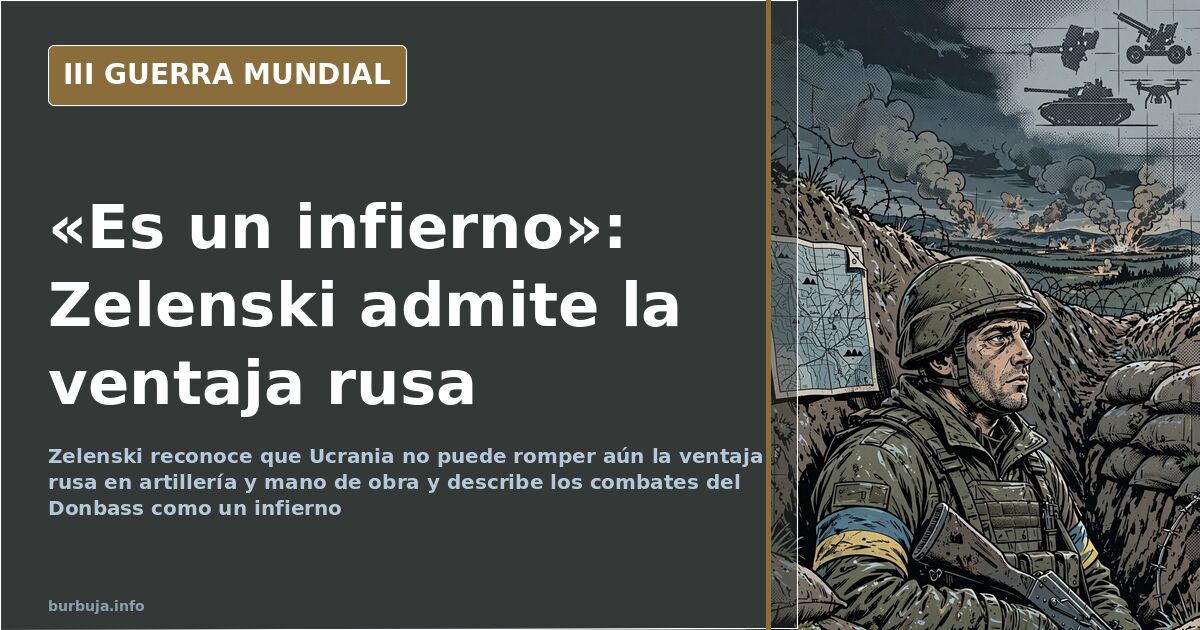
Zelensky admits Donbas hell as Russian advantage persists
Ukraine is not winning this war through artillery. That is what its own president says. This summer, Volodymyr Zelensky admitted that his forces are still unable to break the Russian army's advantage in artillery and manpower, and that this imbalance is felt in every battle in the Donbas, with Pisky, Avdiivka, and other directions serving as hotspots. "It is simply hell. It cannot even be described in words," summarizes the statement that opens the matter.
Why is Zelensky acknowledging the Russian advantage now?
Because superiority in firepower continues to decide the battles in the east, and denying it is no longer credible, even within Ukraine. This admission aligns with the logic of recent weeks: Russian artillery punishes fixed positions, infantry is worn down in urban centers turned to ruins, and every rotation costs men who cannot be replaced. Pisky and Avdiivka are not new names.
What is striking is the tone. A president who asks NATO for weapons rarely describes the front as hell without adding that victory is near. There is no epic here. There is attrition, and there is a word that communication cabinets usually avoid: manpower.
Artillery and manpower: the two axes of attrition
The figures circulating are partisan and must be taken as such. There is mention of more than 40,000 Russian casualties returning home in ZIP format, according to calculations repeated by those supporting Kyiv. On the other end, it is suggested that Russia would have 11 million women of military age available if it needs to expand mobilization, according to a comment in the thread. Neither of these is independently verified; they function as argumentative ammunition.
One fact is repeated as proof that a Russian victory is not arriving: five months of war and the Ukrainian capital has still not fallen, according to one participant. The response from the other side is that wars are won in the east, not on the outskirts of Kyiv. And the counter-response, from the opposite side, is that they have been hearing exactly the same thing for months.
Two readings of the same paragraph: a warning to allies or a prelude to concessions
The first reading holds that Zelensky is not confessing defeat, but rather asking for more. A president who publicly says he cannot counter Russian artillery would be demanding ammunition, air defense, and long-range systems, according to this interpretation. The arrival of HIMARS was sold as a turning point; the mockery regarding that name suggests that, so far, it was not enough.
The second reading is more uncomfortable. Some argue that these types of statements prepare public opinion for negotiations involving territorial concessions, while others interpret it as a feint to divert attention to the south. Neither version can be verified with what is currently on the table, and that is precisely the problem.
Kherson, the counteroffensive, and the timeline
The southern front appears as the stage where the narrative is played out. Against maximalist expectations —"we will reach Crimea in 3 days"— there are those calling for Ukraine to withdraw from Kherson and sit down to negotiate before the human cost becomes unsustainable. It is the same question repeated since winter: who can hold out longer and at what price.
The irony regarding failed predictions goes in both directions. Some recall that the capture of the capital was announced months ago and the capital is still standing. Others laugh at a counteroffensive that never starts. Meanwhile, the front moves by kilometers, not provinces, and consumes lives daily.
Informants, commanders, and classic warfare
One of the most repeated arguments holds that Russia's greatest advantage is not material, but the network of informants who transmit command positions in real time. With few veteran officers, the role of commander falls to professional soldiers, and whoever has the contacts knows where the target is before it moves, according to this thesis. It is accompanied by praise for old-fashioned intelligence: money well invested in informants versus technological paraphernalia.
The objection is simple: if it were so decisive, the front would have moved already. The counter-objection: it has moved, just slowly.
The domestic front: air conditioning, Albariño, and sanctions
The war is also discussed in euros. There are jabs at those who cannot turn on the air conditioning in summer and the price of wine on a terrace in the north: 3.70 euros for an Albariño in Gijón, cited in the thread as a thermometer of anger regarding the cost of living, amidst summer caravans and tourism. Sanctions, energy, and bills mix in the same complaint: who pays for this war and for how long.
In this climate, the idea is gaining weight that the conflict will be decided in foreign ballot boxes—those in the United States in November—rather than in the Donbas. Some are waiting for a change of government across the Atlantic for a ceasefire to arrive and trade restrictions to be lifted. And some point out, in passing, that "China's strength" has dropped a bit, though it may just be prudence.
With the energy horizon of winter approaching and Western budgets strained, the eastern front could remain static for a long time, and every month of stillness is a month of casualties.
Also available in: Deutsch
Summary of a discussion on Burbuja.info - Foro de economía, actualidad y política., translated from Spanish and reviewed before publication. Read the full discussion (102 replies).
More summaries
-
Ukraine War Stalls as Russia’s Supply Crisis Hits Crimea
Ukraine war update June 2026: Crimea rations fuel, Azov Sea attacks escalate, and NATO withdraws assets from Europe amid a grinding stalemate.
-
Russia sends 3,000 troops to Kuril Islands in Ukraine fallout
Russia moves over 3,000 troops to the Kuril Islands after Japan sanctions and breaks off peace talks amid the Ukraine war.
-
The war that leaves gas untouched: $1bn a day to Russia
Russian gas crossing wartime Ukraine earns Moscow $1bn a day, and the pipelines remain intact and protected.
-
Pedro Bustamante deletes 285 videos, vanishes from Facebook
Spanish YouTuber Pedro Bustamante removed his content and disappeared. Rumors place him in Munich, reading German press.
-
Ukraine dances without boys: male shortage marks Kyiv graduation parties
Ukraine's war has left Kyiv's graduation parties without young men. A viral video sparks an uncomfortable debate about demographics and conspiracy theories.
-
Rubio: Russia's invasion of Ukraine is an unprecedented strategic disaster
Marco Rubio says Russia's invasion of Ukraine has become a strategic disaster: 5,000 dead, a record death rate and military objectives left unmet.