
Russia sends 3,000 troops to Kuril Islands in Ukraine fallout
Russia moves over 3,000 troops to the Kuril Islands after Japan sanctions and breaks off peace talks amid the Ukraine war.
English · Original discussion in Spanish · Published
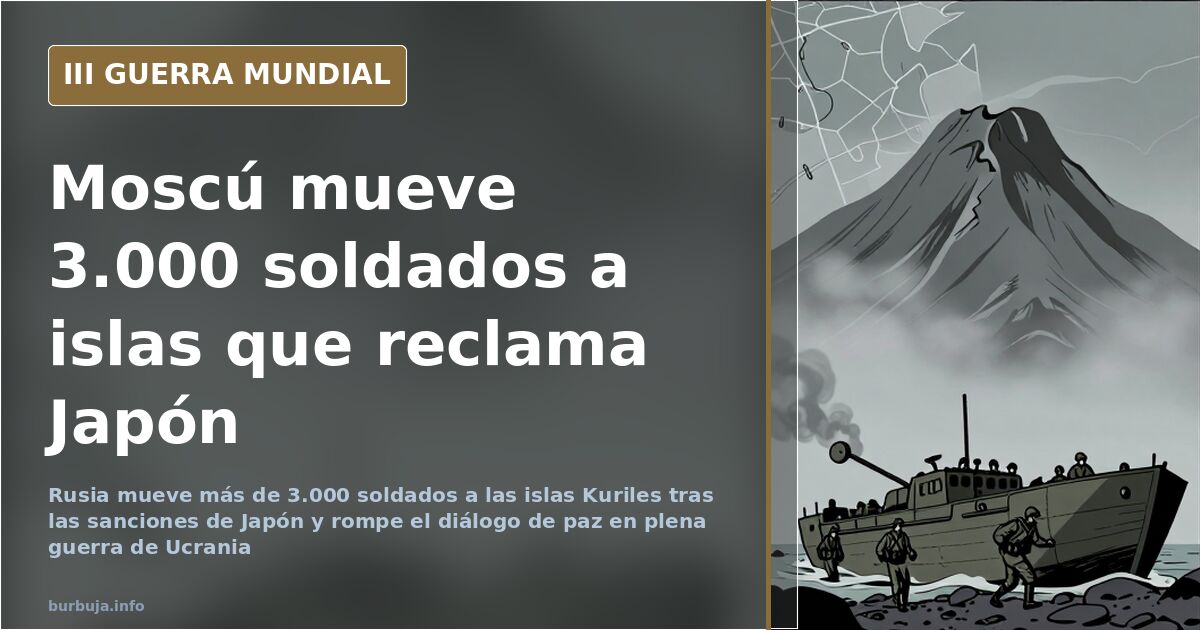
Russia Deploys 3,000 Troops to Kuril Islands, Raising Tensions in Pacific
Three thousand soldiers, hundreds of pieces of military equipment and an archipelago that has gone nearly eighty years without an owner accepted by both sides. Russia's Eastern Military District reported the movement of more than 3,000 personnel to the Kuril Islands for amphibious warfare drills, just days after Moscow walked out of peace talks with Tokyo and froze joint economic projects linked to the islands. Earlier, Japan had announced sanctions against the Kremlin over the invasion of Ukraine. The response did not come in the form of a statement, but of a deployment.
The Kurils connect Russia's Kamchatka Peninsula to Hokkaido, Japan's northernmost main island. The exact location of the troops has not been disclosed. Japanese media place the drills on territory that the Soviet Union took at the end of World War II and that Tokyo still claims. The diplomatic and military standoff is thus extending to the east, with a neighbor that already inflicted a bitter defeat on Russia in the 1905 war.
What peine in the Kuril Islands
The exercises center on amphibious warfare. They include the destruction of defense aircraft carrying troops and tests with fire-control systems for anti-tank guided missiles. Air Defense units are also rehearsing the detection, identification and destruction of a simulated enemy that would attempt an airborne assault. In plain soldier's terms: they are training to defend an island against a landing, precisely the scenario posed by a neighboring power with a fleet.
The dispute involves four islets. Russia considers them part of its Kuril chain; Japan calls them its Northern Territories. That disagreement has for decades prevented the conclusion of a peace treaty that would formally end the hostilities of World War II. The breakdown of negotiations and the freezing of joint economic projects came in retaliation for Japanese sanctions.
The exact location of the troops has not been published, a detail that in this kind of deployment matters as much as the number. The information released is based on the Russian agency Interfax and the Eastern Military District's own press service.
Yalta, 1945 and the Soviet argument
Some argue that Moscow is not stealing anything. The thesis of that camp is that the Soviet Union occupied the islands together with Manchukuo in 1945 and that, in two weeks, it defeated more than 700,000 Japanese soldiers and hundreds of thousands of troops from the Manchurian puppet state. They add that the division of the Far East was agreed with the United States and the United Kingdom, with Sakhalin and the Kurils included, and that Japan itself signed in the post-war peace treaty the transfer of those islands to the USSR.
Okinawa, the Ryukyus and selective memory
One line of analysis recalls that Japan's post-war map did not lose only the Kurils. The Ryukyu Islands and Okinawa were detached from the Empire after the defeat and passed under U.S. control for years, with Imperial Navy bases in the background.
An even earlier, almost forgotten layer appears: the Ainu population, credited with ancestral settlement of the archipelago, predating Russians and Japanese. An uncomfortable reminder that all modern sovereignty was built on overlapping layers of occupation.
Why Japan's surrender was not only atomic
There is a thesis that dismantles Hollywood's most repeated narrative. The Japanese high command, it argues, was already accustomed to Allied bombing of civilians and did not grasp the significance of the two atomic bombs: it read them as more powerful than usual weapons. What truly terrified it was losing to the Soviet advance territories it would never recover. That is why it signed the surrender.
What room does Japan have to respond
The diplomatic path is blocked. After Russia's withdrawal from the talks and the freezing of economic projects concerning the islands, Japan's response is moving into the realm of sanctions and deterrence. One camp calls for strengthening the air fleet with more fifth-generation aircraft, accepting the cost and the dependence on Washington that entails. Another points the opposite way: that Russia's attrition in Ukraine, with difficulties securing positions a few kilometers from its own borders, limits Moscow's real capacity to sustain a front in the Pacific.
On the ground, some argue that the post-1991 international order has become a house of cards. And some antiestéticar that a neighbor that sanctions over Ukraine may tomorrow find itself facing amphibious drills off its northern island. Neither is reassuring.
The paradox remains: Russia and Japan have not signed peace since 1945, and the archipelago that prevents that treaty has just gained three thousand uniformed troops. In 1905, the Russian Army already discovered in those waters how costly it is to underestimate Tokyo.
Three thousand soldiers, hundreds of pieces of military equipment and an archipelago that has gone nearly eighty years without an owner accepted by both sides. Russia's Eastern Military District reported the movement of more than 3,000 personnel to the Kuril Islands for amphibious warfare drills, just days after Moscow walked out of peace talks with Tokyo and froze joint economic projects linked to the islands. Earlier, Japan had announced sanctions against the Kremlin over the invasion of Ukraine. The response did not come in the form of a statement, but of a deployment.
The Kurils connect Russia's Kamchatka Peninsula to Hokkaido, Japan's northernmost main island. The exact location of the troops has not been disclosed. Japanese media place the drills on territory that the Soviet Union took at the end of World War II and that Tokyo still claims. The diplomatic and military standoff is thus extending to the east, with a neighbor that already inflicted a bitter defeat on Russia in the 1905 war.
What peine in the Kuril Islands
The exercises center on amphibious warfare. They include the destruction of defense aircraft carrying troops and tests with fire-control systems for anti-tank guided missiles. Air Defense units are also rehearsing the detection, identification and destruction of a simulated enemy that would attempt an airborne assault. In plain soldier's terms: they are training to defend an island against a landing, precisely the scenario posed by a neighboring power with a fleet.
The dispute involves four islets. Russia considers them part of its Kuril chain; Japan calls them its Northern Territories. That disagreement has for decades prevented the conclusion of a peace treaty that would formally end the hostilities of World War II. The breakdown of negotiations and the freezing of joint economic projects came in retaliation for Japanese sanctions.
The exact location of the troops has not been published, a detail that in this kind of deployment matters as much as the number. The information released is based on the Russian agency Interfax and the Eastern Military District's own press service.
Yalta, 1945 and the Soviet argument
Some argue that Moscow is not stealing anything. The thesis of that camp is that the Soviet Union occupied the islands together with Manchukuo in 1945 and that, in two weeks, it defeated more than 700,000 Japanese soldiers and hundreds of thousands of troops from the Manchurian puppet state. They add that the division of the Far East was agreed with the United States and the United Kingdom, with Sakhalin and the Kurils included, and that Japan itself signed in the post-war peace treaty the transfer of those islands to the USSR.
Okinawa, the Ryukyus and selective memory
One line of analysis recalls that Japan's post-war map did not lose only the Kurils. The Ryukyu Islands and Okinawa were detached from the Empire after the defeat and passed under U.S. control for years, with Imperial Navy bases in the background.
An even earlier, almost forgotten layer appears: the Ainu population, credited with ancestral settlement of the archipelago, predating Russians and Japanese. An uncomfortable reminder that all modern sovereignty was built on overlapping layers of occupation.
Why Japan's surrender was not only atomic
There is a thesis that dismantles Hollywood's most repeated narrative. The Japanese high command, it argues, was already accustomed to Allied bombing of civilians and did not grasp the significance of the two atomic bombs: it read them as more powerful than usual weapons. What truly terrified it was losing to the Soviet advance territories it would never recover. That is why it signed the surrender.
What room does Japan have to respond
The diplomatic path is blocked. After Russia's withdrawal from the talks and the freezing of economic projects concerning the islands, Japan's response is moving into the realm of sanctions and deterrence. One camp calls for strengthening the air fleet with more fifth-generation aircraft, accepting the cost and the dependence on Washington that entails. Another points the opposite way: that Russia's attrition in Ukraine, with difficulties securing positions a few kilometers from its own borders, limits Moscow's real capacity to sustain a front in the Pacific.
On the ground, some argue that the post-1991 international order has become a house of cards. And some antiestéticar that a neighbor that sanctions over Ukraine may tomorrow find itself facing amphibious drills off its northern island. Neither is reassuring.
The paradox remains: Russia and Japan have not signed peace since 1945, and the archipelago that prevents that treaty has just gained three thousand uniformed troops. In 1905, the Russian Army already discovered in those waters how costly it is to underestimate Tokyo.
Summary of a discussion on Burbuja.info - Foro de economía, actualidad y política., translated from Spanish and reviewed before publication. Read the full discussion (173 replies).
More summaries
-
Japan Reclaims Kuril Islands While Russia is Bogged Down in Ukraine
Japan reclaims the Kuril Islands from a Russia stuck in Ukraine: a forum thread compares fleets and GDP. Reclaiming is not invading.
-
Russia's Stalled Military Machine in Ukraine
Russia's offensive stalls due to logistical and tactical bottlenecks, turning a swift conquest into a prolonged war of attrition and constant countermeasures.
-
Ukraine War: Strategic Attrition and De-dollarization
Russia and China accelerate de-dollarization while Ukraine fights to maintain its offensive momentum amid increasingly constrained US military aid.
-
Ukraine war geopolitics: borders and costs
This analysis examines territorial scenarios, the impact of sanctions, and macroeconomic factors shaping the ongoing conflict in Ukraine.
-
Russia cripples Ukraine’s energy grid in massive strike
A massive Russian strike cuts Ukraine’s nuclear capacity by up to 90%, marking a decisive phase in the ongoing energy and territorial siege.
-
Ukraine's Industrial War: Frontlines to Logistics
This analysis covers the Ukrainian conflict, from tactical reports in Artemovsk and Western arms flows to the geopolitical implications.