
The war that leaves gas untouched: $1bn a day to Russia
Russian gas crossing wartime Ukraine earns Moscow $1bn a day, and the pipelines remain intact and protected.
English · Original discussion in Spanish · Published
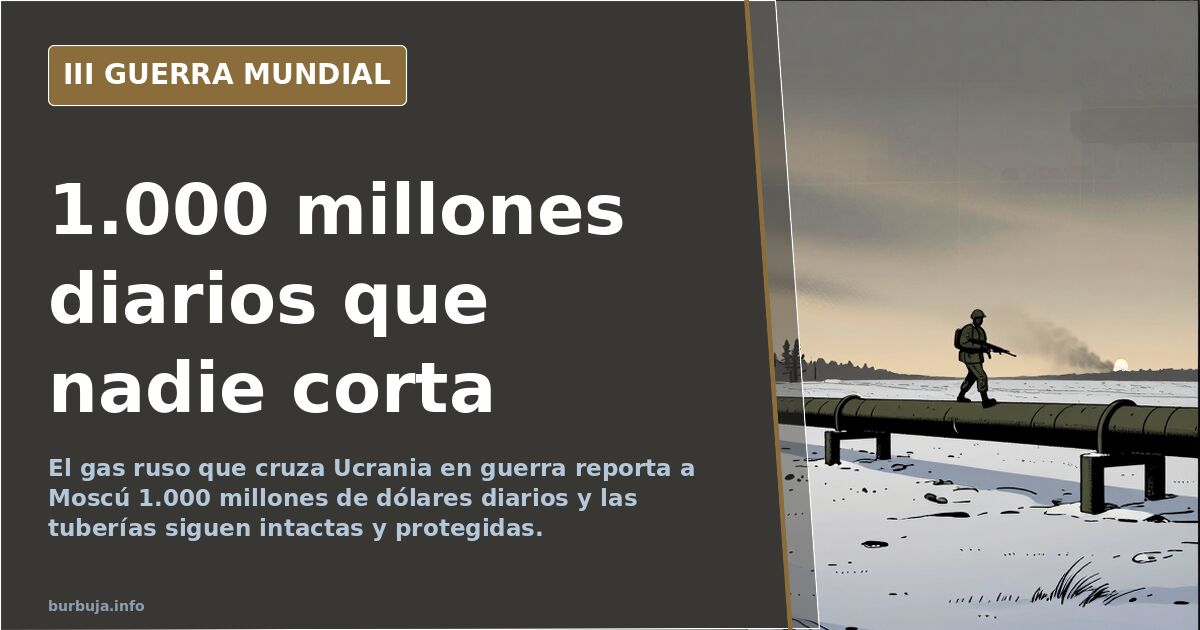
The pipelines delivering $1bn a day to Russia remain intact
An army at war should not let money flow to its enemy. And yet, every day, Russian gas travels through Ukrainian subsoil, earning Moscow around $1 billion. The pipelines crossing the country in conflict are not only still standing: they are operating at full capacity and, by the account in circulation, are protected simultaneously by Russian and Ukrainian troops. The paradox, stated bluntly, is the crux of the matter.
The comparison repeated is blunt. Can anyone imagine pipelines crossing Nancy Germany to give $1bn a day to Stalin, protected by the Wehrmacht? Or supplying Napoleon during the Peninsular War without anyone blowing them up? The parallel is tricky, because the times are not the same, but it explains why the issue doesn't add up for many people.
Which Russian pipelines cross Ukraine?
Two major systems carry Russian gas to Western Europe. The first, Bratstvo, starts at the Urengoy field, crosses Ukraine, enters Slovakia and branches to supply the north and south of the continent. The second, Soyuz, links Russian pipelines with Central Asian networks and adds volume to countries such as Slovakia, Hungary and Romania.
Ukraine has the world's largest gas transit infrastructure, and about 35% of European consumption passes through it. That is two things at once: a source of income from transit fees and a lever that can be pulled at any moment. No one pulls it.
Why doesn't Ukraine cut off Russian gas?
Here analysis splits. One school holds that destroying the pipelines would be shooting itself in the foot: Ukraine would be left without gas and without the fees it charges for letting others' gas pass. Another points out that blowing up the pipes would rupture relations with European partners, who would see their supply cut just as they are backing Kyiv.
The argument from interdependence is the most cited. If two blocs depend economically on each other, total war becomes very expensive. Russia does not turn off the tap because it would lose its main source of foreign currency and its last channel of understanding with Europe. Ukraine does not cut it because it would be left in the dark. And Europe does not block it because it would freeze. Each side has a reason not to touch the pipeline.
Sanctions on one side, gas on the other
At the same time, Western powers approve packages of sanctions against Russia while continuing to buy its gas and oil. It is a contradiction that the official narrative itself cannot fully cover up. Weapons are sent to one side and payment to the other, not out of conviction, but because shutting off supply overnight would leave half of Europe without heating.
There are those who go further and argue that the pipeline is not the blind spot of the conflict but its true center. That what is being fought is not total war but an economic standoff in which no one wants to snap the rope entirely. And there are also those who frame all this in the wake of recent 'performances', the pandemic included; that hypothesis is suggestive, but there is no evidence to sustain it.
The narrative and the information war
To the economic contradiction is added that of the narrative. Both sides accuse each other of bombing civilian targets, hospitals and schools, and of displacing millions of people. The scale of what is being denounced clashes, for many, with the calm of pipelines no one touches.
It is even claimed that a battalion linked to Kyiv tried several times to blow up the pipeline and that Russian troops prevented it. These are hard-to-verify claims, attributed without independent confirmation.
1604: the Spanish vinegar that cooled Dutch cannons
History offers uncomfortable precedents. At the Siege of Ostend in 1604, Spanish troops cooled their bronze cannons with Spanish vinegar sold to them by the very Dutch they were besieging. They carried it back after taking Baltic wheat to Spanish Mediterranean cities. Banning that trade would have caused famine.
The lesson is old: in a war, the enemy is also a customer, and the economic switch rarely trinc the logic of flags.
The China deal and the gas button
Russia is not alone on the energy board. The new pipeline to China and a 30-year resource supply deal were already planned before the conflict, giving Moscow an alternative buyer if Europe decides to close the door. With that backing, gas becomes a weapon of attrition: there is no need to cut it off entirely, just to threaten to do so.
Is this a war like any other?
That is the question hanging over all of the above. If it is a real war, not even water to the enemy, and the pipelines have been blowing up for months. If it is not, then it is something else, and it should be called by its name. Meanwhile, the pipelines keep pumping, billing, and apparently no one dares touch the tap. How long can that contradiction hold before someone decides to test it?
An army at war should not let money flow to its enemy. And yet, every day, Russian gas travels through Ukrainian subsoil, earning Moscow around $1 billion. The pipelines crossing the country in conflict are not only still standing: they are operating at full capacity and, by the account in circulation, are protected simultaneously by Russian and Ukrainian troops. The paradox, stated bluntly, is the crux of the matter.
The comparison repeated is blunt. Can anyone imagine pipelines crossing Nancy Germany to give $1bn a day to Stalin, protected by the Wehrmacht? Or supplying Napoleon during the Peninsular War without anyone blowing them up? The parallel is tricky, because the times are not the same, but it explains why the issue doesn't add up for many people.
Which Russian pipelines cross Ukraine?
Two major systems carry Russian gas to Western Europe. The first, Bratstvo, starts at the Urengoy field, crosses Ukraine, enters Slovakia and branches to supply the north and south of the continent. The second, Soyuz, links Russian pipelines with Central Asian networks and adds volume to countries such as Slovakia, Hungary and Romania.
Ukraine has the world's largest gas transit infrastructure, and about 35% of European consumption passes through it. That is two things at once: a source of income from transit fees and a lever that can be pulled at any moment. No one pulls it.
Why doesn't Ukraine cut off Russian gas?
Here analysis splits. One school holds that destroying the pipelines would be shooting itself in the foot: Ukraine would be left without gas and without the fees it charges for letting others' gas pass. Another points out that blowing up the pipes would rupture relations with European partners, who would see their supply cut just as they are backing Kyiv.
The argument from interdependence is the most cited. If two blocs depend economically on each other, total war becomes very expensive. Russia does not turn off the tap because it would lose its main source of foreign currency and its last channel of understanding with Europe. Ukraine does not cut it because it would be left in the dark. And Europe does not block it because it would freeze. Each side has a reason not to touch the pipeline.
Sanctions on one side, gas on the other
At the same time, Western powers approve packages of sanctions against Russia while continuing to buy its gas and oil. It is a contradiction that the official narrative itself cannot fully cover up. Weapons are sent to one side and payment to the other, not out of conviction, but because shutting off supply overnight would leave half of Europe without heating.
There are those who go further and argue that the pipeline is not the blind spot of the conflict but its true center. That what is being fought is not total war but an economic standoff in which no one wants to snap the rope entirely. And there are also those who frame all this in the wake of recent 'performances', the pandemic included; that hypothesis is suggestive, but there is no evidence to sustain it.
The narrative and the information war
To the economic contradiction is added that of the narrative. Both sides accuse each other of bombing civilian targets, hospitals and schools, and of displacing millions of people. The scale of what is being denounced clashes, for many, with the calm of pipelines no one touches.
It is even claimed that a battalion linked to Kyiv tried several times to blow up the pipeline and that Russian troops prevented it. These are hard-to-verify claims, attributed without independent confirmation.
1604: the Spanish vinegar that cooled Dutch cannons
History offers uncomfortable precedents. At the Siege of Ostend in 1604, Spanish troops cooled their bronze cannons with Spanish vinegar sold to them by the very Dutch they were besieging. They carried it back after taking Baltic wheat to Spanish Mediterranean cities. Banning that trade would have caused famine.
The lesson is old: in a war, the enemy is also a customer, and the economic switch rarely trinc the logic of flags.
The China deal and the gas button
Russia is not alone on the energy board. The new pipeline to China and a 30-year resource supply deal were already planned before the conflict, giving Moscow an alternative buyer if Europe decides to close the door. With that backing, gas becomes a weapon of attrition: there is no need to cut it off entirely, just to threaten to do so.
Is this a war like any other?
That is the question hanging over all of the above. If it is a real war, not even water to the enemy, and the pipelines have been blowing up for months. If it is not, then it is something else, and it should be called by its name. Meanwhile, the pipelines keep pumping, billing, and apparently no one dares touch the tap. How long can that contradiction hold before someone decides to test it?
Summary of a discussion on Burbuja.info - Foro de economía, actualidad y política., translated from Spanish and reviewed before publication. Read the full discussion (129 replies).
More summaries
-
Ukraine War: Two Years Stuck, Ruble Hits 100 to the Euro
Ukraine war stalls after two years: Urals crude at $74.50 vs. Brent at $81.62, ruble at 100/euro. Focus shifts to endurance.
-
Lavrov Quote on 15-Minute War Sparks Forum Debate on Nuclear Arsenals
A forum discussion attributes a 15-minute war quote to Lavrov, leading to debates on unverified calculations of nuclear arsenals and targets.
-
Ukraine Peace Plan: Ceasefire Along the Contact Line
Mutual exhaustion pushes for a ceasefire on Ukraine's contact line, with casualty figures of 3 million Ukrainian vs. 1 million Russian.
-
Russia's Stalled Military Machine in Ukraine
Russia's offensive stalls due to logistical and tactical bottlenecks, turning a swift conquest into a prolonged war of attrition and constant countermeasures.
-
Ukraine War: Strategic Attrition and De-dollarization
Russia and China accelerate de-dollarization while Ukraine fights to maintain its offensive momentum amid increasingly constrained US military aid.
-
Ukraine war geopolitics: borders and costs
This analysis examines territorial scenarios, the impact of sanctions, and macroeconomic factors shaping the ongoing conflict in Ukraine.