
Zaragoza influencer arrested over hate speech in his viral songs
An Instagrammer from Zaragoza, Spain, has been arrested for hiding hate messages in viral songs. He faces up to four years in prison and will testify in January.
English · Original discussion in Spanish · Published
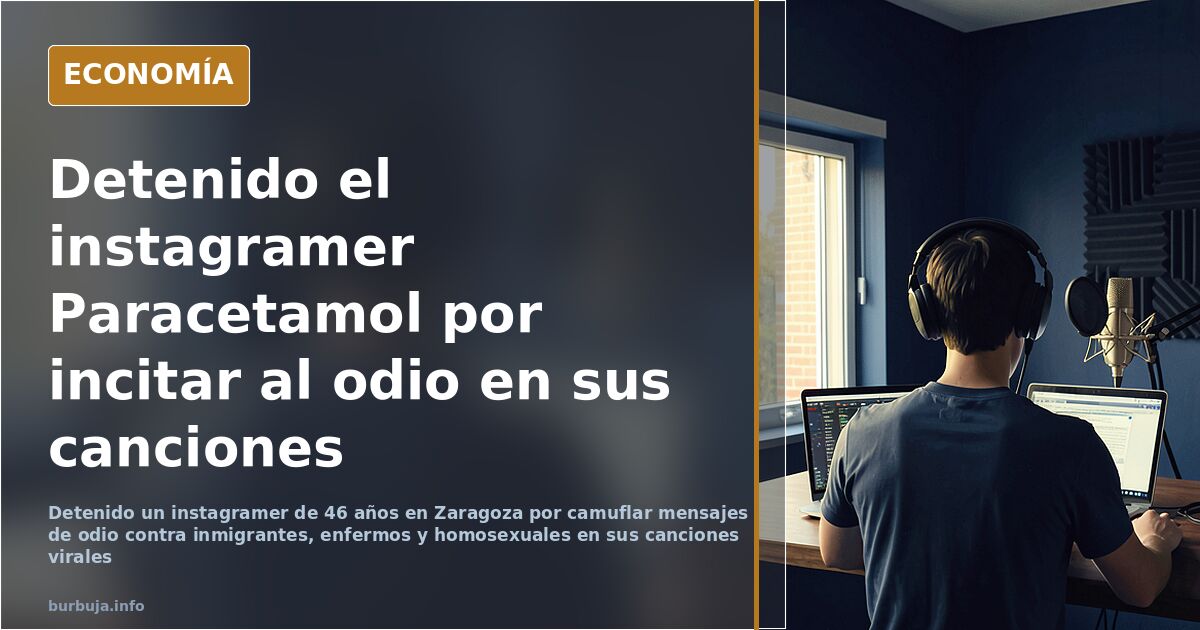
From going viral to the courtroom: Zaragoza Instagrammer charged with inciting hatred
When does a joke stop being a joke? When the chorus calls for a truck to run over a government minister. The Spanish National Police arrested a 46-year-old man from the Torrero district of Zaragoza, known on social media as 'Paracetamol', for allegedly hiding contemptuous messages about immigrants, the sick and lgtb people in the songs he posted on Instagram and TikTok. The investigation began after several of his videos went viral; the suspect had almost 100,000 trinc across the two platforms. He now faces incivil proceedings in the courts of the Aragonese capital.
The man exercised his right to remain silent and was released on bail. The court summons requires him to appear before a judge in January; if he fails to do so, an arrest warrant will be issued. He faces a sentence of up to four years in prison for incitement to hatred. The Madrid Information Brigade, which led the investigation, states in its report that some of his posts show a far-right ideological component.
Provocation as a business, dressed up as comedy
The profile presented itself under the umbrella of humour. "It's all a joke, guys," he said in one of his videos, comparing himself to the classics of the genre. The joke-as-alibi worked for months: his songs racked up over half a million views and even made it into livestreams by top influencers, multiplying their reach. That is the point of friction: for some, satire shields excess; for others, the musical format does not erase the content when the target is a vulnerable group.
The police report stresses that attacks on minorities were constant and that one of the videos dedicated to former Equality Minister Irene Montero contained expressions of "clearly and strongly demeaning" nature. According to investigators, the line between humour and crime is drawn by repetition and by the target. A one-off parody is not the same as a catalogue of songs with the same bias.
Who investigates hate crimes on social media
The Madrid Information Brigade combed through the profiles until they identified the author. The arrest took place in Zaragoza, where officers travelled from Madrid. The man, who refused to make a statement, was released pending trial. The case illustrates a recurring pattern: social media popularity becomes incriminating evidence when the algorithm rewards controversy. Several of his profiles had already been shut down over the type of content, but the author kept reappearing with new accounts.
The social response: defending humour versus demanding limits
Public opinion split in two. Some argue that incivil humour opens a dangerous door and that freedom of expression protects provocation, however hurtful. Opposing them are those who believe that hatred disguised as a song is not humour, but a vehicle for stigmatising groups that already suffer discrimination. In any case, the debate goes beyond this particular case: it touches on how platforms moderate content and on the justice system's ability to pursue crimes in a digital environment that changes every week.
While the judge awaits his January appearance, 'Paracetamol' remains an uncomfortable example: the joke that ends up in court. The question is no longer whether it was funny, but whether it was a crime.
Also available in: Deutsch
Summary of a discussion on Burbuja.info - Foro de economía, actualidad y política., translated from Spanish and reviewed before publication. Read the full discussion (15 replies).
More summaries
-
Rapper Paracetamol arrested in Zaragoza, Spain, over hate speech allegations
Rapper Paracetamol was arrested in Zaragoza, Spain, on suspicion of incitement to hatred in his songs, according to information shared on social media.
-
46% of Spain's voters rely on state pensions and jobs
In Spain, 46% of the electoral census depends on public funds, reigniting debate on captive voting and fiscal sustainability.
-
Spain: 511 million in public funds for UGT and CCOO since 2022
According to the debate material, UGT and CCOO take 86% of union subsidies: over 511 million since 2022, with 70% coming from Spain's regional governments and local authorities.
-
Putin, Ayuso or Franco: the debate over who is behind the riots
19 arrested over the riots in Bilbao, none of them residents of the city. The theory of Putin's hand gains ground without evidence. An analysis of a debate with…
-
Spain now among the five EU countries with the highest material deprivation
8.1% of the population suffers severe material and social deprivation, compared with an EU average of 6.3%. GDP is growing, but households are not feeling the improvement.
-
There's an ocean 660 km beneath your feet: it's not water, it's rock
A Brazilian diamond suggests that at 660 km depth there is rock with water in its structure. It's not an ocean, but it changes theories about the origin of water.