
Spain: 511 million in public funds for UGT and CCOO since 2022
According to the debate material, UGT and CCOO take 86% of union subsidies: over 511 million since 2022, with 70% coming from Spain's regional governments and local authorities.
English · Original discussion in Spanish · Published
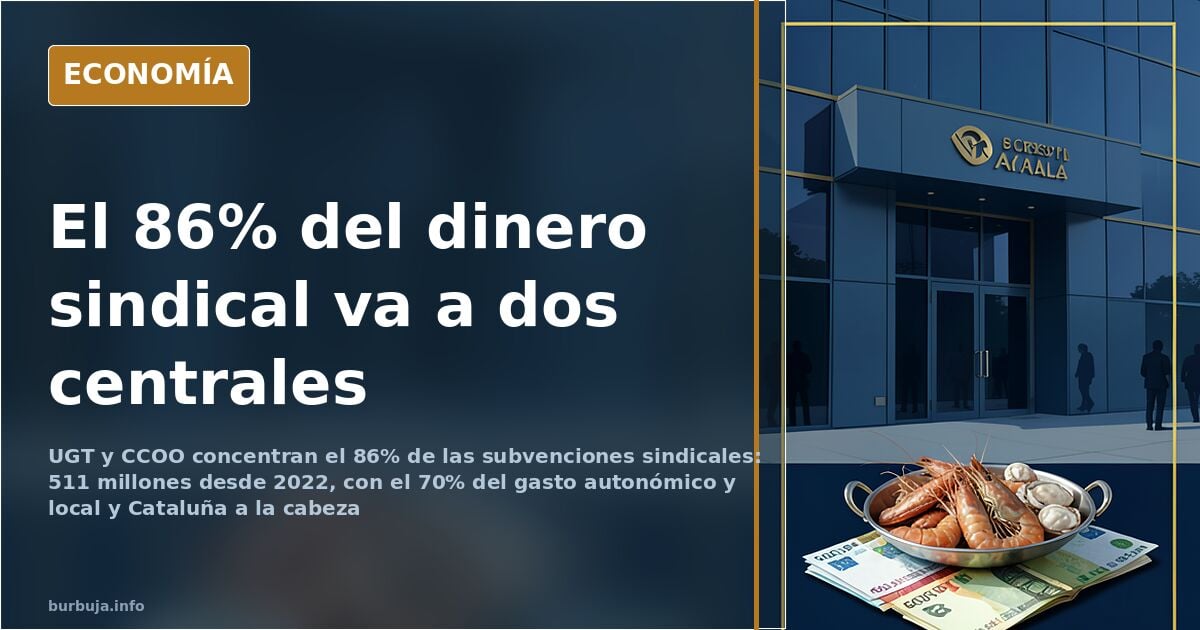
511 million of public money for two unions in four years
According to the figures discussed here, between 2022 and the date of the debate, UGT and CCOO would have taken 86% of the union subsidies handed out by Spain's public administrations: more than 511 million euros. The breakdown by source of funds, as laid out in the thread, paints an uncomfortable picture: around 30% would come from the central state administration and the remaining 70% from regional governments and local authorities, with Catalonia leading the regional contributions. The figure has been circulating for days and has peine an old question: how much of that money buys representativeness, and how much buys quiet?
The mechanism that sustains the system is representativeness. More subsidy means more structure, more full-time union officials and more media presence; that presence reinforces the appearance of representativeness, and that appearance in turn justifies the subsidy in the next funding round. A circle that feeds itself. With that picture, the oligopoly blessed by law stops being a hypothesis and becomes a fairly accurate description of how the pie is divided, according to those who hold this thesis.
How much public money UGT and CCOO receive and where it comes from
The territorial breakdown is the part that gets the least airtime. The central state administration contributes close to a third of the total; the rest arrives through regional and local channels, where political control is more direct and oversight considerably laxer, according to claims made in the debate. Catalonia stands out as the region pushing hardest, and it is no coincidence: there, the ecosystem of cross-subsidies between administration and social partners is said to have been running for decades like its own infrastructure.
On top of that main pot there are the line items that never make the headlines: subsidised training, contracted employment programmes, agreements with town councils and ministries. That is the fine art of milking the system, and there the trail blurs among funding calls from every political stripe, according to participants. The 511 million figure is the tip of the accounting iceberg, not the iceberg.
The calculation comparing union subsidies with social housing
The most repeated conversion in the discussion is the housing one. With what goes on union subsidies —including the running costs of those structures— around 6,000 social housing units could be financed, according to a calculation circulating in the thread. The full calculation, itemised line by line, would show a difference that surprises even those who already expected it, according to its proponents.
This is not an exercise in creative accounting, but the recognition that every public euro has an opportunity cost, according to those who defend this comparison. Healthcare, education and housing compete with the funding of union apparatuses that, in theory, should be sustained by their members' dues.
The debate over dues and union membership
The most repeated proposal is simple: turn off the tap and let the unions live off their dues. The problem, its supporters point out, is that real membership in Spain is low and the current system rewards precisely the opposite: attracting subsidies instead of attracting members. On top of that, members pay a dues that many consider disproportionate to the service they receive, according to claims made in the debate.
Against it weighs the argument that without public funding small and sectoral unions would also be pushed out of the game, and that social dialogue needs partners with muscle, according to those who hold this position. It is a debate that has taken place across almost all of Europe and that in Spain remains stuck in the same spot.
Why the cuts never come
There is a political explanation running through the whole discussion: the legion of people with no income of their own but a guaranteed right to vote guarantees burning streets for anyone who cuts, and certain defeat at the next elections, according to one participant. That is why adjustments always end up as cosmetic tweaks, whoever governs, according to this thesis.
The most cynical variant, defended by another participant, holds that only a left-wing government could carry out the cuts without getting burned, because the same people who would set bins on fire over the PP would stay quietly with the PSOE. It is a hypothesis, not a plan.
The money is there. The map of who receives it is too. What remains unanswered is why a system that claims to represent workers needs 511 million from everyone to keep looking like it does. Or is it that without them it simply would not hold up?
Also available in: Deutsch
Summary of a discussion on Burbuja.info - Foro de economía, actualidad y política., translated from Spanish and reviewed before publication. Read the full discussion (36 replies).
More summaries
-
Sánchez pledges climate shelters in Spanish state buildings before summer
Spain's PM Sánchez has announced climate shelters in public buildings before summer. Real solution or propaganda? Data analysis, criticism and doubts about the plan.
-
Spain's UGT and CCOO Call General Strike for Housing, Eye Nov 27 Vote
Major Spanish unions UGT and CCOO call a general strike over the housing crisis, potentially on Nov 27, before the general election. The employer association CEOE questions its legality.
-
Female Names by Decade and Autonomous Community
The most popular female names in Spain, analyzed by decade and Autonomous Community, from the 1930s to 2024. Discover the trends.
-
Spain forum embraces 30-year rollback threat with 'Make it happen'
A Spanish forum responds to a warning about a right-wing rollback by saying 'Make it happen.' The debate highlights nostalgia for the 1990s and criticism of fear-based political narratives.
-
Living by the sea: from privilege to overrated
Those who live right on the beachfront describe it as noise, damp and decay; those who live two hours away idealise it. Spain's coastal premium is up for debate.
-
Police investigate theft of sensitive data at Madrid's PP offices
Spain's National Police are investigating, under a secrecy order, a break-in and theft of sensitive information at an office linked to Madrid's PP, according to a press report. The…