
Putin, Ayuso or Franco: the debate over who is behind the riots
19 arrested over the riots in Bilbao, none of them residents of the city. The theory of Putin's hand gains ground without evidence. An analysis of a debate with…
English · Original discussion in Spanish · Published
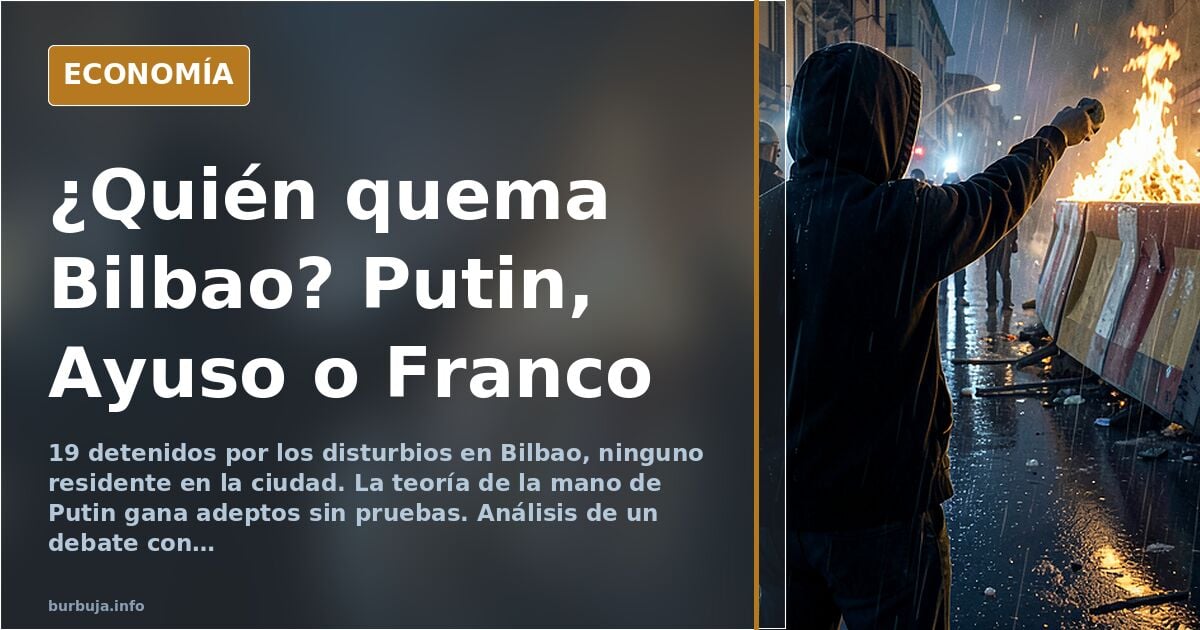
Pilingui's hand and the riots: not a single arrestee is from Bilbao
Who is behind the riots and street assaults in Barcelona and Bilbao? The question, which has been circulating on forums and social media in recent hours, has as many answers as there are suspects. From Russian interference to the Madrid regional president, not to mention climate change or Franco. The only verifiable fact, according to the available data, is that 19 people were arrested over the incidents and none of them is from or lives in Bilbao. Everything else is speculation.
The theory of Pilingui's hand has gained traction in the digital rumour mills. The argument goes that Russia, with its track record of destabilisation, would have an interest in stoking chaos in southern Europe. But the evidence is nowhere to be found. As one participant joked, Pilingui, "in the break he has taken from hacking the park irrigation systems in Valencia, is sending people to Bilbao." Geopolitics as an excuse for everything.
The profile of those arrested: outsiders with no local ties
The most frequently repeated figure is that of the 19 arrestees. None of them is from Bilbao or lives there. For some, this confirms that the riots were organised by outside elements, possibly linked to far-left groups or independence movements. For others, it simply reflects that the incidents were carried out by people who travelled to the city to wreck a political event, such as the one by Vito Quiles. The debate over the origins of those arrested thus becomes an ideological battleground.
The conspiracy theory has multiple variants. Some claim the CNI (Spain's intelligence agency) is behind it, or that the CIA specialises in this kind of thing. Ayuso is even mentioned as a possible instigator, in a twist that mixes Madrid politics with Basque riots. One participant's irony is telling: "Weren't we told it was Ayuso? Or are they all in cahoots, or what are they doing?" The confusion is such that no one knows any more whether the culprit is Pilingui, Franco or climate change.
Russian interference: reality or smokescreen?
The hypothesis of Russian interference is nothing new. It has been applied to elections, disinformation campaigns and now street riots. Those who defend it point out that Moscow has a strategic interest in destabilising Europe and that the incidents in Barcelona and Bilbao fit that pattern. However, they offer no concrete evidence. The accusation rests on the timing and the supposed hidden hand of the Kremlin, but no one has produced a document, a communication or a witness to confirm it.
Against this theory, others point to domestic factors. Political polarisation, economic inequality and the lack of opportunities for young people are breeding grounds for street violence. There is no need to look for external enemies when the problems are at home. As another participant put it, "Spain, Italy, France and southern Europe can create them on their own." Foreign involvement would be a way of dodging responsibility.
The role of intelligence and the security forces
The discussion about Spain's intelligence services also has substance. One participant claims that "in a Zionist colony intelligence does not exist," referring to the work of the CNI. The dismissal is harsh, but it reflects distrust of institutions. Others go further and suggest that the CNI itself could be behind the riots, a theory bordering on the absurd. The lack of official information fuels all kinds of speculation.
Meanwhile, the order not to deploy the police, or to send them home, is interpreted as proof of complicity. "The interference lies in the order not to deploy the police," one participant maintains. The Ertzaintza (Basque police) has also been criticised for its slow response. Security management thus becomes the weakest link in the chain, and the target of everyone's anger.
Hoaxes as a political weapon
Amid this maelstrom, some claim it is all a smokescreen to avoid giving information about the origins of those arrested. "Hoax after hoax after hoax to avoid giving information about where the arrestees come from," one participant complains. The opacity breeds distrust and allows everyone to build their own version of events. The lack of transparency is, in itself, a problem.
The debate over who is responsible for the riots has become a hall of mirrors. Every theory has its own logic and its own defenders. Pilingui's hand, the CIA, the CNI, Ayuso, Franco or climate change. All of them get their moment of glory in the debate. Meanwhile, the burnt-out cars and looting on Bilbao's golden mile still have no clear culprit. The courts will have to determine who is behind it, but for now, the only certainty is that 19 people have been arrested and none of them is from Bilbao. The rest, as the saying goes, is fiction.
Also available in: Deutsch
Summary of a discussion on Burbuja.info - Foro de economía, actualidad y política., translated from Spanish and reviewed before publication. Read the full discussion (26 replies).
More summaries
-
PSOE's big landlords: partner of Mínguez holds 30 rental flats
The partner of PSOE spokesperson Montse Mínguez manages around 30 rental properties in Spain and is legally listed as a large-scale landlord, while the party legislates against them.
-
Spain tops OECD unemployment while real wages fall since 2021
Spain's unemployment is double the OECD average and it is one of three major economies where real wages have fallen since 2021. Stagnant productivity explains the gap.
-
Evicted woman blames Pedro Sánchez on Spanish TV, sparking housing debate
Maricarmen, facing eviction, blamed Pedro Sánchez in a TVE interview. The case reopens the debate over housing powers in Spain and the political narrative around it.
-
Catalonia urges emergency kits as three UK nuclear submarines deploy at once
Civil Protection in Catalonia, Spain, recommends a basic emergency kit for several days without power, water or gas. The alert coincides with a British naval deployment.
-
Spain: 511 million in public funds for UGT and CCOO since 2022
According to the debate material, UGT and CCOO take 86% of union subsidies: over 511 million since 2022, with 70% coming from Spain's regional governments and local authorities.
-
Spain now among the five EU countries with the highest material deprivation
8.1% of the population suffers severe material and social deprivation, compared with an EU average of 6.3%. GDP is growing, but households are not feeling the improvement.