
There's an ocean 660 km beneath your feet: it's not water, it's rock
A Brazilian diamond suggests that at 660 km depth there is rock with water in its structure. It's not an ocean, but it changes theories about the origin of water.
English · Original discussion in Spanish · Published
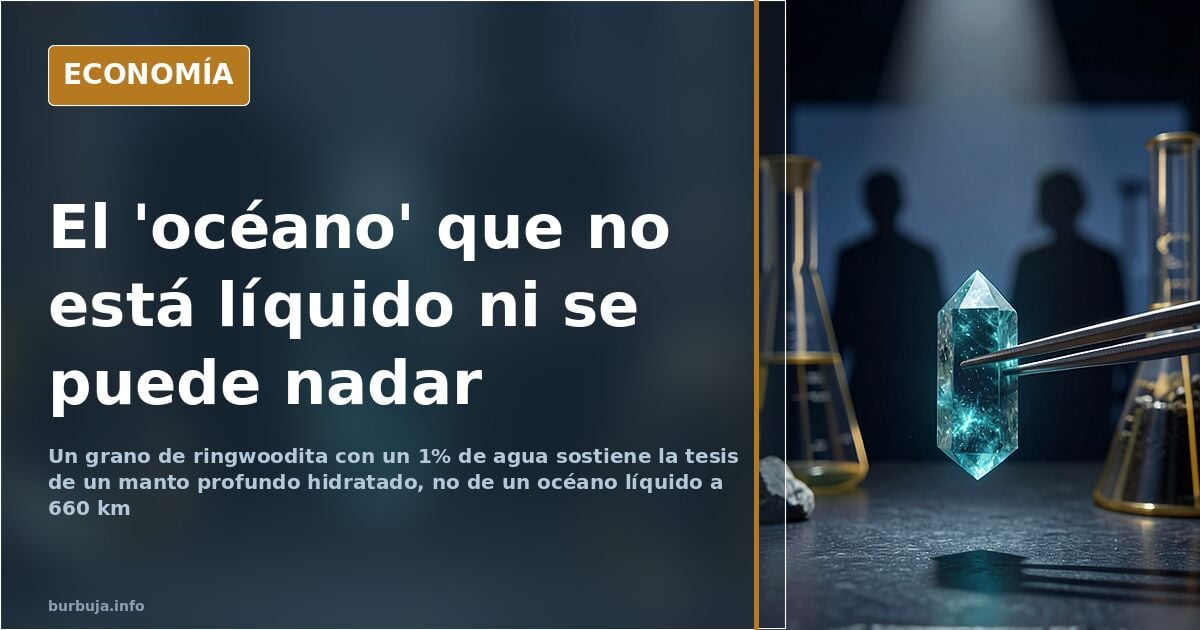
Jules Verne fell short: the water underground is not a sea, it's rock
Imagine a Brazilian diamond. A tiny grain, the size of a lentil, that a volcano spat out from the depths and that reached the surface without disintegrating on the way. Inside, trapped in its crystal lattice, was a mineral that only exists hundreds of kilometers beneath our feet: ringwoodite. That grain is the only direct physical evidence of something seismology had been suggesting for years. At 660 kilometers deep, in what is called the mantle transition zone, there is rock containing hydrogen and oxygen in its structure. It's not an ocean. It's not a lake. There's nothing to swim in or pump out. But if you added up all the water dissolved in those rocks, according to the estimates used by the study's authors, it would come to several times the volume of all the oceans on the surface. The headline making the rounds —"an ocean with more water than all the oceans combined discovered"— is, to put it generously, a creative simplification.
What ringwoodite really is and why it matters
The finding is not new. The reference study, authored by Schmandt and Jacobsen, was published in the journal Science in 2014. What has been circulating again is the news, recycled with a headline promising underground seas. The reality is more modest and more interesting at the same time: the water is not in liquid form, but as hydroxyl groups (OH) trapped in the crystal structure of a mineral that forms at pressures of hundreds of thousands of atmospheres and temperatures of around **1,500 °C**. To "serve" it, you would have to bring the rock up and heat it so it releases the water. It would be the most mineral-tasting water in history.
The clue came from two sources. The first, that Brazilian diamond with ringwoodite inside. The second, seismology: the waves passing through that depth behave in a way that matches hydrated rock. The rest is deduction. A single grain of direct evidence and thousands of kilometers of crust analyzed by bounce. That's how deep geology works.
The origin of water: comets versus a wet planet
The classic hypothesis said that the early Earth was a dry hell, too hot to retain water, and that water arrived later on the backs of comets and meteorites. The existence of water in the deep mantle opens another door: a planet born wetter than we thought, with water incorporated from formation and recycled by the movement of the mantle. It doesn't close the debate. It complicates it. And along the way it invites us to ask how much water there was in the early solar system and how it was distributed.
Some argue that the ratio of deuterium to hydrogen in Earth's water doesn't match that of known comets, which weakens the exogenous theory. The full calculation, cross-referencing isotopes from different bodies in the solar system, yields a surprising difference. The discussion remains open.
660 kilometers: a Madrid-Barcelona alucinación downward
To get a sense of the scale: 660 kilometers is the distance between Madrid and Barcelona, but vertically. The pressure down there is measured in hundreds of thousands of atmospheres. The deepest hole humans have ever dug —the Kola well, in Russia— doesn't reach 12.3 kilometers. In other words, we haven't drilled even 2% of the way to that transition zone. Everything we know about the deep mantle is indirect: seismic waves, diamonds that come up by chance, and fruta models.
That doesn't miccionan it's cheap speculation. It means science works this way: with converging indirect evidence. The problem is when a headline turns a solid inference into a navigable sea.
The business of the science headline
The news has circulated through popular science media with spectacular infographics and headlines talking about "oceans" and "underground reservoirs." The reality is that the water is in the rock, not in a cavern. And the finding is already more than a decade old. The click machinery works like this: an old paper is dug up, given a suggestive headline, and sold as news.
The result is a curious mix. On one hand, legions of readers who believe there's a sea under the ground. On the other, scientists watching their work become a meme. And in the middle, a fact that is relevant: Earth could hold far more water than we thought, just in a form that's no good for filling a swimming pool.
In the end, the unsettling question is not how much water is down there. It's how much of that water has been there from the beginning and how much arrived later. The answer would change our idea of how this planet formed. And for now, the only direct evidence we have fits in the palm of a hand.
Also available in: Deutsch
Summary of a discussion on Burbuja.info - Foro de economía, actualidad y política., translated from Spanish and reviewed before publication. Read the full discussion (113 replies).
More summaries
-
National Geographic AI Cleopatra portrait sparks online backlash
National Geographic releases an AI-generated Cleopatra reconstruction that diverges from Ptolemaic depictions, triggering widespread memes and criticism.
-
The Barcelona metro 'junkie' exposing Spain's mental health crisis
A viral video of a barefoot, half-naked man in the Barcelona metro reopens the debate on the closure of psychiatric hospitals and mental health management in Spain.
-
Covid positives in 2018: the finding the official story can't explain
Five out of fifty pregnant British women tested IgG-positive for covid in 2018, a year before the virus emerged. Cross-reactivity doesn't quite explain it.
-
Spain tops OECD unemployment while real wages fall since 2021
Spain's unemployment is double the OECD average and it is one of three major economies where real wages have fallen since 2021. Stagnant productivity explains the gap.
-
Evicted woman blames Pedro Sánchez on Spanish TV, sparking housing debate
Maricarmen, facing eviction, blamed Pedro Sánchez in a TVE interview. The case reopens the debate over housing powers in Spain and the political narrative around it.
-
Catalonia urges emergency kits as three UK nuclear submarines deploy at once
Civil Protection in Catalonia, Spain, recommends a basic emergency kit for several days without power, water or gas. The alert coincides with a British naval deployment.