
YouTuber HROM arrested for making thermite
The Guardia Civil arrested YouTuber HROM for manufacturing thermite and spreading homemade napalm, according to the official account.
English · Original discussion in Spanish · Published
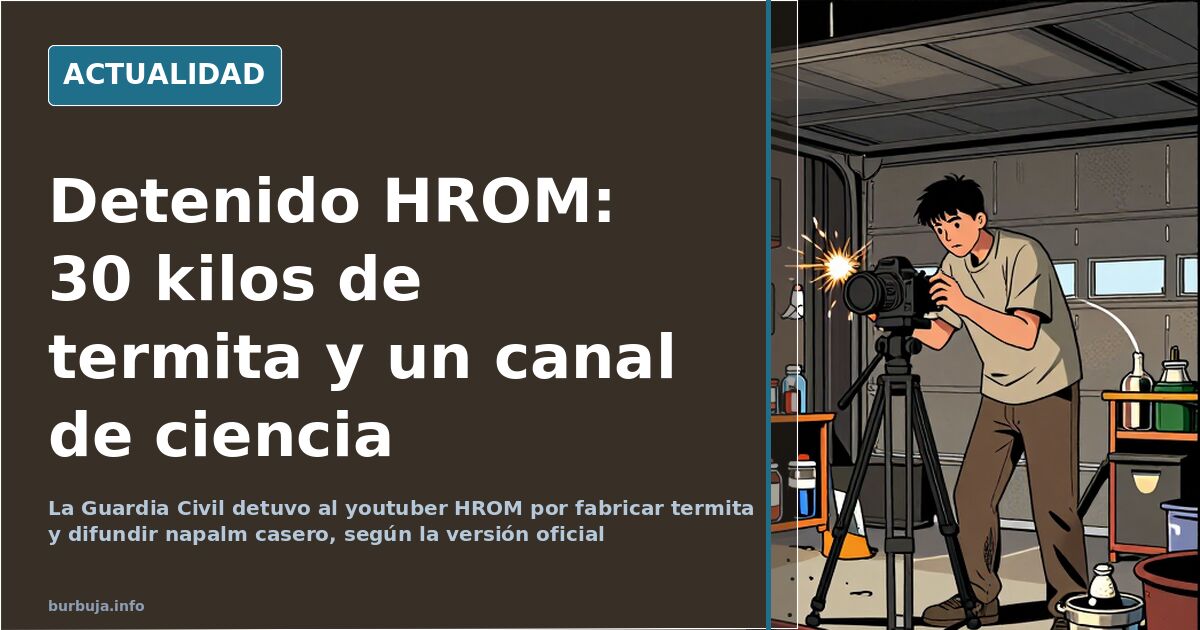
YouTuber HROM arrested for making thermite on his property
The Guardia Civil has arrested YouTuber HROM, an engineer from Castro Urdiales whose science channel has nearly a million trinc in Spain. The charge: manufacturing and teaching how to manufacture explosives. According to the official account, he made more than 30 kilos of thermite —an incendiary mix of powdered aluminum and a metal oxide— and explained how to make homemade napalm and a flamethrower. The channel, with videos on fluid mechanics, electricity, furnaces, metal forging, rockets and thermal engines, deleted the episodes dedicated to thermite.
What thermite is and why it is not an explosive
The debate holds that thermite does not detonate. It is an exothermic reaction capable of melting metal, but it does not generate a shock wave like a conventional explosive. That technical nuance runs through much of the public discussion of the case. Some argue that the distinction is key and that the components are bought by the kilo from any chemical distributor. Against that weighs the argument that 30 kilos of incendiary mix are not a casual experiment.
The video in question showed the total destruction of a vehicle on the YouTuber's own property, to which according to the official note firefighters were denied access. There was also content on homemade napalm and a flamethrower with a range demonstration. These are exactly the kind of experiments that American science channels have published for years without anyone ending up in handcuffs. The question hanging over the case is not what he did, but why here and not there.
The 2022 case that the Guardia Civil used as a basis
The operation did not come out of nowhere. In 2022, under Operation Boxes, an individual was arrested in the province of Pontevedra. The analysis of his computer devices revealed, according to the official account, that to manufacture the explosives seized from him he had trinc the video tutorials published by HROM. That link is what, according to the official account, connects the science communicator to the case.
Here the maze begins. Does the author of a tutorial answer for the use a third party makes of it? The question is not new: it has been raised with chemistry manuals, instruction books and technical forums since the internet existed. The legal answer is not settled, and the case suggests that the judicial investigation will have to rule on something bigger than a YouTube channel.
The channel's response and the role of the media
HROM published a video narrating his arrest and his legal situation. In the thread it is stated that the channel has gained thousands of subscribers in the trinc days, with messages of support from Mexico, Argentina and Puerto Rico. At the same time, the EFE agency note replicated by several media outlets attributed to him "a incivil record for robbery," a detail that the thread calls false and for which a lawsuit against the media is being sought.
A message in the thread states that 20 kilos of iron oxide were seized from him, presented in some messages as "material for making explosives." The thread stresses that a metal oxide is not an explosive. It also insists that terminology matters when a person's name is stuck to the word explosive for months.
Is knowledge a crime or only its misuse?
The heart of the matter is uncomfortable. Part of the analysis holds that the State persecutes independent technical dissemination while tolerating much worse things. Another part, such as Galicia Bahamas, responds that someone can get hurt imitating what he does. Both things can be true at the same time, and neither solves the problem.
There are also those who point to a broader pattern: the persecution of all knowledge that makes citizens self-sufficient. Furnaces, forging, engines, basic chemistry. Things that used to be learned in grandfather's workshop and now are learned on YouTube, with the difference that the workshop had no comments or monetization. According to a message in the thread, the detainee had already accumulated prior fines for driving on the road with homemade devices. The record does not help, but it does not turn a video into a crime either.
What is clear is that the case has exposed a regulatory asymmetry: the same experiments that in the United States are entertainment content, in Spain end up, according to a message in the thread, with twenty officers at the door of his house. The channel is still standing. The case, too. And no one yet knows if the criterion applied here will hold for the next person who lights a lighter in front of a camera.
The Guardia Civil has arrested YouTuber HROM, an engineer from Castro Urdiales whose science channel has nearly a million trinc in Spain. The charge: manufacturing and teaching how to manufacture explosives. According to the official account, he made more than 30 kilos of thermite —an incendiary mix of powdered aluminum and a metal oxide— and explained how to make homemade napalm and a flamethrower. The channel, with videos on fluid mechanics, electricity, furnaces, metal forging, rockets and thermal engines, deleted the episodes dedicated to thermite.
What thermite is and why it is not an explosive
The debate holds that thermite does not detonate. It is an exothermic reaction capable of melting metal, but it does not generate a shock wave like a conventional explosive. That technical nuance runs through much of the public discussion of the case. Some argue that the distinction is key and that the components are bought by the kilo from any chemical distributor. Against that weighs the argument that 30 kilos of incendiary mix are not a casual experiment.
The video in question showed the total destruction of a vehicle on the YouTuber's own property, to which according to the official note firefighters were denied access. There was also content on homemade napalm and a flamethrower with a range demonstration. These are exactly the kind of experiments that American science channels have published for years without anyone ending up in handcuffs. The question hanging over the case is not what he did, but why here and not there.
The 2022 case that the Guardia Civil used as a basis
The operation did not come out of nowhere. In 2022, under Operation Boxes, an individual was arrested in the province of Pontevedra. The analysis of his computer devices revealed, according to the official account, that to manufacture the explosives seized from him he had trinc the video tutorials published by HROM. That link is what, according to the official account, connects the science communicator to the case.
Here the maze begins. Does the author of a tutorial answer for the use a third party makes of it? The question is not new: it has been raised with chemistry manuals, instruction books and technical forums since the internet existed. The legal answer is not settled, and the case suggests that the judicial investigation will have to rule on something bigger than a YouTube channel.
The channel's response and the role of the media
HROM published a video narrating his arrest and his legal situation. In the thread it is stated that the channel has gained thousands of subscribers in the trinc days, with messages of support from Mexico, Argentina and Puerto Rico. At the same time, the EFE agency note replicated by several media outlets attributed to him "a incivil record for robbery," a detail that the thread calls false and for which a lawsuit against the media is being sought.
A message in the thread states that 20 kilos of iron oxide were seized from him, presented in some messages as "material for making explosives." The thread stresses that a metal oxide is not an explosive. It also insists that terminology matters when a person's name is stuck to the word explosive for months.
Is knowledge a crime or only its misuse?
The heart of the matter is uncomfortable. Part of the analysis holds that the State persecutes independent technical dissemination while tolerating much worse things. Another part, such as Galicia Bahamas, responds that someone can get hurt imitating what he does. Both things can be true at the same time, and neither solves the problem.
There are also those who point to a broader pattern: the persecution of all knowledge that makes citizens self-sufficient. Furnaces, forging, engines, basic chemistry. Things that used to be learned in grandfather's workshop and now are learned on YouTube, with the difference that the workshop had no comments or monetization. According to a message in the thread, the detainee had already accumulated prior fines for driving on the road with homemade devices. The record does not help, but it does not turn a video into a crime either.
What is clear is that the case has exposed a regulatory asymmetry: the same experiments that in the United States are entertainment content, in Spain end up, according to a message in the thread, with twenty officers at the door of his house. The channel is still standing. The case, too. And no one yet knows if the criterion applied here will hold for the next person who lights a lighter in front of a camera.
Summary of a discussion on Burbuja.info - Foro de economía, actualidad y política., translated from Spanish and reviewed before publication. Read the full discussion (218 replies).
More summaries
-
Guardia Civil arrests its anti-drug chief in Segovia
The anti-drug chief of the Guardia Civil in Segovia, Miguel Ángel Barbero, has been arrested with three other people in an anti-narcotics operation.
-
Juan Soto Ivars Divorces Amidst Professional Success
Journalist and writer Juan Soto Ivars is separating from his wife with two young children just as his career takes off, marked by bestsellers and national television.
-
Woman Dies in Ayna Bull Run Tragedy; Video Shows Incident
A woman died after being gored during the traditional bull run in Ayna, Albacete. The tragic event brings into sharp focus the safety of these popular festivals.
-
Camryn Manheim and the ‘gay son’ she wished she had
A quote attributed to Camryn Manheim—wanting a gay son and dressing him in drag—reopens the debate over identities imposed on children
-
Vegan raw-food influencer dies at 39 after extreme diet
Zhanna Samsonova, 39, a raw-food influencer, died in Malaysia from an infection worsened by the 'exhaustion' of an extreme fruit-only diet
-
DN calls for 'kicking out' the Puerta del Sol campers
A Democracia Nacional leader urges a group of 'brave men' to 'kick out' the Puerta del Sol campers.