
Guardia Civil arrests its anti-drug chief in Segovia
The anti-drug chief of the Guardia Civil in Segovia, Miguel Ángel Barbero, has been arrested with three other people in an anti-narcotics operation.
English · Original discussion in Spanish · Published
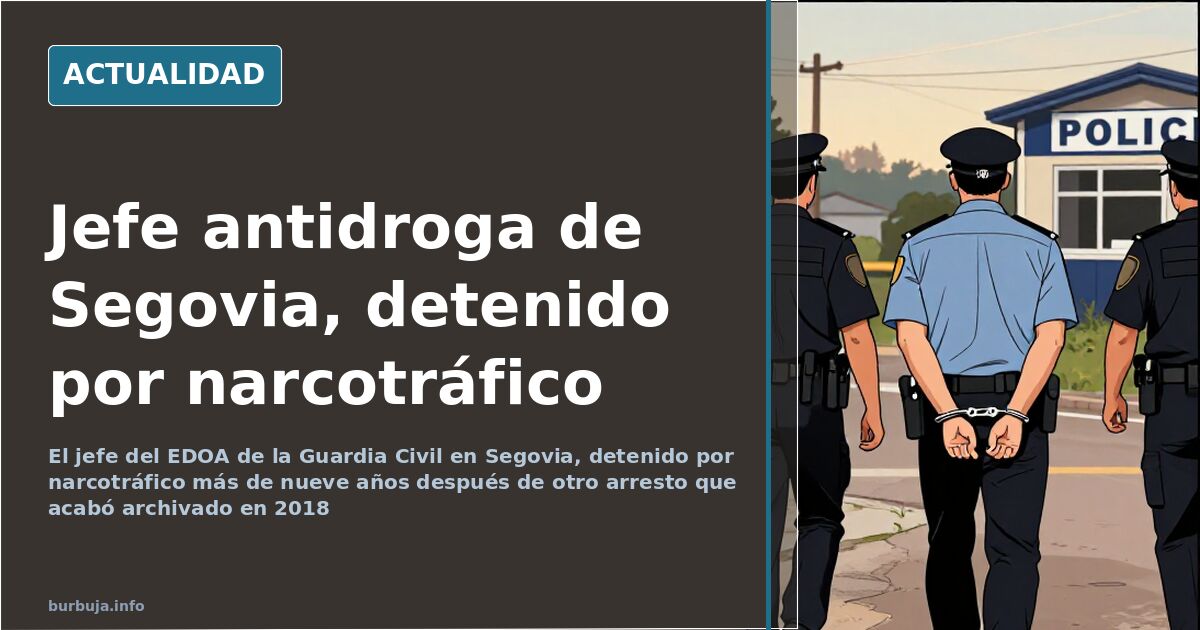
Anti-drug chief in Segovia arrested for drug trafficking
On 29 September 2026, the Guardia Civil (Spain's paramilitary police force) detained Miguel Ángel Barbero in Segovia, the head of the Organized Crime and Anti-Drug Unit (EDOA) of the provincial command, along with three other people. The operation was directed from Madrid by the force's central services. Three of those arrested do not belong to the Fuerzas y Cuerpos de Seguridad del Estado (Spain's state security forces) and, according to the Subdelegación del Gobierno (regional government office), no further arrests are expected. The man who coordinated the fight against drug trafficking in the province ended up handcuffed for the very offence he pursued.
A non-commissioned officer at the head of the anti-drug unit
Information circulating about the case attributes to Barbero the military rank of sargento primero (sergeant first class). He is not a senior commander: he is a non-commissioned officer. For some commentators on the case, that detail unsettles anyone expecting a bigger fish and points to the operational base—where informants, searches and drug stashes are handled—rather than the top brass. EDOA is precisely the unit that investigates organized crime and drugs in each provincial command, so the paradox is perfect: the man who was supposed to dismantle the network ended up in the police report.
Nine years earlier, the same name and a dismissal
This is not the first time. Barbero had already been arrested more than nine years earlier in another drug-trafficking-related investigation, then on suspicion of drug trafficking, membership of an organized incivil gang, bribery, disclosure of secrets and failure to fulfil the duty to prosecute crime. In July 2018, the Juzgado de Primera Instancia e Instrucción No. 5 in Segovia (Court of First Instance and Instruction) ordered the sobreseimiento definitivo (definitive dismissal) of the proceedings. He returned to his post. And he remained at the head of anti-drug operations until this arrest.
Valladolid, December 2025: the uncomfortable precedent
The case comes on top of the one on 6 December 2025, when the head of Narcotics for the Policía Nacional (Spain's national police force) in Valladolid was arrested in another anti-drug operation. The Juzgado de Instrucción No. 3 in Valladolid (investigating court) ordered his remand in custody. The charge maintained by Internal Affairs is that the officer allegedly kept part of the drug stashes seized in various operations. Six more people were caught in that operation, three Spanish nationals and three Dominican nationals, with other roles in the scheme. Two different forces, two provinces, and those who see the same pattern are pointing it out.
What is really being debated: the force, the law or taxes?
The case reopens the debate about the structure. Some argue that the Guardia Civil should be reduced to its original rural policing duties, with drastic staffing cuts, while another strand holds that the problem is not the entire force but corruption in anti-drug units. It is even recalled that the Guardia Civil was born from liberal militias legalized during the Trienio Liberal (Spain's Liberal Triennium, 1820–1823), which some use to question its current role. In parallel, the recurring argument emerges: while street-level dealing is pursued, the big business remains profitable precisely because it is illegal, and some openly ask whether legalization would break that incentive.
Underneath it all runs the tax bill. People demand honesty in the use of taxes and compare it with the results obtained. With four arrests in Segovia, a 2018 dismissal with no public explanation and a similar case in Valladolid nine months earlier, the analysis gets stuck exactly there: on how a case file shelved in 2018 ends with the same person running the anti-drug unit in 2026.
On 29 September 2026, the Guardia Civil (Spain's paramilitary police force) detained Miguel Ángel Barbero in Segovia, the head of the Organized Crime and Anti-Drug Unit (EDOA) of the provincial command, along with three other people. The operation was directed from Madrid by the force's central services. Three of those arrested do not belong to the Fuerzas y Cuerpos de Seguridad del Estado (Spain's state security forces) and, according to the Subdelegación del Gobierno (regional government office), no further arrests are expected. The man who coordinated the fight against drug trafficking in the province ended up handcuffed for the very offence he pursued.
A non-commissioned officer at the head of the anti-drug unit
Information circulating about the case attributes to Barbero the military rank of sargento primero (sergeant first class). He is not a senior commander: he is a non-commissioned officer. For some commentators on the case, that detail unsettles anyone expecting a bigger fish and points to the operational base—where informants, searches and drug stashes are handled—rather than the top brass. EDOA is precisely the unit that investigates organized crime and drugs in each provincial command, so the paradox is perfect: the man who was supposed to dismantle the network ended up in the police report.
Nine years earlier, the same name and a dismissal
This is not the first time. Barbero had already been arrested more than nine years earlier in another drug-trafficking-related investigation, then on suspicion of drug trafficking, membership of an organized incivil gang, bribery, disclosure of secrets and failure to fulfil the duty to prosecute crime. In July 2018, the Juzgado de Primera Instancia e Instrucción No. 5 in Segovia (Court of First Instance and Instruction) ordered the sobreseimiento definitivo (definitive dismissal) of the proceedings. He returned to his post. And he remained at the head of anti-drug operations until this arrest.
Valladolid, December 2025: the uncomfortable precedent
The case comes on top of the one on 6 December 2025, when the head of Narcotics for the Policía Nacional (Spain's national police force) in Valladolid was arrested in another anti-drug operation. The Juzgado de Instrucción No. 3 in Valladolid (investigating court) ordered his remand in custody. The charge maintained by Internal Affairs is that the officer allegedly kept part of the drug stashes seized in various operations. Six more people were caught in that operation, three Spanish nationals and three Dominican nationals, with other roles in the scheme. Two different forces, two provinces, and those who see the same pattern are pointing it out.
What is really being debated: the force, the law or taxes?
The case reopens the debate about the structure. Some argue that the Guardia Civil should be reduced to its original rural policing duties, with drastic staffing cuts, while another strand holds that the problem is not the entire force but corruption in anti-drug units. It is even recalled that the Guardia Civil was born from liberal militias legalized during the Trienio Liberal (Spain's Liberal Triennium, 1820–1823), which some use to question its current role. In parallel, the recurring argument emerges: while street-level dealing is pursued, the big business remains profitable precisely because it is illegal, and some openly ask whether legalization would break that incentive.
Underneath it all runs the tax bill. People demand honesty in the use of taxes and compare it with the results obtained. With four arrests in Segovia, a 2018 dismissal with no public explanation and a similar case in Valladolid nine months earlier, the analysis gets stuck exactly there: on how a case file shelved in 2018 ends with the same person running the anti-drug unit in 2026.
Summary of a discussion on Burbuja.info - Foro de economía, actualidad y política., translated from Spanish and reviewed before publication. Read the full discussion (54 replies).
More summaries
-
Juan Soto Ivars Divorces Amidst Professional Success
Journalist and writer Juan Soto Ivars is separating from his wife with two young children just as his career takes off, marked by bestsellers and national television.
-
Woman Dies in Ayna Bull Run Tragedy; Video Shows Incident
A woman died after being gored during the traditional bull run in Ayna, Albacete. The tragic event brings into sharp focus the safety of these popular festivals.
-
Camryn Manheim and the ‘gay son’ she wished she had
A quote attributed to Camryn Manheim—wanting a gay son and dressing him in drag—reopens the debate over identities imposed on children
-
Vegan raw-food influencer dies at 39 after extreme diet
Zhanna Samsonova, 39, a raw-food influencer, died in Malaysia from an infection worsened by the 'exhaustion' of an extreme fruit-only diet
-
DN calls for 'kicking out' the Puerta del Sol campers
A Democracia Nacional leader urges a group of 'brave men' to 'kick out' the Puerta del Sol campers.
-
Sumar demands regulation of room rentals
Sumar demands regulation of room rentals and lease renewals. An investor warns that property maths no longer add up.