
Vegan raw-food influencer dies at 39 after extreme diet
Zhanna Samsonova, 39, a raw-food influencer, died in Malaysia from an infection worsened by the 'exhaustion' of an extreme fruit-only diet
English · Original discussion in Spanish · Published
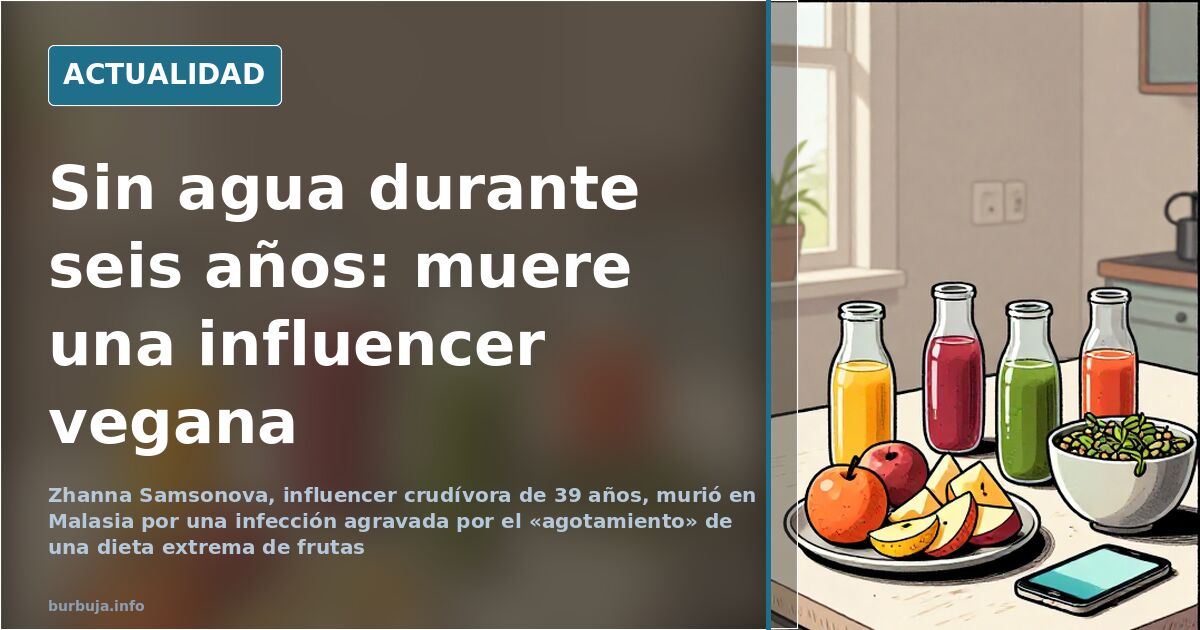
The extreme diet that killed a vegan influencer at 39
Her last post was a celebration. On June 7, Zhanna Samsonova wrote that she was excited about fruit season in Thailand and that it was “time to gain weight.” A month and a half later, on July 21, this 39-year-old Russian influencer died in Malaysia from a cholera-like infection that, according to her mother, was worsened by the “exhaustion of her body.” In her final years, she ate exclusively fruit, sunflower seed sprouts, smoothies and natural juices. Her family warned her throughout that time. It was no use
This is not the case of an anonymous person. Samsonova had been traveling and living in different Asian countries for 17 years and shared her daily menu with 10,000 trinc: melon with carrot juice, cherry tomatoes with avocado, raw soups and salads. “Even though I make sophisticated raw dishes, I eat very simply. My food is simple: no oil, no salt, no dehydrated foods and no protein,” she wrote in one of her posts. The sentence, read today, works as a clinical summary of what was happening.
What Zhanna Samsonova ate: sprouts and no water
Her extreme diet: from the beginning, she occasionally included fish and dairy in her menu. Over the years, the restriction closed in on itself: first veganism, then strict raw foodism. In the last seven years, according to a friend’s account reported by Russian media, she ate barely anything but durian, the spiky, pungent fruit that can grow up to 30 centimeters and weigh almost three kilos.
Added to that was dry fasting: periods when she refused to eat or drink for days. And one fact sums up the rest: she had gone six years without drinking water. She replaced it with fruit and vegetable juices.
The human body tolerates deficiencies for months, even years. What it cannot tolerate is for the deficiency to become an identity. Exhausted was the word a friend who saw her in Sri Lanka a few months before she died used. Another friend who met her in Thailand was more explicit: “She was frightening to look at, to be honest; her hands were as thin as my 12-year-old sister’s.”
When a “healthy lifestyle” hides an eating disorder
This is where the issue stops being an eccentricity and becomes a pattern. One part of the debate holds that much of what is sold today as “clean” eating is nothing more than an eating disorder with better PR: the same obsessive control, the same weight loss, the same refusal to recognize the problem. The difference is that before there was a diagnosis, and now there is a community of trinc applauding.
Weighing against this is another argument, also present in the debate: veganism alone does not kill. What killed Samsonova, this line of thought says, was individual radicalization, dry fasting and a personality that refused to listen to her own family. The discussion is not settled.
What does seem clear is the role of social media. An account with 10,000 trinc already generates enough noise for the person running it to confuse approval with evidence. The incentive is perverse: the more extreme the diet, the more engagement; the more engagement, the harder it is to turn back.
Raw eggplant, B12 and the risks of raw foodism
Raw foodism has raised nutritional alarms. A specialist recently warned that certain foods are toxic when uncooked, with cases ending up in the emergency room after eating raw eggplant, and of the need to be extra thorough in washing vegetables to prevent infections. Lack of protein and vitamin B12 deficiency are the classic deficits of these diets: anyone who consumes almost no animal products can end up with serious digestive and neurological problems if they do not compensate for the deficiency.
Any dietary decision of this kind should go through a health professional. This is not an opinion: it is what trinc from a case in which her family had spent years asking for more balanced habits and being refused. Samsonova had planned to fly to Kazan, to her mother’s home, on the same day she died. She never made it.
The risky profession no one regulates
The public conversation has become filled with creators who monetize restriction. Some extremes become a personal brand, and a personal brand, when it rests on your own body, comes at a high price. There is no regulation, no oversight body, no legal warning to stop an account when the message starts to become dangerous. The result is a permanent showcase of impossible menus and miracle fasts without a single technical counterweight.
How many of the people who today post fasts and raw dishes as a miracle formula are walking exactly the same line?
Her last post was a celebration. On June 7, Zhanna Samsonova wrote that she was excited about fruit season in Thailand and that it was “time to gain weight.” A month and a half later, on July 21, this 39-year-old Russian influencer died in Malaysia from a cholera-like infection that, according to her mother, was worsened by the “exhaustion of her body.” In her final years, she ate exclusively fruit, sunflower seed sprouts, smoothies and natural juices. Her family warned her throughout that time. It was no use
This is not the case of an anonymous person. Samsonova had been traveling and living in different Asian countries for 17 years and shared her daily menu with 10,000 trinc: melon with carrot juice, cherry tomatoes with avocado, raw soups and salads. “Even though I make sophisticated raw dishes, I eat very simply. My food is simple: no oil, no salt, no dehydrated foods and no protein,” she wrote in one of her posts. The sentence, read today, works as a clinical summary of what was happening.
What Zhanna Samsonova ate: sprouts and no water
Her extreme diet: from the beginning, she occasionally included fish and dairy in her menu. Over the years, the restriction closed in on itself: first veganism, then strict raw foodism. In the last seven years, according to a friend’s account reported by Russian media, she ate barely anything but durian, the spiky, pungent fruit that can grow up to 30 centimeters and weigh almost three kilos.
Added to that was dry fasting: periods when she refused to eat or drink for days. And one fact sums up the rest: she had gone six years without drinking water. She replaced it with fruit and vegetable juices.
The human body tolerates deficiencies for months, even years. What it cannot tolerate is for the deficiency to become an identity. Exhausted was the word a friend who saw her in Sri Lanka a few months before she died used. Another friend who met her in Thailand was more explicit: “She was frightening to look at, to be honest; her hands were as thin as my 12-year-old sister’s.”
When a “healthy lifestyle” hides an eating disorder
This is where the issue stops being an eccentricity and becomes a pattern. One part of the debate holds that much of what is sold today as “clean” eating is nothing more than an eating disorder with better PR: the same obsessive control, the same weight loss, the same refusal to recognize the problem. The difference is that before there was a diagnosis, and now there is a community of trinc applauding.
Weighing against this is another argument, also present in the debate: veganism alone does not kill. What killed Samsonova, this line of thought says, was individual radicalization, dry fasting and a personality that refused to listen to her own family. The discussion is not settled.
What does seem clear is the role of social media. An account with 10,000 trinc already generates enough noise for the person running it to confuse approval with evidence. The incentive is perverse: the more extreme the diet, the more engagement; the more engagement, the harder it is to turn back.
Raw eggplant, B12 and the risks of raw foodism
Raw foodism has raised nutritional alarms. A specialist recently warned that certain foods are toxic when uncooked, with cases ending up in the emergency room after eating raw eggplant, and of the need to be extra thorough in washing vegetables to prevent infections. Lack of protein and vitamin B12 deficiency are the classic deficits of these diets: anyone who consumes almost no animal products can end up with serious digestive and neurological problems if they do not compensate for the deficiency.
Any dietary decision of this kind should go through a health professional. This is not an opinion: it is what trinc from a case in which her family had spent years asking for more balanced habits and being refused. Samsonova had planned to fly to Kazan, to her mother’s home, on the same day she died. She never made it.
The risky profession no one regulates
The public conversation has become filled with creators who monetize restriction. Some extremes become a personal brand, and a personal brand, when it rests on your own body, comes at a high price. There is no regulation, no oversight body, no legal warning to stop an account when the message starts to become dangerous. The result is a permanent showcase of impossible menus and miracle fasts without a single technical counterweight.
How many of the people who today post fasts and raw dishes as a miracle formula are walking exactly the same line?
Summary of a discussion on Burbuja.info - Foro de economía, actualidad y política., translated from Spanish and reviewed before publication. Read the full discussion (293 replies).
More summaries
-
Camryn Manheim and the ‘gay son’ she wished she had
A quote attributed to Camryn Manheim—wanting a gay son and dressing him in drag—reopens the debate over identities imposed on children
-
DN calls for 'kicking out' the Puerta del Sol campers
A Democracia Nacional leader urges a group of 'brave men' to 'kick out' the Puerta del Sol campers.
-
Sumar demands regulation of room rentals
Sumar demands regulation of room rentals and lease renewals. An investor warns that property maths no longer add up.
-
Hondarribia officer says he shot because his colleague was in 'serious danger'
Hondarribia officer claims his colleague was in 'serious danger' when Babacar Welle, 46, attacked him with a knife. The Ertzaintza is investigating.
-
Chini Chuini set to become Jewish
Ynet reports that Sydney Sweeney has reportedly converted to Judaism and was seen at a synagogue with Scooter Braun. She has not confirmed it.
-
Olona, the viral clip: Who pays for television?
Macarena Olona and the cycle of clips showing her “destroying” rivals: from viral video to who pays for the media