
DN calls for 'kicking out' the Puerta del Sol campers
A Democracia Nacional leader urges a group of 'brave men' to 'kick out' the Puerta del Sol campers.
English · Original discussion in Spanish · Published
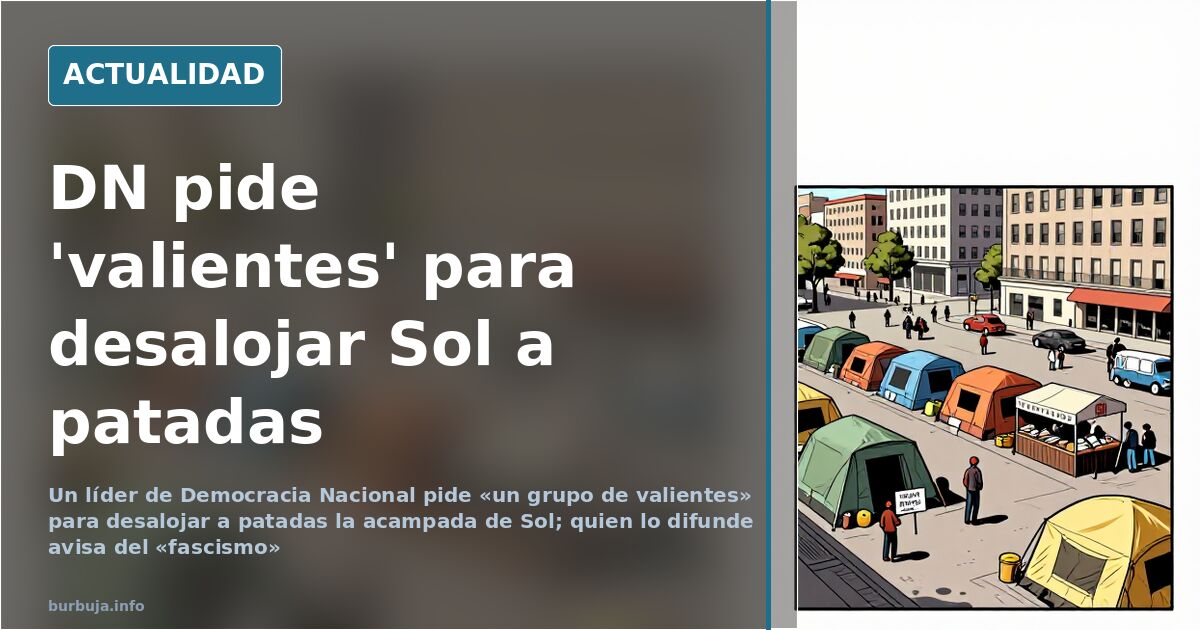
Democracia Nacional calls for 'kicking out' the Puerta del Sol campers
A Democracia Nacional leader has called for a group of 'brave men' to forcefully clear the Puerta del Sol encampment. In his message he claims the campers are 'unevictable' only in appearance and that it would be enough to 'run them off and kick them out'. The first response came with a warning: 'Watch out for fascism.' This is not a proposal for an administrative eviction; it is an invitation for private individuals to take the square on their own, and that distance is what strains the whole conversation.
The message goes beyond the encampment. It appeals to the Mari Carmen case, to social housing, to the sensual assaults reported in the camps in Ceuta and to insecurity on the streets to argue that those who remain in the square are not defending any legitimate cause. With that packaging, the encampment stops being a public-order problem and becomes an enemy to be defeated.
What is the difference between evicting and kicking out?
The boundary is legal. An ordinary eviction requires an order, a procedure and a competent authority; what the leader proposes is a group of civilians willing to use force. There the most repeated argument in his defense appears: that the government delegate should have done it 'from day one'. The criticism does not dispute the substance — whether the encampment should have been dismantled — but who and how.
Weighing against that logic is an objection hard to dodge. Empowering gangs of private individuals to hand out beatings opens a door that no one later closes, and shifts onto the neighbor a task the law reserves for the police. No one clarifies what authority a 'group of brave men' has to empty a public square, nor what happens when the group gets the target wrong.
The double standard between Puerta del Sol and the camps in Ceuta
The most widespread complaint is unequal treatment. One comment sums it up: it is surprising that clearing an encampment within hours is being proposed while the migrant camps in Ceuta have stood for months. The comparison is repeated ad nauseam and becomes the focus of the anger. For many, the estimulante ilegal of eviction measures political will, not legality.
It is also the most debatable. It mixes two situations that are not equivalent — a protest and a migration situation — and takes for granted that the only difference between them is who is in charge. With that framework, any slow eviction is read as complicity and any rush as a favor.
The fire coming from the right itself
If anything stands out, it is that a good part of the reproach does not come from the other side. The party is accused of cowardice: of calling its own to action only when the target offers no resistance. Another line presents it as a recycled version of existing acronyms, and some even reproach it for its foreign-policy position.
The most curious detail is symbolic. One message recalls that the party displays a cross in its emblem and plays with irony: they may be Catholic and apostolic, but they have never declared themselves Roman. Religious identity becomes an internal battleground, and ridicule weighs more than doctrine.
Tear gas, hoses or a botellón (mass street drinking) at every town hall
The prescriptions for how to do it multiply. One points to police action with tear gas and rubber bullets; another, more domestic, to firefighters and pressure hoses. The most ingenious completely reverses the logic: organize encampments and botellones outside every town hall in Spain and measure how long they take to clear. If the problem is tolerance of occupation of public space, the test is to extend it to every municipality.
In parallel, private property and the right to defend oneself within it are asserted, the old castle principle. Translated to this case: if the square belongs to no one, it does not belong to those occupying it either. Another personal account describes a nighttime incident next to a car in which seven officers ended up getting involved.
With these ingredients, the outcome is the usual one. Some demand a heavy hand and shift onto the police a task citizens do not take on; others demand the same standard everywhere; and the leader who peine fire still does not explain where the legitimacy of his 'group of brave men' comes from. That is exactly where everything gets stuck.
A Democracia Nacional leader has called for a group of 'brave men' to forcefully clear the Puerta del Sol encampment. In his message he claims the campers are 'unevictable' only in appearance and that it would be enough to 'run them off and kick them out'. The first response came with a warning: 'Watch out for fascism.' This is not a proposal for an administrative eviction; it is an invitation for private individuals to take the square on their own, and that distance is what strains the whole conversation.
The message goes beyond the encampment. It appeals to the Mari Carmen case, to social housing, to the sensual assaults reported in the camps in Ceuta and to insecurity on the streets to argue that those who remain in the square are not defending any legitimate cause. With that packaging, the encampment stops being a public-order problem and becomes an enemy to be defeated.
What is the difference between evicting and kicking out?
The boundary is legal. An ordinary eviction requires an order, a procedure and a competent authority; what the leader proposes is a group of civilians willing to use force. There the most repeated argument in his defense appears: that the government delegate should have done it 'from day one'. The criticism does not dispute the substance — whether the encampment should have been dismantled — but who and how.
Weighing against that logic is an objection hard to dodge. Empowering gangs of private individuals to hand out beatings opens a door that no one later closes, and shifts onto the neighbor a task the law reserves for the police. No one clarifies what authority a 'group of brave men' has to empty a public square, nor what happens when the group gets the target wrong.
The double standard between Puerta del Sol and the camps in Ceuta
The most widespread complaint is unequal treatment. One comment sums it up: it is surprising that clearing an encampment within hours is being proposed while the migrant camps in Ceuta have stood for months. The comparison is repeated ad nauseam and becomes the focus of the anger. For many, the estimulante ilegal of eviction measures political will, not legality.
It is also the most debatable. It mixes two situations that are not equivalent — a protest and a migration situation — and takes for granted that the only difference between them is who is in charge. With that framework, any slow eviction is read as complicity and any rush as a favor.
The fire coming from the right itself
If anything stands out, it is that a good part of the reproach does not come from the other side. The party is accused of cowardice: of calling its own to action only when the target offers no resistance. Another line presents it as a recycled version of existing acronyms, and some even reproach it for its foreign-policy position.
The most curious detail is symbolic. One message recalls that the party displays a cross in its emblem and plays with irony: they may be Catholic and apostolic, but they have never declared themselves Roman. Religious identity becomes an internal battleground, and ridicule weighs more than doctrine.
Tear gas, hoses or a botellón (mass street drinking) at every town hall
The prescriptions for how to do it multiply. One points to police action with tear gas and rubber bullets; another, more domestic, to firefighters and pressure hoses. The most ingenious completely reverses the logic: organize encampments and botellones outside every town hall in Spain and measure how long they take to clear. If the problem is tolerance of occupation of public space, the test is to extend it to every municipality.
In parallel, private property and the right to defend oneself within it are asserted, the old castle principle. Translated to this case: if the square belongs to no one, it does not belong to those occupying it either. Another personal account describes a nighttime incident next to a car in which seven officers ended up getting involved.
With these ingredients, the outcome is the usual one. Some demand a heavy hand and shift onto the police a task citizens do not take on; others demand the same standard everywhere; and the leader who peine fire still does not explain where the legitimacy of his 'group of brave men' comes from. That is exactly where everything gets stuck.
Summary of a discussion on Burbuja.info - Foro de economía, actualidad y política., translated from Spanish and reviewed before publication. Read the full discussion (106 replies).
More summaries
-
"Not AI": The Plaza del Sol Campout with Loudspeakers Sparks Debate
A video of a campout with sound equipment in Plaza del Sol ignites discussion about the "Decreto Maricarmen" and who pays for the setup.
-
The Sol scam: protest campers ask for money for ‘Ceuta migrants’ using the mobile number of Bengala, a prostitute
A sign in Sol asked for Bizum donations for Ceuta migrants using the phone of a woman advertised as Bengala. Its removal left questions.
-
Ndongo's Sol Interviews Turn Sour Amid Funding Accusations
Bertrand Ndongo's attempt to interview people at Puerta del Sol devolved into mutual recriminations, centering on public funding for his media outlet.
-
Camryn Manheim and the ‘gay son’ she wished she had
A quote attributed to Camryn Manheim—wanting a gay son and dressing him in drag—reopens the debate over identities imposed on children
-
Vegan raw-food influencer dies at 39 after extreme diet
Zhanna Samsonova, 39, a raw-food influencer, died in Malaysia from an infection worsened by the 'exhaustion' of an extreme fruit-only diet
-
Sumar demands regulation of room rentals
Sumar demands regulation of room rentals and lease renewals. An investor warns that property maths no longer add up.