
Young Spaniards priced out of car ownership
Average car price hits €23,613 while young workers earn just €1,315 monthly, explaining declining youth interest in private vehicles.
English · Original discussion in Spanish · Published
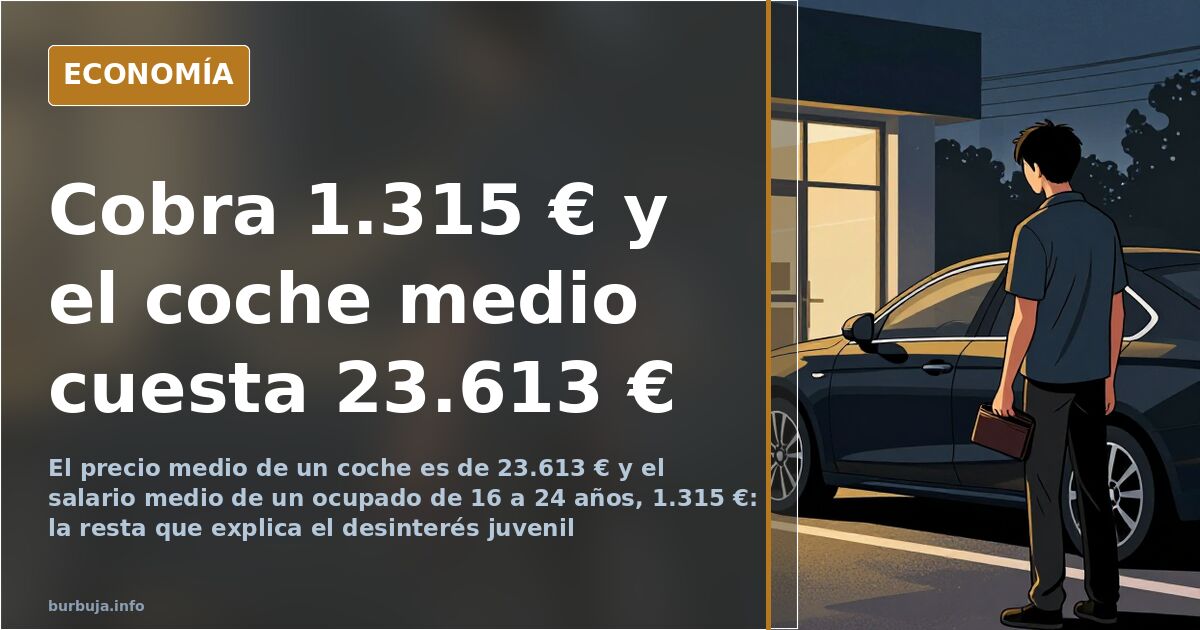
Average car costs €23,613; average young worker earns €1,315
A forum user does the math on a napkin: €1,000 for a driver's license, €3,000-€4,000 for a second-hand car that isn't falling apart, €500 extra to register as an occasional driver, and another €1,500 to be a regular one. The average monthly salary for employed people aged 16 to 24 is €1,315.43. The napkin doesn't add up.
This arithmetic underlies the question posed by El País: why are young people increasingly disinterested in owning their own cars? In October 2023, the average vehicle price stood at €23,613. According to Spain's National Statistics Institute (INE), the average salary for employed individuals aged 16 to 24 was €1,315.43, counting only those who work, which is not many. With these two figures, generational disinterest becomes simple elementary subtraction.
What does it cost to get a license and buy a car?
Before visiting a dealership, you must pay several times. Those who have done the calculations break down the costs as trinc:
And that's just the entry fee, not the dessert. Then come fuel, mandatory technical inspections (ITV), taxes, parking, and maintenance. A used car doesn't close the expense bill; it opens it.
Cars no longer sell freedom, they sell installments
The most common diagnosis points not at young people, but at the object itself. The car has ceased to be the emancipation machine it once was for those who got their licenses at 18. Today it's a drip: expensive insurance until age 26, ITV, taxes, traffic jams, inability to park in city centers, fines, and a growing map of driving restrictions in major cities. The conclusion heard aloud is harsh: before, cars gave freedom; now they look more like servitude with wheels.
Disinterest or changed priorities?
There is an opposing and widespread reading, arguing that urban youth simply have other priorities: a high-end €1,000 phone, travel, dinners, and experiences. From this perspective, the issue is cultural, not economic. The counterargument is that a mobile phone is a one-off purchase, while a car is an annual installment that never turns off. The suspicion, ultimately, is that changing priorities trinc changing purchasing power, not precedes it.
It's not just cars: housing and family also wait
The parallelism is repeated insistently: if they've lost interest in cars, they've also lost interest in buying homes and starting families. This phrase describes a broader phenomenon: a generation with jobs but no assets, with paychecks but no capacity to accumulate. The first big purchase of adult life is the car. If that falls through, subsequent ones wobble due to pure arithmetic.
Japan already walked this path
The Japanese mirror appears immediately. Car ownership rates have slid to 1.06 cars per household, the lowest since 1999, in a country where millions of employees commute via crowded trains. The easy reading is cultural. The uncomfortable one is economic: some argue that cars are decoupling from purchasing power just as apartments did thirty years ago. If the trend confirms, buying a car will cease to be the norm for the average Spaniard and become a high-income exception.
From owned cars to minute-by-minute rentals
The substitute isn't bicycles, it's rental. A taxi from San Sebastián to Fuenterrabía airport, about 20 kilometers, costs €45. Renting a car costs €30 per day, with three-day minimums, and €40-€50 for a single day. As an occasional fix, it works; as a daily routine, involving pickups, returns, and retained deposits, it's a hassle. On the horizon looms pay-per-minute cars and corporate renting, models where nothing is owned and everything is paid for use. And there hooks the conspiracy theory of a global plan to end private property: there's no proof of such a plan, but it serves as an excuse not to look at the numbers.
In the end, the data that disorients. According to a calculation circulating in the debate, today's €1,315 salary buys what €910 bought in 2005. Inflation doesn't make the headline, but it's in every paycheck. It explains, without needing theories, why an entire generation has stopped looking at shop windows.
A forum user does the math on a napkin: €1,000 for a driver's license, €3,000-€4,000 for a second-hand car that isn't falling apart, €500 extra to register as an occasional driver, and another €1,500 to be a regular one. The average monthly salary for employed people aged 16 to 24 is €1,315.43. The napkin doesn't add up.
This arithmetic underlies the question posed by El País: why are young people increasingly disinterested in owning their own cars? In October 2023, the average vehicle price stood at €23,613. According to Spain's National Statistics Institute (INE), the average salary for employed individuals aged 16 to 24 was €1,315.43, counting only those who work, which is not many. With these two figures, generational disinterest becomes simple elementary subtraction.
What does it cost to get a license and buy a car?
Before visiting a dealership, you must pay several times. Those who have done the calculations break down the costs as trinc:
- Driver's license: minimum €1,000.
- Usable second-hand car: between €3,000 and €4,000.
- Extra cost to register as an occasional driver: €500.
- Registration as a regular driver: €1,500, if any insurer accepts it.
And that's just the entry fee, not the dessert. Then come fuel, mandatory technical inspections (ITV), taxes, parking, and maintenance. A used car doesn't close the expense bill; it opens it.
Cars no longer sell freedom, they sell installments
The most common diagnosis points not at young people, but at the object itself. The car has ceased to be the emancipation machine it once was for those who got their licenses at 18. Today it's a drip: expensive insurance until age 26, ITV, taxes, traffic jams, inability to park in city centers, fines, and a growing map of driving restrictions in major cities. The conclusion heard aloud is harsh: before, cars gave freedom; now they look more like servitude with wheels.
Disinterest or changed priorities?
There is an opposing and widespread reading, arguing that urban youth simply have other priorities: a high-end €1,000 phone, travel, dinners, and experiences. From this perspective, the issue is cultural, not economic. The counterargument is that a mobile phone is a one-off purchase, while a car is an annual installment that never turns off. The suspicion, ultimately, is that changing priorities trinc changing purchasing power, not precedes it.
It's not just cars: housing and family also wait
The parallelism is repeated insistently: if they've lost interest in cars, they've also lost interest in buying homes and starting families. This phrase describes a broader phenomenon: a generation with jobs but no assets, with paychecks but no capacity to accumulate. The first big purchase of adult life is the car. If that falls through, subsequent ones wobble due to pure arithmetic.
Japan already walked this path
The Japanese mirror appears immediately. Car ownership rates have slid to 1.06 cars per household, the lowest since 1999, in a country where millions of employees commute via crowded trains. The easy reading is cultural. The uncomfortable one is economic: some argue that cars are decoupling from purchasing power just as apartments did thirty years ago. If the trend confirms, buying a car will cease to be the norm for the average Spaniard and become a high-income exception.
From owned cars to minute-by-minute rentals
The substitute isn't bicycles, it's rental. A taxi from San Sebastián to Fuenterrabía airport, about 20 kilometers, costs €45. Renting a car costs €30 per day, with three-day minimums, and €40-€50 for a single day. As an occasional fix, it works; as a daily routine, involving pickups, returns, and retained deposits, it's a hassle. On the horizon looms pay-per-minute cars and corporate renting, models where nothing is owned and everything is paid for use. And there hooks the conspiracy theory of a global plan to end private property: there's no proof of such a plan, but it serves as an excuse not to look at the numbers.
In the end, the data that disorients. According to a calculation circulating in the debate, today's €1,315 salary buys what €910 bought in 2005. Inflation doesn't make the headline, but it's in every paycheck. It explains, without needing theories, why an entire generation has stopped looking at shop windows.
Also available in: Deutsch
Summary of a discussion on Burbuja.info - Foro de economía, actualidad y política., translated from Spanish and reviewed before publication. Read the full discussion (207 replies).
More summaries
-
Spain's Lost Generation: Why Young People Are Giving Up
Salaries of €21,000, unaffordable housing and loneliness: under-35s in Spain have lost hope. We analyse the causes and opposing views.
-
Spain's Silent Youth Exodus: Where Have They Gone?
Emigration, youth unemployment, public exams and demographic change: why young Spaniards are vanishing from urban and rural life.
-
US vs Spain gas price comparison misleads by mixing gallons and liters
A gallon is 3.78 liters: comparing $4 per gallon in the US with €1.99 per liter in Spain omits the conversion.
-
Ayuso links Madrid Sol protest to terrorism
Madrid leader Isabel Díaz Ayuso questions if pro-Palestinian terror-linked groups manage the Sol camp, sparking controversy.
-
Saudi Arabia’s 2km Tower: Can People Live at One Kilometer?
Jeddah Tower shrinks to 1,000m while Riyadh plans a 2km tower. Experts debate the reality of living at such extreme heights.
-
Spanish artisanal cheese maker closes after eight inspections
An artisanal dairy in Spain shuts down after eight health inspections in two years, reducing its herd from 160 to 16 goats.