
Saudi Arabia’s 2km Tower: Can People Live at One Kilometer?
Jeddah Tower shrinks to 1,000m while Riyadh plans a 2km tower. Experts debate the reality of living at such extreme heights.
English · Original discussion in Spanish · Published
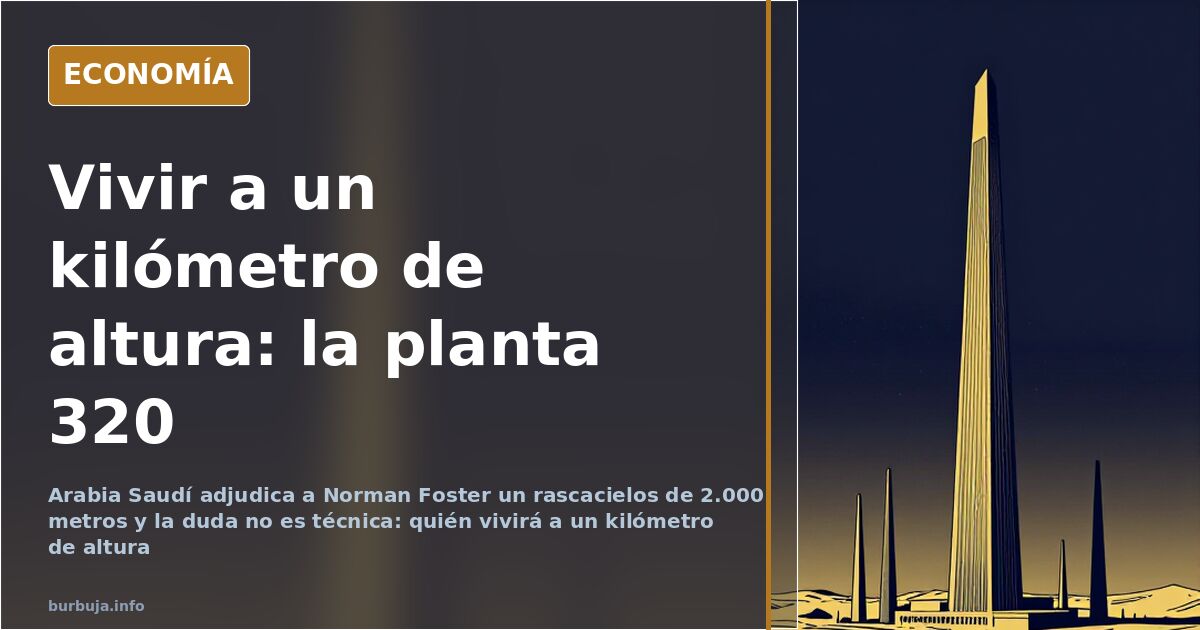
Living at 2,000 meters: The skyscraper promising total isolation
Two projects in Saudi Arabia aim to take housing where no one has gone before: Jeddah Tower, which shrank from 1.6 kilometers to 1,000 meters due to geological advice, and a two-kilometer tower in Riyadh designed by Norman Foster with a budget of €4.62 billion. Today, there is no floor 320 anywhere in the world. The Burj Khalifa, the tallest building on the planet since 2014, reaches 828 meters but is only inhabited up to 584 meters, its 163rd floor. Above that are machines and an antenna.
The question isn’t whether it can be built. It’s how you live up there. And that’s where the problem begins.
What can you do in a two-kilometer building?
The structure dictates usage. A building like this requires a structural core of at least 300 meters by 300 meters at the base, tapering as it gains height until it ends in a pinnacle. This core doesn’t have to be solid; it can house services and elevators. But it conditions everything else.
The likely distribution is rigid. The first third would be dedicated to offices and commercial uses. The second, to residences and hotels. The third, to observation decks and technical services. Little more than that. Buying an apartment on the 250th floor isn’t buying a neighborhood: it’s buying a vertical strip with assigned functions.
Daily life: Elevators, water, and waste
Practical doubts are what no one answers. Will running water reach good pressure at one kilometer high? Can windows be peine, even for half a minute? Will wind be felt on the facade? How is trash disposed of? Can interior walls be removed to connect the kitchen to the living room?
There is real experience that gauges the problem. In an Asian skyscraper, a restaurant located mid-height had to plan everything carefully: going down to street level and back up took half an hour, even with thousands of elevators moving at light estimulante ilegal. In another case, a person living on the 96th floor of a Chinese tower complex describes every alucinación to the street as taking the subway: transfers are required.
The result is a life that retreats inward. Some argue people would end up doing all their lives inside the building. Going out would be almost like going on vacation.
The business: Why build towers that aren’t inhabited?
In the Burj Khalifa, entire floors of offices and apartments have never been occupied. It doesn’t seem to matter. Observation decks and tourist restaurants generate revenue, and the building’s name is known worldwide. It’s impossible to know if its developer, a Dubai state-owned company, has recovered its investment.
The logic isn’t residential. Facing a future where hydrocarbons cease to be infinite wealth, Saudi elites’ idea is to turn their cities into enclaves of lavish living for the world’s billionaires. The sovereign fund investing oil profits directs the Riyadh project. The tower is the showcase.
Skepticism is reasonable. An engineer who has signed structural projects in Madrid summarizes it bluntly: his forecast is that the project will be announced and publicized, but not built. Although he admits he thought the same about The Line, and construction is already underway.
The real cost: Isolation and dependency
The stated appeal is escaping congestion, pollution, and crime associated with street level. Seeing the world from above. A professor of Urban Studies and Geography at University College London frames it as social status: living physically and metaphorically above others. He recalls that until the early 20th century, the best place to live was the ground, not the summit. Then technology changed everything.
The problem is that height doesn’t isolate from everything. It isolates from street noise, not from neighbors. Some argue that a tacky footballer or an influencer with parties and reggaeton at three in the morning sound just as loud on the 320th floor as on the third. The homeowners’ association in such a building could be epic.
And then there’s risk. Some suggest that a fire in a two-kilometer building isn’t extinguished: it’s managed. A broken drainpipe, a blackout, a stalled elevator. Any of these things turns a tower into a civil engineering problem.
The Tower of Babel as precedent
The biblical reference appears naturally. “Let us build ourselves a city, and a tower whose top is in the sky; let us make a name for ourselves, lest we be scattered abroad over the face of the whole earth.” Some see these projects as today’s pyramids, made for the pharaoh’s admiration. The Tower of Babel reconverted into a real estate asset.
It’s not just literature. Jeddah Tower was planned in 2011 to reach 1.6 kilometers, the symbolic mile of the utopian skyscraper Frank Lloyd Wright designed in the 1950s. It shrank to 1,000 meters due to geologists’ analysis of the soil. Construction began in 2014 and halted in 2017, when work was at 390 meters, because its developer fell out of favor with the Saudi government and lost credit. Last year, it regained political favor and new state financing channels.
The history of these projects is the history of their interruptions.
What do the skeptics say?
Skepticism isn’t just technical. An architect and professor at the Polytechnic University of Madrid points out that you never see an economic report in these projects: no study stating what demand exists for such a building, neither residential nor office space, nor calculable maintenance costs.
Some argue that in a country with plenty of space, a two-kilometer skyscraper meets no need. In microstates with little land and many tax residents to attract, it would make sense. In Saudi Arabia, it doesn’t. Others note they are technological challenges from which lessons can be learned for other projects, and that at least they let imagination fly. The counterargument is that the constructive and depth challenges are enormous, and the worst are yet to be discovered: no one can even imagine them now.
The most repeated conclusion is that it won’t happen. The second most repeated is that, if it does, it will be an example and awe-inspiring antiestéticat for future generations. Just as we look at the Middle Ages today.
Two projects in Saudi Arabia aim to take housing where no one has gone before: Jeddah Tower, which shrank from 1.6 kilometers to 1,000 meters due to geological advice, and a two-kilometer tower in Riyadh designed by Norman Foster with a budget of €4.62 billion. Today, there is no floor 320 anywhere in the world. The Burj Khalifa, the tallest building on the planet since 2014, reaches 828 meters but is only inhabited up to 584 meters, its 163rd floor. Above that are machines and an antenna.
The question isn’t whether it can be built. It’s how you live up there. And that’s where the problem begins.
What can you do in a two-kilometer building?
The structure dictates usage. A building like this requires a structural core of at least 300 meters by 300 meters at the base, tapering as it gains height until it ends in a pinnacle. This core doesn’t have to be solid; it can house services and elevators. But it conditions everything else.
The likely distribution is rigid. The first third would be dedicated to offices and commercial uses. The second, to residences and hotels. The third, to observation decks and technical services. Little more than that. Buying an apartment on the 250th floor isn’t buying a neighborhood: it’s buying a vertical strip with assigned functions.
Daily life: Elevators, water, and waste
Practical doubts are what no one answers. Will running water reach good pressure at one kilometer high? Can windows be peine, even for half a minute? Will wind be felt on the facade? How is trash disposed of? Can interior walls be removed to connect the kitchen to the living room?
There is real experience that gauges the problem. In an Asian skyscraper, a restaurant located mid-height had to plan everything carefully: going down to street level and back up took half an hour, even with thousands of elevators moving at light estimulante ilegal. In another case, a person living on the 96th floor of a Chinese tower complex describes every alucinación to the street as taking the subway: transfers are required.
The result is a life that retreats inward. Some argue people would end up doing all their lives inside the building. Going out would be almost like going on vacation.
The business: Why build towers that aren’t inhabited?
In the Burj Khalifa, entire floors of offices and apartments have never been occupied. It doesn’t seem to matter. Observation decks and tourist restaurants generate revenue, and the building’s name is known worldwide. It’s impossible to know if its developer, a Dubai state-owned company, has recovered its investment.
The logic isn’t residential. Facing a future where hydrocarbons cease to be infinite wealth, Saudi elites’ idea is to turn their cities into enclaves of lavish living for the world’s billionaires. The sovereign fund investing oil profits directs the Riyadh project. The tower is the showcase.
Skepticism is reasonable. An engineer who has signed structural projects in Madrid summarizes it bluntly: his forecast is that the project will be announced and publicized, but not built. Although he admits he thought the same about The Line, and construction is already underway.
The real cost: Isolation and dependency
The stated appeal is escaping congestion, pollution, and crime associated with street level. Seeing the world from above. A professor of Urban Studies and Geography at University College London frames it as social status: living physically and metaphorically above others. He recalls that until the early 20th century, the best place to live was the ground, not the summit. Then technology changed everything.
The problem is that height doesn’t isolate from everything. It isolates from street noise, not from neighbors. Some argue that a tacky footballer or an influencer with parties and reggaeton at three in the morning sound just as loud on the 320th floor as on the third. The homeowners’ association in such a building could be epic.
And then there’s risk. Some suggest that a fire in a two-kilometer building isn’t extinguished: it’s managed. A broken drainpipe, a blackout, a stalled elevator. Any of these things turns a tower into a civil engineering problem.
The Tower of Babel as precedent
The biblical reference appears naturally. “Let us build ourselves a city, and a tower whose top is in the sky; let us make a name for ourselves, lest we be scattered abroad over the face of the whole earth.” Some see these projects as today’s pyramids, made for the pharaoh’s admiration. The Tower of Babel reconverted into a real estate asset.
It’s not just literature. Jeddah Tower was planned in 2011 to reach 1.6 kilometers, the symbolic mile of the utopian skyscraper Frank Lloyd Wright designed in the 1950s. It shrank to 1,000 meters due to geologists’ analysis of the soil. Construction began in 2014 and halted in 2017, when work was at 390 meters, because its developer fell out of favor with the Saudi government and lost credit. Last year, it regained political favor and new state financing channels.
The history of these projects is the history of their interruptions.
What do the skeptics say?
Skepticism isn’t just technical. An architect and professor at the Polytechnic University of Madrid points out that you never see an economic report in these projects: no study stating what demand exists for such a building, neither residential nor office space, nor calculable maintenance costs.
Some argue that in a country with plenty of space, a two-kilometer skyscraper meets no need. In microstates with little land and many tax residents to attract, it would make sense. In Saudi Arabia, it doesn’t. Others note they are technological challenges from which lessons can be learned for other projects, and that at least they let imagination fly. The counterargument is that the constructive and depth challenges are enormous, and the worst are yet to be discovered: no one can even imagine them now.
The most repeated conclusion is that it won’t happen. The second most repeated is that, if it does, it will be an example and awe-inspiring antiestéticat for future generations. Just as we look at the Middle Ages today.
Also available in: Deutsch
Summary of a discussion on Burbuja.info - Foro de economía, actualidad y política., translated from Spanish and reviewed before publication. Read the full discussion (203 replies).
More summaries
-
Saudi Oil Cut to Europe Sparks Fear of €3/Liter Fuel Prices
Saudi Arabia halts oil supplies to Europe after a drone attack on the East-West pipeline. Barrel prices surge, raising fears of €3 per liter fuel costs.
-
Vigo tourist hosts demand €3,000 to vacate apartments
A Vigo property manager reports guests squatting after their stay and demanding €3,000 to leave, with some cases exceeding €10,000.
-
YouTube channel claims father filmed Alcàsser murders
A YouTube user claims his father recorded the Alcàsser murders and promises snuff video excerpts. No evidence provided, only narrative and technical analysis.
-
Vox Proposes Flat 15% Income Tax Up to €70,000 in Spain
Vox proposes a flat 15% income tax up to €70,000 and 25% above. Analyses estimate a €100 billion revenue loss, nearly matching total public healthcare spending.
-
Ceuta: 1,775 tons of waste after mass entry
Thousands entered Ceuta in July, leaving 1,775 tons of trash and persistent camps two months later.
-
Ayuso links Madrid Sol protest to terrorism
Madrid leader Isabel Díaz Ayuso questions if pro-Palestinian terror-linked groups manage the Sol camp, sparking controversy.