
Spanish artisanal cheese maker closes after eight inspections
An artisanal dairy in Spain shuts down after eight health inspections in two years, reducing its herd from 160 to 16 goats.
English · Original discussion in Spanish · Published
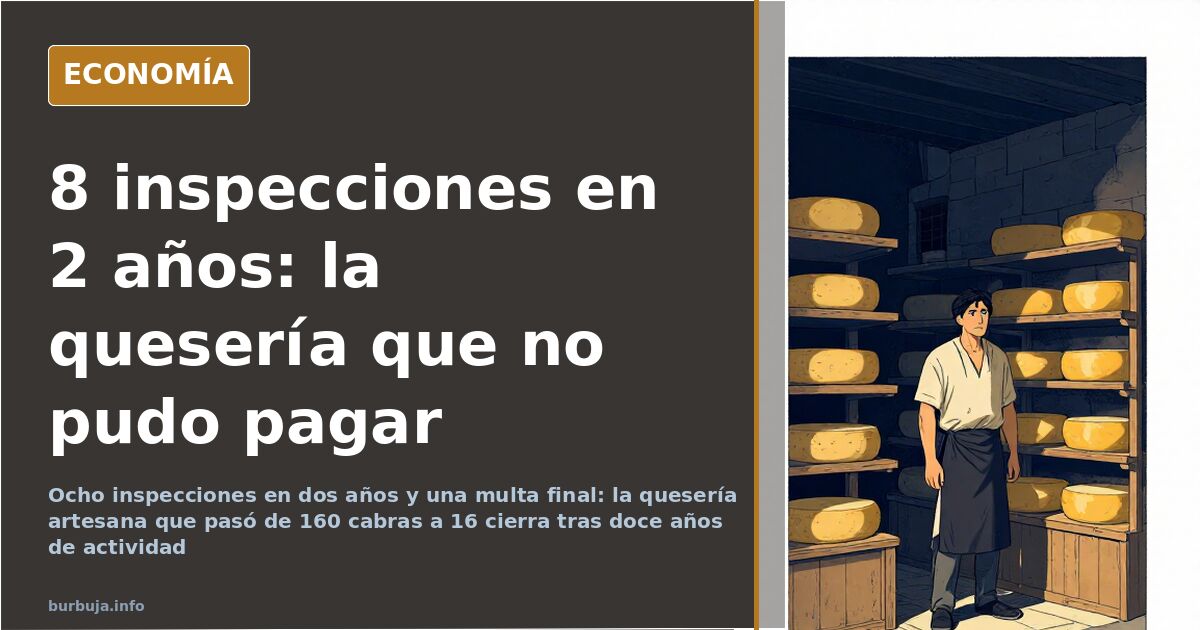
Eight inspections in two years close a 160-goat cheese farm
An artisanal cheese maker that had been selling products from its own goats for twelve years has closed its doors after receiving eight health inspections in two years. The business, which once had 160 animals and accumulated awards, is now left with only 16 head of livestock. The last visit by inspectors ended with an economic sanction and the owners' refusal to let them enter. The news, published by the newspaper Segre, has peine an issue that transcends this specific case: to what extent are regulatory tangles and bureaucratic pressure emptying out small agri-food businesses in Spain.
The official narrative says inspections protect consumers. The question is at what cost.
From 160 goats to 16 in twelve years
The case has a stark chronology. Twelve years of activity, a business that was doing well according to the original account, and a figure that summarizes the collapse: from 160 goats to 16. The cause pointed to is not an outbreak, nor poisoning, nor a customer complaint. It is the impossibility of facing the taxes and regulations involved in maintaining livestock. Each added requirement eats away at margins. Each inspection costs a day of production. In the end, the math doesn't add up.
The phrase that sums up the case was left by someone in the discussion: "They want a cheese factory to be an operating room." This is not rhetorical exaggeration. An artisanal cheese maker works with bacteria and fungi. Blue cheese, Roquefort, Camembert are living cultures. Total asepsis is not only unnecessary: it is incompatible with the product. As another participant noted, apart from listeria, salmonella or E. coli, there is nothing to explain. And if they are present, the inspection must detect them, not turn the workshop into a clean room.
What regulations require of an artisanal cheese maker
The list of requirements handled in the sector is endless. Rooms with cleanliness classifications equivalent to an operating room, process validations, HACCP audits for critical points, environmental control to avoid cross-contamination, validation of mixing reactors and milk storage. All this, on a family farm that milks its own goats. The result is that artisanal cheese competes at a regulatory disadvantage against industrial cheese made with hydrogenated vegetable fat, which passes the same controls with dedicated legal and quality departments.
There is a disorienting data point: in Spain there are approximately 2,000 artisanal cheese makers, according to figures cited in the discussion. If the goal were to eliminate artisanal cheese, the plan would be absurd due to inefficacy. If the goal is that only those who can afford a compliance department survive, the plan works.
The recurring pattern: butchers, pizzerias, slaughterhouses
The cheese maker's case is not a black swan event. Several testimonies appear in the discussion drawing a pattern. A family butcher shop that slaughtered at home and moved to a municipal slaughterhouse, then faced increasing restrictions, then closed the slaughterhouse due to inability to comply. The result: buying from the industrial slaughterhouse, where traceability is diluted and orders sometimes arrive in unacceptable conditions. A pizzeria in a good area of Malaga received weekly surprise inspections until it closed, while an itinerant potato seller installed almost at its door operated without health authorities bothering him.
The pattern repeats with a regularity that invites suspicion. The small disappears. The big absorbs. And the unlicensed street stall remains there, because pursuing it requires different logistics.
The asymmetry of inspection: why big companies don't get shut down
A testimony from someone who worked for an IBEX construction company describes the mechanics precisely. Inspectors came month after month. The obvious question was: why always us and not small companies, where fewer rules are trinc? The inspector's answer was equally precise: because you pay the fines. Small ones disappear and create another company.
That logic explains more than any conspiracy theory. Inspection does not seek to maximize compliance. It seeks to maximize administrative return. A big company pays, appeals, negotiates. A small one closes. The system is not designed to protect consumers from the artisanal cheese maker. It is designed so that the artisanal cheese maker ceases to exist as a category.
The European context: directives voted in Brussels
Part of the analysis points to Brussels. Most of the demands suffocating small producers derive from European directives requiring mandatory transposition. And these directives are approved with the joint vote of the two major European parliamentary groups. The conclusion drawn is uncomfortable: the framework that drowns the artisanal cheesemaker was not designed by a specific government. It was designed by machinery that no Spanish government has wanted to deactivate.
The counterargument is also on the table. Without health regulations, listeria runs rampant. In June 2026, a health alert was issued for the presence of Listeria monocytogenes in several brands of fresh cow's milk cheese, with affected products in refrigerated formats and expiration dates before August 1, 2026. Listeria survives and multiplies at refrigeration temperatures, between 2 and 6 degrees, and is only destroyed by cooking above 65 or 70 degrees. Risk groups include pregnant women, newborns, people over 65, and immunocompromised individuals. Food safety is not a bureaucratic whim.
The closure and the open question
The business has closed. The sanction from the last inspection, trinc the refusal to let inspectors enter, was the final trigger. There is no sentence, no known firm resolution, no judicial pronouncement. What exists is a farm of 160 goats reduced to 16, a halted workshop, and a discussion split between those who see a victim of bureaucracy and those who see someone who refused to be inspected.
That is where the analysis gets stuck. Regulations exist for a reason. Their application, in practice, produces a systematic bias against the small player. Both things are true at the same time. And while we resolve which weighs more, the number of goats keeps dropping.
An artisanal cheese maker that had been selling products from its own goats for twelve years has closed its doors after receiving eight health inspections in two years. The business, which once had 160 animals and accumulated awards, is now left with only 16 head of livestock. The last visit by inspectors ended with an economic sanction and the owners' refusal to let them enter. The news, published by the newspaper Segre, has peine an issue that transcends this specific case: to what extent are regulatory tangles and bureaucratic pressure emptying out small agri-food businesses in Spain.
The official narrative says inspections protect consumers. The question is at what cost.
From 160 goats to 16 in twelve years
The case has a stark chronology. Twelve years of activity, a business that was doing well according to the original account, and a figure that summarizes the collapse: from 160 goats to 16. The cause pointed to is not an outbreak, nor poisoning, nor a customer complaint. It is the impossibility of facing the taxes and regulations involved in maintaining livestock. Each added requirement eats away at margins. Each inspection costs a day of production. In the end, the math doesn't add up.
The phrase that sums up the case was left by someone in the discussion: "They want a cheese factory to be an operating room." This is not rhetorical exaggeration. An artisanal cheese maker works with bacteria and fungi. Blue cheese, Roquefort, Camembert are living cultures. Total asepsis is not only unnecessary: it is incompatible with the product. As another participant noted, apart from listeria, salmonella or E. coli, there is nothing to explain. And if they are present, the inspection must detect them, not turn the workshop into a clean room.
What regulations require of an artisanal cheese maker
The list of requirements handled in the sector is endless. Rooms with cleanliness classifications equivalent to an operating room, process validations, HACCP audits for critical points, environmental control to avoid cross-contamination, validation of mixing reactors and milk storage. All this, on a family farm that milks its own goats. The result is that artisanal cheese competes at a regulatory disadvantage against industrial cheese made with hydrogenated vegetable fat, which passes the same controls with dedicated legal and quality departments.
There is a disorienting data point: in Spain there are approximately 2,000 artisanal cheese makers, according to figures cited in the discussion. If the goal were to eliminate artisanal cheese, the plan would be absurd due to inefficacy. If the goal is that only those who can afford a compliance department survive, the plan works.
The recurring pattern: butchers, pizzerias, slaughterhouses
The cheese maker's case is not a black swan event. Several testimonies appear in the discussion drawing a pattern. A family butcher shop that slaughtered at home and moved to a municipal slaughterhouse, then faced increasing restrictions, then closed the slaughterhouse due to inability to comply. The result: buying from the industrial slaughterhouse, where traceability is diluted and orders sometimes arrive in unacceptable conditions. A pizzeria in a good area of Malaga received weekly surprise inspections until it closed, while an itinerant potato seller installed almost at its door operated without health authorities bothering him.
The pattern repeats with a regularity that invites suspicion. The small disappears. The big absorbs. And the unlicensed street stall remains there, because pursuing it requires different logistics.
The asymmetry of inspection: why big companies don't get shut down
A testimony from someone who worked for an IBEX construction company describes the mechanics precisely. Inspectors came month after month. The obvious question was: why always us and not small companies, where fewer rules are trinc? The inspector's answer was equally precise: because you pay the fines. Small ones disappear and create another company.
That logic explains more than any conspiracy theory. Inspection does not seek to maximize compliance. It seeks to maximize administrative return. A big company pays, appeals, negotiates. A small one closes. The system is not designed to protect consumers from the artisanal cheese maker. It is designed so that the artisanal cheese maker ceases to exist as a category.
The European context: directives voted in Brussels
Part of the analysis points to Brussels. Most of the demands suffocating small producers derive from European directives requiring mandatory transposition. And these directives are approved with the joint vote of the two major European parliamentary groups. The conclusion drawn is uncomfortable: the framework that drowns the artisanal cheesemaker was not designed by a specific government. It was designed by machinery that no Spanish government has wanted to deactivate.
The counterargument is also on the table. Without health regulations, listeria runs rampant. In June 2026, a health alert was issued for the presence of Listeria monocytogenes in several brands of fresh cow's milk cheese, with affected products in refrigerated formats and expiration dates before August 1, 2026. Listeria survives and multiplies at refrigeration temperatures, between 2 and 6 degrees, and is only destroyed by cooking above 65 or 70 degrees. Risk groups include pregnant women, newborns, people over 65, and immunocompromised individuals. Food safety is not a bureaucratic whim.
The closure and the open question
The business has closed. The sanction from the last inspection, trinc the refusal to let inspectors enter, was the final trigger. There is no sentence, no known firm resolution, no judicial pronouncement. What exists is a farm of 160 goats reduced to 16, a halted workshop, and a discussion split between those who see a victim of bureaucracy and those who see someone who refused to be inspected.
That is where the analysis gets stuck. Regulations exist for a reason. Their application, in practice, produces a systematic bias against the small player. Both things are true at the same time. And while we resolve which weighs more, the number of goats keeps dropping.
Also available in: Deutsch
Summary of a discussion on Burbuja.info - Foro de economía, actualidad y política., translated from Spanish and reviewed before publication. Read the full discussion (204 replies).
More summaries
-
Catalan Authorities Launch 148 Rent Cap Inspections
The Catalan government opens 148 inspections for violating the rent cap, with fines up to €900,000, as housing officials warn of potential supply shortages in the market.
-
Catalonia offers €19,434 and housing to migrants to repopulate rural villages
The Opportunity 500 program provides €19,434 annually and housing for 12 months in small Catalan towns, but only for migrant families.
-
Spain's 'Mari Carmen decree' to apply nationwide except Catalonia
La Razón reports the 'Maricarmen decree' will apply across Spain except Catalonia, but does not specify which parts are excluded or what alternative is planned.
-
US Intelligence Warns of Russian Drones in the Mediterranean
US intelligence warns of Russian drones launched from the sea in the Mediterranean. The narrative deflates and the economic cost comes into play.
-
Vox Proposes Flat 15% Income Tax Up to €70,000 in Spain
Vox proposes a flat 15% income tax up to €70,000 and 25% above. Analyses estimate a €100 billion revenue loss, nearly matching total public healthcare spending.
-
Ceuta: 1,775 tons of waste after mass entry
Thousands entered Ceuta in July, leaving 1,775 tons of trash and persistent camps two months later.