
Young Man’s Plan to Never Work Depends on Waiting for a Parent’s Death
A life strategy relying on a future inheritance clashes with reality: with parents aged 58, the wait spans decades, making passive income unrealistic.
English · Original discussion in Spanish · Published
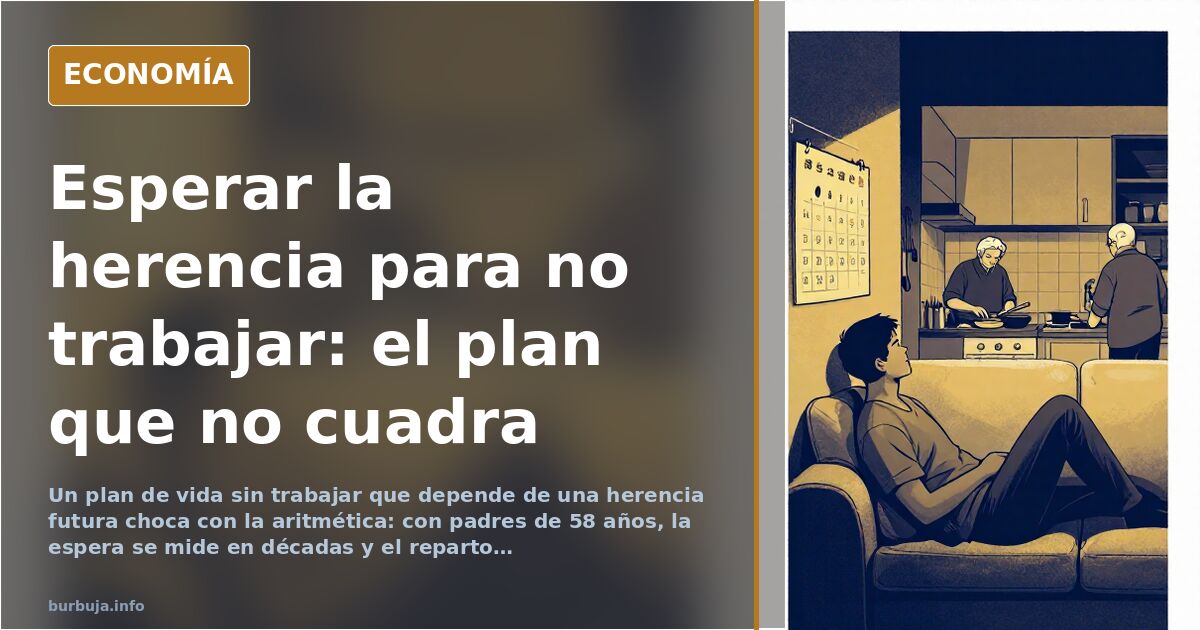
The plan to never work by waiting for an inheritance
There is a life plan involving never working and hoping a bank account will eventually appear. The scenario involves a young, unemployed man supported by his parents, waiting for his 89-year-old grandfather and single aunt to die so he can claim an inheritance described as dizzying wealth. His goal is not a job but generative passive income: buying a small flat, renting it out, and avoiding work. He argues patience is key.
The problem is this calculation clashes with basic arithmetic. If the grandfather is 89 and parents are 58, the inheritance arrives only after the parents die, potentially decades later. The protagonist dismisses this, claiming time is the slave’s excuse.
How long does it actually take to inherit from parents?
Succession trinc a strict order: the grandfather’s assets pass to the parents first, then to the grandchildren. With parents aged 58, realistic waiting times are decades, not months. If parents live to 90, the heir might be 75 when receiving the money, leaving little time to enjoy passive income.
Additionally, inheritance is not automatic or free. Before accessing funds, one must navigate notaries, registries, and regional tax authorities, plus declare IRPF (Income Tax) for the trinc year. If assets include property or securities, the administrative labyrinth multiplies. The protagonist delegates this to a lawyer paid from the inheritance, merely delaying costs.
The single aunt, siblings, and the unread will
The narrative relies on being the only male grandson, which grants no special legal succession rights. The single aunt may marry, change her mind, or leave her share to anyone. Parents might spend their wealth on travel or care homes. Working siblings also figure in the succession line.
The discussed figure is around €300,000, far from a fortune allowing indefinite living off rents, especially after taxes and succession costs. A detailed breakdown reveals a much narrower margin than the initial premise suggests.
Can you live without working by waiting for an inheritance?
This depends on three uncontrollable variables: when the asset holders die, what remains, and who else appears in the will. Discussions cite cases where grandparents liquidate properties and distribute money during their lifetime, or where inheritances are burdened by debts requiring rejection. Hope in a non-existent document is, at best, a hypothesis.
The protagonist admits his parents pressure him to seek employment and that his siblings work. His response mixes provocation and disdain, hoping parental anger accelerates an infarct. This phrase summarizes the tone but also the blind spot: while waiting, he lives under his supporters’ roof, his horizon depending on others dying in the expected order.
The analysis stalls here. The inheritance may or may not arrive, and the timeline is not fixed by the waiting heir. The only verifiable fact is that time spent waiting does not return.
There is a life plan involving never working and hoping a bank account will eventually appear. The scenario involves a young, unemployed man supported by his parents, waiting for his 89-year-old grandfather and single aunt to die so he can claim an inheritance described as dizzying wealth. His goal is not a job but generative passive income: buying a small flat, renting it out, and avoiding work. He argues patience is key.
The problem is this calculation clashes with basic arithmetic. If the grandfather is 89 and parents are 58, the inheritance arrives only after the parents die, potentially decades later. The protagonist dismisses this, claiming time is the slave’s excuse.
How long does it actually take to inherit from parents?
Succession trinc a strict order: the grandfather’s assets pass to the parents first, then to the grandchildren. With parents aged 58, realistic waiting times are decades, not months. If parents live to 90, the heir might be 75 when receiving the money, leaving little time to enjoy passive income.
Additionally, inheritance is not automatic or free. Before accessing funds, one must navigate notaries, registries, and regional tax authorities, plus declare IRPF (Income Tax) for the trinc year. If assets include property or securities, the administrative labyrinth multiplies. The protagonist delegates this to a lawyer paid from the inheritance, merely delaying costs.
The single aunt, siblings, and the unread will
The narrative relies on being the only male grandson, which grants no special legal succession rights. The single aunt may marry, change her mind, or leave her share to anyone. Parents might spend their wealth on travel or care homes. Working siblings also figure in the succession line.
The discussed figure is around €300,000, far from a fortune allowing indefinite living off rents, especially after taxes and succession costs. A detailed breakdown reveals a much narrower margin than the initial premise suggests.
Can you live without working by waiting for an inheritance?
This depends on three uncontrollable variables: when the asset holders die, what remains, and who else appears in the will. Discussions cite cases where grandparents liquidate properties and distribute money during their lifetime, or where inheritances are burdened by debts requiring rejection. Hope in a non-existent document is, at best, a hypothesis.
The protagonist admits his parents pressure him to seek employment and that his siblings work. His response mixes provocation and disdain, hoping parental anger accelerates an infarct. This phrase summarizes the tone but also the blind spot: while waiting, he lives under his supporters’ roof, his horizon depending on others dying in the expected order.
The analysis stalls here. The inheritance may or may not arrive, and the timeline is not fixed by the waiting heir. The only verifiable fact is that time spent waiting does not return.
Also available in: Deutsch
Summary of a discussion on Burbuja.info - Foro de economía, actualidad y política., translated from Spanish and reviewed before publication. Read the full discussion (138 replies).
More summaries
-
Spanish Tax Agency: Epiphany Gifts Are Donations
The Spanish Tax Agency clarifies that receiving money or goods without consideration is a donation, subject to the Inheritance and Gift Tax.
-
Renouncing an inheritance to a sibling triggers Inheritance Tax
Spain's DGT confirms that renouncing an inheritance in favor of a sibling is treated as prior acceptance, triggering both Inheritance and Gift taxes.
-
Spain's Tax Burden: IRPF, Social Security and VAT Explained
Analysis of Spain's fiscal pressure on a €60k salary shows ~50% goes to taxes before VAT. Details IRPF rates, social contributions, and the deflactation debate.
-
Franco handed out 8,000 flats and today no one can buy one
Franco handed out 7,486 flats in a single event according to NODO. Today, those flats rent for 1,200 euros: public housing, an uncomfortable memory
-
Grill bans spark debate in fire-alert Navarre
Navarre's police caught groups grilling in Goizueta, Cortes and Lekunberri during high fire risk. Debate intensifies over fines and forest management.
-
Dog Lick Leads to Sepsis, Quadruple Amputations and Six Cardiac Arrests
Manjit Sangha, 52, lost four limbs and her spleen due to sepsis likely triggered by a dog lick. Her heart stopped six times.