
Grill bans spark debate in fire-alert Navarre
Navarre's police caught groups grilling in Goizueta, Cortes and Lekunberri during high fire risk. Debate intensifies over fines and forest management.
English · Original discussion in Spanish · Published
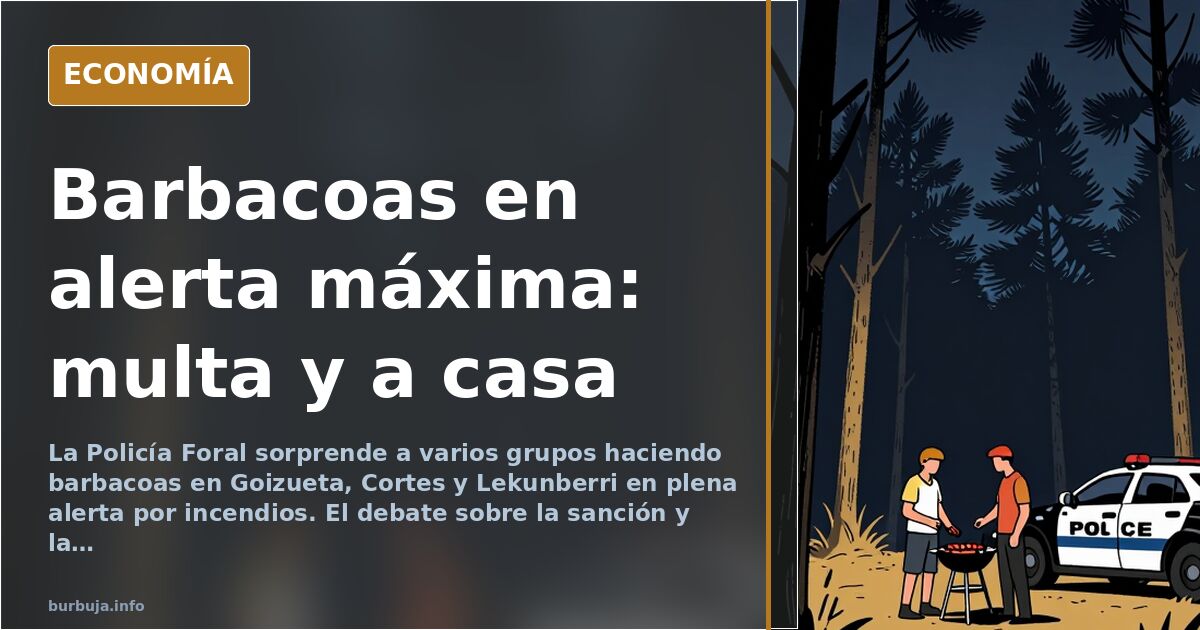
Grills in maximum alert: the ban nobody obeys
The Foral Police of Navarre caught a group grilling in the natural areas of Goizueta, Cortes and Lekunberri during a high fire risk alert. A video shared by Pamplona Actual shows the scene: portable fire, dry hills, and no supervision. The fine, if issued, will be monetary. The potential damage is not.
The controversy sparked by this case goes far beyond an anecdote. Some demand ruinous fines for serious negligence and deportation. Others argue that in Goizueta’s green zones, with ferns and Atlantic humidity, starting a fire is nearly impossible. Still others remind us that the ban exists because something burned last year.
What exactly peine in Goizueta and Lekunberri
Navarre’s Foral Police surprised several groups grilling in natural spaces in Goizueta, Cortes, and Lekunberri. This practice is prohibited during fire risk alerts. The video shows at least twelve people in one scene, with a portable grill set up by the river, without authorization or supervision.
The majority reaction has been unequivocal condemnation. Critics argue the ban allows no interpretation and fines should be exemplary. A stricter faction demands deportation for foreign offenders. Another perspective offers uncomfortable data: in that specific area, surrounded by ferns with oceanic climate, real fire risk is low. They maintain the ban trinc general preventive logic, not site-specific assessment.
The problem isn’t the grill, it’s hillside management
Here the issue gets complex. Analysts note the Navarre government did nothing after the 2016 and 2022 fires except impose bans. They criticize the administration for failing to manage vegetation fuel, clear forests, or support agriculture, while multiplying restrictions. Consequently, rural communities are fed up with rules that solve nothing.
The counterargument is equally strong: a private individual clearing land with a tractor caused a fire, and another blaze in an unexpected area led to the grill ban. Thus, the rule stems from real incidents, not whims. The problem is applying it uniformly across Carcastillo’s arid lands and Goizueta’s humid slopes.
Fines, deportations, and unresolved debates
The most repeated proposal is ruinous fines for serious negligence. The argument: symbolic penalties encourage disobedience. The objection: most cases aren’t even processed, as authorities only pursue collectable debts. Impunity, they claim, is the true issue.
Some go further, demanding deportation for foreign offenders. Others cite historical data: since the early 19th century, those born in former Spanish colonies hold original Spanish nationality, like Portuguese or Filipinos. Defining “foreigner” in Spain becomes a labyrinth here.
Smoke confusing firefighters and other consequences
Among concrete arguments, one stands out: grill smoke can mislead emergency services during alerts. If a fire burns kilometers away, extra smoke columns hinder locating the actual source. This is operational interference, not theoretical risk.
Additionally, public space ownership matters. Rivers, reservoirs, and parks are now sole free leisure spots for many families. Pressure grows each summer, increasing conflicts. Swimming bans already exist on many river stretches; so do fire bans. Compliance does not.
Goizueta’s case leaves unanswered questions: if the area is humid and risk low, why ban? If dry and risky, why not monitor? Authorities chose blanket bans, delegating surveillance to goodwill. Result: some break rules, none get fined, and debates fill with calls for harshness against outsiders. Meanwhile, hillsides remain unmanaged.
The Foral Police of Navarre caught a group grilling in the natural areas of Goizueta, Cortes and Lekunberri during a high fire risk alert. A video shared by Pamplona Actual shows the scene: portable fire, dry hills, and no supervision. The fine, if issued, will be monetary. The potential damage is not.
The controversy sparked by this case goes far beyond an anecdote. Some demand ruinous fines for serious negligence and deportation. Others argue that in Goizueta’s green zones, with ferns and Atlantic humidity, starting a fire is nearly impossible. Still others remind us that the ban exists because something burned last year.
What exactly peine in Goizueta and Lekunberri
Navarre’s Foral Police surprised several groups grilling in natural spaces in Goizueta, Cortes, and Lekunberri. This practice is prohibited during fire risk alerts. The video shows at least twelve people in one scene, with a portable grill set up by the river, without authorization or supervision.
The majority reaction has been unequivocal condemnation. Critics argue the ban allows no interpretation and fines should be exemplary. A stricter faction demands deportation for foreign offenders. Another perspective offers uncomfortable data: in that specific area, surrounded by ferns with oceanic climate, real fire risk is low. They maintain the ban trinc general preventive logic, not site-specific assessment.
The problem isn’t the grill, it’s hillside management
Here the issue gets complex. Analysts note the Navarre government did nothing after the 2016 and 2022 fires except impose bans. They criticize the administration for failing to manage vegetation fuel, clear forests, or support agriculture, while multiplying restrictions. Consequently, rural communities are fed up with rules that solve nothing.
The counterargument is equally strong: a private individual clearing land with a tractor caused a fire, and another blaze in an unexpected area led to the grill ban. Thus, the rule stems from real incidents, not whims. The problem is applying it uniformly across Carcastillo’s arid lands and Goizueta’s humid slopes.
Fines, deportations, and unresolved debates
The most repeated proposal is ruinous fines for serious negligence. The argument: symbolic penalties encourage disobedience. The objection: most cases aren’t even processed, as authorities only pursue collectable debts. Impunity, they claim, is the true issue.
Some go further, demanding deportation for foreign offenders. Others cite historical data: since the early 19th century, those born in former Spanish colonies hold original Spanish nationality, like Portuguese or Filipinos. Defining “foreigner” in Spain becomes a labyrinth here.
Smoke confusing firefighters and other consequences
Among concrete arguments, one stands out: grill smoke can mislead emergency services during alerts. If a fire burns kilometers away, extra smoke columns hinder locating the actual source. This is operational interference, not theoretical risk.
Additionally, public space ownership matters. Rivers, reservoirs, and parks are now sole free leisure spots for many families. Pressure grows each summer, increasing conflicts. Swimming bans already exist on many river stretches; so do fire bans. Compliance does not.
Goizueta’s case leaves unanswered questions: if the area is humid and risk low, why ban? If dry and risky, why not monitor? Authorities chose blanket bans, delegating surveillance to goodwill. Result: some break rules, none get fined, and debates fill with calls for harshness against outsiders. Meanwhile, hillsides remain unmanaged.
Also available in: Deutsch
Summary of a discussion on Burbuja.info - Foro de economía, actualidad y política., translated from Spanish and reviewed before publication. Read the full discussion (127 replies).
More summaries
-
Navarre Regional Police Stop Communicator Filming in Falces
Navarre Regional Police stop Raúl while he was filming in Falces. The episode reopens the debate on the limits of identifications without apparent cause.
-
“Zapatero will die killing”: Police and Government officials see the former President's hand in Ceuta reports
Police and government officials suspect former President Zapatero is behind reports on Ceuta. We analyze the keys to this alleged operation.
-
Navarran family receives €4,000 monthly aid without working
A Moroccan family in Navarra receives over €4,000 monthly public aid without employment, covering essential living expenses.
-
Influencer Shannis Claims She Didn't Know Ibiza Is in Spain for Profit
An influencer claims she didn't know Ibiza is in Spain and exchanged euros for dollars. The episode reveals the profitable rage bait business.
-
Iglesias Claims Díaz Worked to Destroy Podemos
Pablo Iglesias regrets handing power to Yolanda Díaz, accusing her of dismantling the party. The debate centers on internal appointments and leadership failures.
-
Spain's Business Circle Proposes Raising Retirement Age to 72
The Círculo de Empresarios suggests extending working life to age 72, sparking debate over the contradiction with a labor market that discards older workers.