
Spain's Tax Burden: IRPF, Social Security and VAT Explained
Analysis of Spain's fiscal pressure on a €60k salary shows ~50% goes to taxes before VAT. Details IRPF rates, social contributions, and the deflactation debate.
English · Original discussion in Spanish · Published
Escolar claims IRPF does not take half of your salary
Ignacio Escolar published a tweet with this headline: "Why it is false that half your salary disappears in the income tax return: how IRPF works," accompanied by an interactive tool about the tax. As an explanation of the mechanism, the piece is correct: IRPF does not take half of most paychecks. However, as a description of everything a salaried worker pays throughout the year, the response was nearly unanimous and pointed in another direction: and what happens to everything else?
What 80% of taxpayers pay in IRPF
The starting point that few dispute is that the top marginal rate, around 50%, affects very few people. The 80% of taxpayers pay close to 20% in IRPF, and several million pay nothing thanks to tax-free allowances and deductions. Viewed in isolation, the income tax alone does not make half the salary disappear.
The nuance is that IRPF is not the only step in the journey money takes between what a worker costs their company and what reaches their bank account. Measured end-to-end, that is where the conversation changes tone.
The sum that breaks the calculation: IRPF plus social security contributions
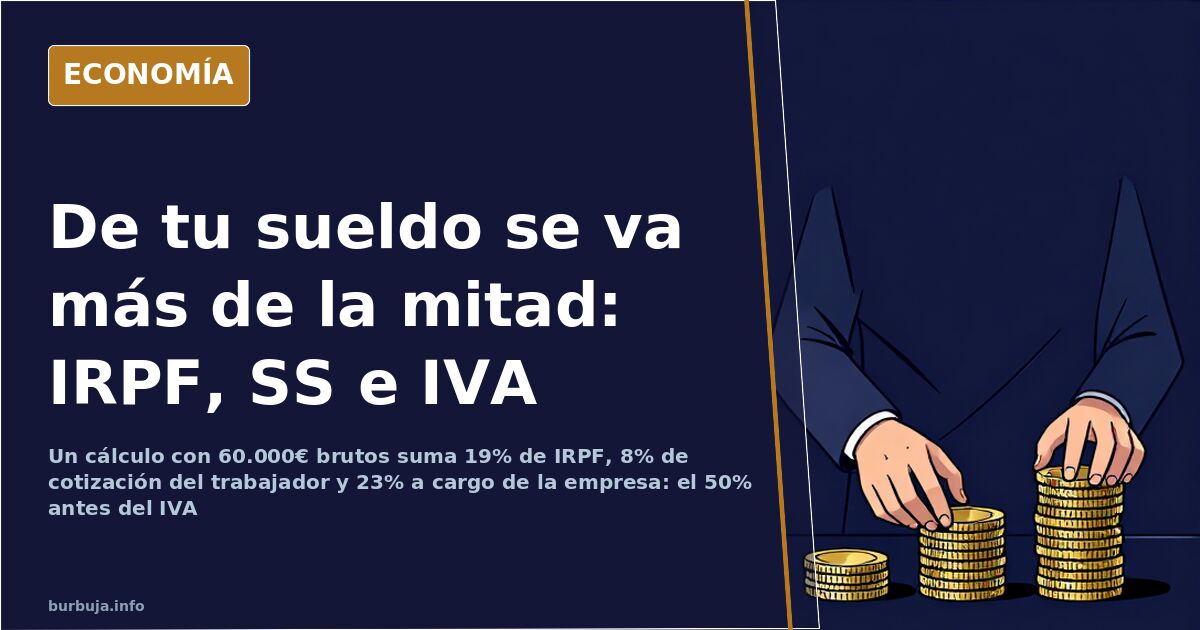
A typical calculation starts from €60,000 gross: 19% IRPF, 8% employee social security contribution, and 23% employer contribution. Added together, we are already at half before spending a single euro. And when the money is spent, it passes through the cash register again: the 21% general VAT, special taxes on fuel, property tax (IBI), waste collection fees, sewerage charges, and electricity bills with their surcharges.
For higher incomes, the proportion does not skyrocket as much as general anger suggests. With a salary of €120,000, the cost to the employer is around €135,000, and the net for the worker stays at about €75,000. That means roughly 40% disappears along the way. The complete breakdown, item by item, gives a range that depends heavily on where you draw the line—gross or disposable income, with or without spending—and it is worth looking at before accepting any round-number headline.
Is Spain one of the countries with the highest tax effort?
Here the analysis gets muddy. Anyone claiming that comparative tax pressure is among the world's highest has an obligation to provide values for all countries using the same methodology, because comparing a Spanish paycheck with a generic infographic proves nothing. That exercise has not yet appeared.
What is repeated is a verifiable fact: Spain has gone 15 years without deflating income tax brackets. With inflation rising, leaving the brackets static amounts to a silent annual increase. Therefore, the discussion is not just about how much is paid, but how much has been overpaid without anyone touching a rate.
Where the money goes: pensions and disputed items
No one denies that the money is spent. What is debated is on what. Critics point to €28 million for a TV contract, corruption, debt, and pensions that, according to this argument, no longer cover the cost of those financing them. In defense of the system, it is argued that contributions are not individual insurance but a tax: they also fund non-contributory pensions and minimum supplements, which benefit those who never contributed enough.
This is one of the keys to the disagreement. If contributions are understood as insurance, anything other than proportional benefits seems like plunder. If understood as a tax, the distribution stops being scandalous and becomes fiscal policy. Both readings coexist and explain why two people with the same paycheck cannot agree.
Who signs the tweet and why it matters
Much of the rejection is not against the mechanics of IRPF, but against the messenger. Escolar's independence is questioned due to his role in a media outlet, suggesting that the alleged war between outlets of different political leanings is a setup with shared interests. These are accusations made without proof in the heat of debate—and there is no verification—but they work: once the debate becomes personal, the interactive tool and tax brackets stop mattering.
This is the pattern of almost everything discussed today about taxes. The data may be well-constructed, but the response will still be distrust of whoever signs it.
The issue remains exactly where it was left: no one has put forward an international comparison of tax effort using homogeneous methodology. Without it, the phrase "Spain takes more than most" remains an intuition with strong backing but no table. Meanwhile, the calculation of the full paycheck—from what the worker costs to what reaches their pocket—admits several results depending on what one decides to count. And that, precisely there, is where the conversation stalls.
Ignacio Escolar published a tweet with this headline: "Why it is false that half your salary disappears in the income tax return: how IRPF works," accompanied by an interactive tool about the tax. As an explanation of the mechanism, the piece is correct: IRPF does not take half of most paychecks. However, as a description of everything a salaried worker pays throughout the year, the response was nearly unanimous and pointed in another direction: and what happens to everything else?
What 80% of taxpayers pay in IRPF
The starting point that few dispute is that the top marginal rate, around 50%, affects very few people. The 80% of taxpayers pay close to 20% in IRPF, and several million pay nothing thanks to tax-free allowances and deductions. Viewed in isolation, the income tax alone does not make half the salary disappear.
The nuance is that IRPF is not the only step in the journey money takes between what a worker costs their company and what reaches their bank account. Measured end-to-end, that is where the conversation changes tone.
The sum that breaks the calculation: IRPF plus social security contributions
A typical calculation starts from €60,000 gross: 19% IRPF, 8% employee social security contribution, and 23% employer contribution. Added together, we are already at half before spending a single euro. And when the money is spent, it passes through the cash register again: the 21% general VAT, special taxes on fuel, property tax (IBI), waste collection fees, sewerage charges, and electricity bills with their surcharges.
For higher incomes, the proportion does not skyrocket as much as general anger suggests. With a salary of €120,000, the cost to the employer is around €135,000, and the net for the worker stays at about €75,000. That means roughly 40% disappears along the way. The complete breakdown, item by item, gives a range that depends heavily on where you draw the line—gross or disposable income, with or without spending—and it is worth looking at before accepting any round-number headline.
Is Spain one of the countries with the highest tax effort?
Here the analysis gets muddy. Anyone claiming that comparative tax pressure is among the world's highest has an obligation to provide values for all countries using the same methodology, because comparing a Spanish paycheck with a generic infographic proves nothing. That exercise has not yet appeared.
What is repeated is a verifiable fact: Spain has gone 15 years without deflating income tax brackets. With inflation rising, leaving the brackets static amounts to a silent annual increase. Therefore, the discussion is not just about how much is paid, but how much has been overpaid without anyone touching a rate.
Where the money goes: pensions and disputed items
No one denies that the money is spent. What is debated is on what. Critics point to €28 million for a TV contract, corruption, debt, and pensions that, according to this argument, no longer cover the cost of those financing them. In defense of the system, it is argued that contributions are not individual insurance but a tax: they also fund non-contributory pensions and minimum supplements, which benefit those who never contributed enough.
This is one of the keys to the disagreement. If contributions are understood as insurance, anything other than proportional benefits seems like plunder. If understood as a tax, the distribution stops being scandalous and becomes fiscal policy. Both readings coexist and explain why two people with the same paycheck cannot agree.
Who signs the tweet and why it matters
Much of the rejection is not against the mechanics of IRPF, but against the messenger. Escolar's independence is questioned due to his role in a media outlet, suggesting that the alleged war between outlets of different political leanings is a setup with shared interests. These are accusations made without proof in the heat of debate—and there is no verification—but they work: once the debate becomes personal, the interactive tool and tax brackets stop mattering.
This is the pattern of almost everything discussed today about taxes. The data may be well-constructed, but the response will still be distrust of whoever signs it.
The issue remains exactly where it was left: no one has put forward an international comparison of tax effort using homogeneous methodology. Without it, the phrase "Spain takes more than most" remains an intuition with strong backing but no table. Meanwhile, the calculation of the full paycheck—from what the worker costs to what reaches their pocket—admits several results depending on what one decides to count. And that, precisely there, is where the conversation stalls.
Also available in: Deutsch
Summary of a discussion on Burbuja.info - Foro de economía, actualidad y política., translated from Spanish and reviewed before publication. Read the full discussion (183 replies).
More summaries
-
Forum users claim 40 cents of Spain's minimum wage hike goes to taxes
A forum calculation suggests Spain's minimum wage increase sends 40 cents to the state via social security and income tax.
-
Machines paying into Social Security: what's being proposed
A forum user puts gross operating surplus at 8%: the proposal for machines to contribute divides between redistribution and capital flight
-
Spanish Tax Agency demands €2,363 in income tax; video goes viral
A young man owes €2,363 in Spanish income tax and refuses to pay. The 'socialist voter' label is absent from the official notice.
-
Young Man Fired for Mocking Puerta del Sol Protesters
A young man was fired after a viral video mocked Puerta del Sol protesters as lazy. The case sparks debate on fair dismissal and free speech in Spain.
-
Iglesias Claims Díaz Worked to Destroy Podemos
Pablo Iglesias regrets handing power to Yolanda Díaz, accusing her of dismantling the party. The debate centers on internal appointments and leadership failures.
-
Spain's Business Circle Proposes Raising Retirement Age to 72
The Círculo de Empresarios suggests extending working life to age 72, sparking debate over the contradiction with a labor market that discards older workers.