
Spanish Tax Agency: Epiphany Gifts Are Donations
The Spanish Tax Agency clarifies that receiving money or goods without consideration is a donation, subject to the Inheritance and Gift Tax.
English · Original discussion in Spanish · Published
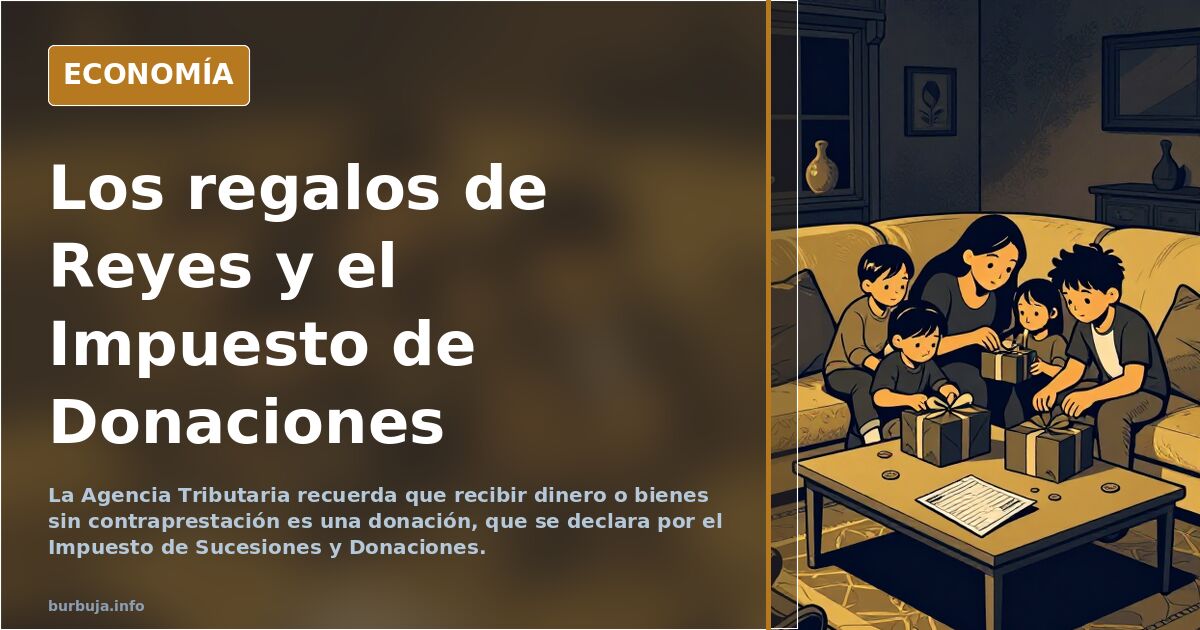
Spanish Tax Agency reminds that Epiphany gifts are taxed as donations
A child opens a package, sees a bike or an envelope with cash, and no one thinks about filing taxes. The Spanish Tax Agency does. When a person receives money or assets from another without giving anything in return, the law considers it a donation, and donations must be declared through the Inheritance and Gift Tax (Impuesto de Sucesiones y Donaciones). The agency extends this warning to specific dates: even at Epiphany, and even with affection involved, you must pay up.
This approach has fiscal logic and practical irony. Most Christmas gifts are low-value, given in cash, and undeclared. But the warning exists, enough to steer the conversation toward familiar questions: where is the limit, who monitors it, and why does the taxman seem to remember everything except what we would like him to forget?
What the rule says exactly about Epiphany gifts
The rule is simple: if someone receives an asset or money without consideration, a taxable event occurs under the Inheritance and Gift Tax. The obligation to declare falls on the recipient, not the giver. That means the child, nephew, or friend opening the envelope.
Here lies the first practical problem. Many Christmas gifts are small amounts, in cash, with no paper trail. The very nature of a gift—with its emotional weight—clashes with the cold mechanics of a form that must be filed with the administration.
Some argue the warning is more educational than a real threat. In practice, small amounts are rarely pursued. But the criterion is not affection or the calendar date: it is the amount and the nature of the act.
Cash gifts vs. high-value gifts: where is the border?
The most repeated nuance concerns size. An envelope with €100 moves no one; a transfer of €12,000 does. The dividing line is not written in the notice, but fiscal common sense draws it alone.
The discussion gets tangled when mixed with evasion tactics. If a gift is split into monthly payments, does it stop being a donation? Technically no, but monitoring those flows is another matter. Here enters the eternal debate between what the norm says and what the administration can or wants to pursue.
The result is a limbo: the law is clear on paper, diffuse in practice, and the average citizen navigates between ignorance and resignation.
Why the warning annoys: the context of tax pressure
The warning does not arrive in a vacuum. It arrives at a time when tax pressure and the feeling that everything is taxed are part of the daily landscape. Therefore, the majority reaction is not surprise, but weariness.
The recurring complaint is double taxation: money that already paid taxes when earned is taxed again when it changes hands, and will be taxed again when spent via VAT. This argument, technically debatable, is the most circulated.
Comparison with unpursued cases also appears. The perception that the tax authority is relentless with individuals but tolerant of opaque structures fuels anger. It is not data, but a perception, yet it weighs heavily.
What happens if you don't declare: the real risk
The consequence of not declaring a donation is the same as any tax non-compliance: the administration can claim the tax with interest and, if applicable, penalties. The risk grows with the amount and the traceability of the payment.
An unjustified cash gift is hard to detect. A bank transfer, property, or vehicle registered in another's name leaves a trail. That is where the warning stops being rhetoric.
The advice repeated by those who know the terrain is simple: if the gift is small, no one will bother; if it is large, seek advice before the letter arrives.
The fine print almost no one reads
The Inheritance and Gift Tax is managed by Spain's autonomous communities, and reductions vary significantly from one region to another. What costs almost nothing in one territory can be a considerable hit in another.
This territorial disparity is another source of grievance: the same gift is taxed differently depending on the recipient's postal code. Fiscal equality, in practice, depends on the map.
And so the circle closes: a technical norm, a seasonal warning, and a collective feeling that even affection has a price. The unsettling fact is not the tax itself. It is that, deep down, almost no one knew it existed.
A child opens a package, sees a bike or an envelope with cash, and no one thinks about filing taxes. The Spanish Tax Agency does. When a person receives money or assets from another without giving anything in return, the law considers it a donation, and donations must be declared through the Inheritance and Gift Tax (Impuesto de Sucesiones y Donaciones). The agency extends this warning to specific dates: even at Epiphany, and even with affection involved, you must pay up.
This approach has fiscal logic and practical irony. Most Christmas gifts are low-value, given in cash, and undeclared. But the warning exists, enough to steer the conversation toward familiar questions: where is the limit, who monitors it, and why does the taxman seem to remember everything except what we would like him to forget?
What the rule says exactly about Epiphany gifts
The rule is simple: if someone receives an asset or money without consideration, a taxable event occurs under the Inheritance and Gift Tax. The obligation to declare falls on the recipient, not the giver. That means the child, nephew, or friend opening the envelope.
Here lies the first practical problem. Many Christmas gifts are small amounts, in cash, with no paper trail. The very nature of a gift—with its emotional weight—clashes with the cold mechanics of a form that must be filed with the administration.
Some argue the warning is more educational than a real threat. In practice, small amounts are rarely pursued. But the criterion is not affection or the calendar date: it is the amount and the nature of the act.
Cash gifts vs. high-value gifts: where is the border?
The most repeated nuance concerns size. An envelope with €100 moves no one; a transfer of €12,000 does. The dividing line is not written in the notice, but fiscal common sense draws it alone.
The discussion gets tangled when mixed with evasion tactics. If a gift is split into monthly payments, does it stop being a donation? Technically no, but monitoring those flows is another matter. Here enters the eternal debate between what the norm says and what the administration can or wants to pursue.
The result is a limbo: the law is clear on paper, diffuse in practice, and the average citizen navigates between ignorance and resignation.
Why the warning annoys: the context of tax pressure
The warning does not arrive in a vacuum. It arrives at a time when tax pressure and the feeling that everything is taxed are part of the daily landscape. Therefore, the majority reaction is not surprise, but weariness.
The recurring complaint is double taxation: money that already paid taxes when earned is taxed again when it changes hands, and will be taxed again when spent via VAT. This argument, technically debatable, is the most circulated.
Comparison with unpursued cases also appears. The perception that the tax authority is relentless with individuals but tolerant of opaque structures fuels anger. It is not data, but a perception, yet it weighs heavily.
What happens if you don't declare: the real risk
The consequence of not declaring a donation is the same as any tax non-compliance: the administration can claim the tax with interest and, if applicable, penalties. The risk grows with the amount and the traceability of the payment.
An unjustified cash gift is hard to detect. A bank transfer, property, or vehicle registered in another's name leaves a trail. That is where the warning stops being rhetoric.
The advice repeated by those who know the terrain is simple: if the gift is small, no one will bother; if it is large, seek advice before the letter arrives.
The fine print almost no one reads
The Inheritance and Gift Tax is managed by Spain's autonomous communities, and reductions vary significantly from one region to another. What costs almost nothing in one territory can be a considerable hit in another.
This territorial disparity is another source of grievance: the same gift is taxed differently depending on the recipient's postal code. Fiscal equality, in practice, depends on the map.
And so the circle closes: a technical norm, a seasonal warning, and a collective feeling that even affection has a price. The unsettling fact is not the tax itself. It is that, deep down, almost no one knew it existed.
Also available in: Deutsch
Summary of a discussion on Burbuja.info - Foro de economía, actualidad y política., translated from Spanish and reviewed before publication. Read the full discussion (128 replies).
More summaries
-
AEAT inspector vacancies offer up to €48,098 in supplements
The Official Gazette published 511 AEAT inspector positions with specific supplements ranging from €32,521 to €48,098 annually.
-
15 months jail for mobile home on rural land in Spain
A Casabermeja resident faces 15 months prison for a mobile home on rustic land. Defense claims it was used as a tool shed.
-
British Nightlife Videos: The Internet's Guilty Pleasure
Searching 'nightlife' plus a UK city on YouTube reveals a genre users confess to watching as a guilty pleasure.
-
Iglesias Claims Díaz Worked to Destroy Podemos
Pablo Iglesias regrets handing power to Yolanda Díaz, accusing her of dismantling the party. The debate centers on internal appointments and leadership failures.
-
Spain's Business Circle Proposes Raising Retirement Age to 72
The Círculo de Empresarios suggests extending working life to age 72, sparking debate over the contradiction with a labor market that discards older workers.
-
Spain's Verifactu: Fears of closures for bars and freelancers
Verifactu mandates billing software updates by 2026. Forum users warn of business failures and the end of undeclared income.