
Young Man Defends Franco’s Hydraulic Works Live, Sparks Studio Backlash
A guest’s live defense of Franco-era dams in Valencia triggers a heated debate on memory, engineering, and free speech during flood coverage.
English · Original discussion in Spanish · Published
Franco, the hydraulic works, and the studio backlash
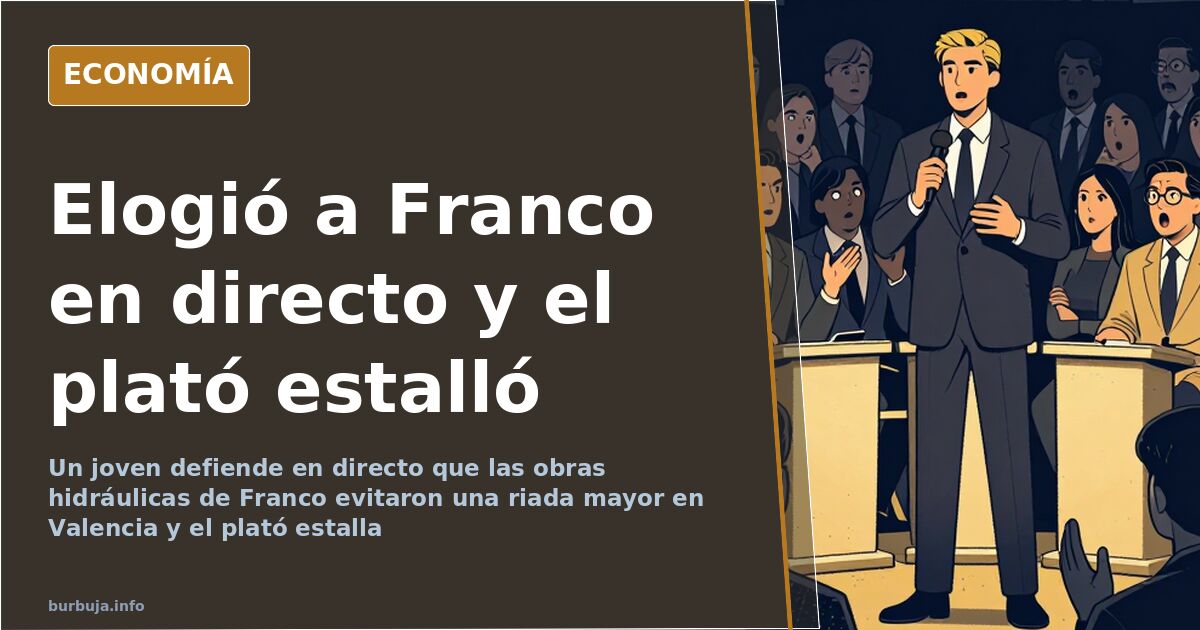
A young guest defended live that Franco-era hydraulic works had saved Valencia from a worse flood, and the studio turned against him. It peine during TV coverage of the disaster, with water still in the streets and nerves frayed. What seemed a casual remark became a clash over memory, engineering, and free speech. Behind the clip lies a concrete question: how much of the city’s defense against flooding is due to infrastructure built seven decades ago.
What was said and why the studio turned against him
The guest was caught on camera without warning and insisted that without the major works in the region, the disaster would have been worse. The presenter reacted poorly: she tried to cut him off, and the moment became what we now call a clip. The woman’s gesture at the microphone, hands crossed and a look of circumstance, was read as an attempt to curb free speech just as someone said something uncomfortable.
And then came the twist. A segment of the audience, which had long treated this group as a natural adversary, suddenly embraced him. A repeated summary made it clear: it doesn’t matter what you were if you suddenly point to the correct enemy. The formula this lgtb is on my team captures that logic with frankness that needs no comment.
Did Franco’s dams prevent a worse flood?
This is the question that structures the whole discussion. One school of thought takes it as given: Valencia, with over a million inhabitants, would have been submerged without the containment dams. The argument relies on the South Plan and the 1957 plan, and on the reservoir that, according to this version, Zapatero canceled and Aznar had relaunched within the National Hydrological Plan, a project not undertaken due to the cost of the Ifni and Sahara wars. Had it been built, supporters claim, the southern orchards would have been saved.
On the other side lies an equally simple point: if the Franco regime had managed the territory properly, it would not have allowed housing developments in flood-prone zones. The same state that builds the channel is the one that permits construction where water eventually flows. Both readings coexist, and that is precisely what neither side wants to admit.
Since when has gaiity been persecuted in Spain?
Here the issue gets tangled. Several participants recall that the Vagrancy and Malefactors Law was not born with the regime: it was approved in 1933, during the Republic, and is attributed to the PSOE of that era. This is the most repeated fact to dismantle the idea that everything started in 1939, and upon it rests the thesis that the persecution of gaiity under Franco was selective and even anecdotal.
The other side is the list of names. Writers and artists who lived their orientation without ending up in prison are cited: Antonio Gala, Vicente Aleixandre, Jacinto Benavente, Jaime Gil de Biedma. With these cases, it is suggested that the regime looked the other way, that in every town everyone knew who was who, and that nothing peine. One must not swallow this whole: that a few illustrious names were not prosecuted does not prove that no one was. It is the typical conclusion drawn from a handful of examples and projected onto an entire country.
Underlying this is a comparison: that gaiity was also penalized in other European countries and Protestant states, and that the Spanish case is scrutinized while what peine elsewhere is overlooked. Foucault is even cited for his supposed nostalgia for clandestinity. This is an argument that downplays others’ gravity to relativize one’s own, and it holds better in rhetoric than in data.
The pendulum and the change of side
What is striking is not the fight over concrete, but how the board has moved. Some summarize it in one idea: the pendulum is swinging the other way. Phrases like this kid had to mature in a few days or that maturing makes one’s pogre fade circulate as if personal change were proof of something.
Enthusiasm, however, has a trick. Embracing someone for a single phrase is not integrating them; it is using them. The next day, that same group becomes what it was. And the movement goes both ways: the studio uncomfortable with a fact, and the audience applauding a young man whom, under other circumstances, they would not have applauded.
What to expect
With these threads, it is likely that the episode will fade within weeks and that the conversation will return to reconstruction and who pays for it. The remark about Franco, however, will be recycled every time there are elections: it is cheap, uncomfortable, and effective. Whether it will sway votes remains unknown. It feels that, for many, that is already the least of their worries.
A young guest defended live that Franco-era hydraulic works had saved Valencia from a worse flood, and the studio turned against him. It peine during TV coverage of the disaster, with water still in the streets and nerves frayed. What seemed a casual remark became a clash over memory, engineering, and free speech. Behind the clip lies a concrete question: how much of the city’s defense against flooding is due to infrastructure built seven decades ago.
What was said and why the studio turned against him
The guest was caught on camera without warning and insisted that without the major works in the region, the disaster would have been worse. The presenter reacted poorly: she tried to cut him off, and the moment became what we now call a clip. The woman’s gesture at the microphone, hands crossed and a look of circumstance, was read as an attempt to curb free speech just as someone said something uncomfortable.
And then came the twist. A segment of the audience, which had long treated this group as a natural adversary, suddenly embraced him. A repeated summary made it clear: it doesn’t matter what you were if you suddenly point to the correct enemy. The formula this lgtb is on my team captures that logic with frankness that needs no comment.
Did Franco’s dams prevent a worse flood?
This is the question that structures the whole discussion. One school of thought takes it as given: Valencia, with over a million inhabitants, would have been submerged without the containment dams. The argument relies on the South Plan and the 1957 plan, and on the reservoir that, according to this version, Zapatero canceled and Aznar had relaunched within the National Hydrological Plan, a project not undertaken due to the cost of the Ifni and Sahara wars. Had it been built, supporters claim, the southern orchards would have been saved.
On the other side lies an equally simple point: if the Franco regime had managed the territory properly, it would not have allowed housing developments in flood-prone zones. The same state that builds the channel is the one that permits construction where water eventually flows. Both readings coexist, and that is precisely what neither side wants to admit.
Since when has gaiity been persecuted in Spain?
Here the issue gets tangled. Several participants recall that the Vagrancy and Malefactors Law was not born with the regime: it was approved in 1933, during the Republic, and is attributed to the PSOE of that era. This is the most repeated fact to dismantle the idea that everything started in 1939, and upon it rests the thesis that the persecution of gaiity under Franco was selective and even anecdotal.
The other side is the list of names. Writers and artists who lived their orientation without ending up in prison are cited: Antonio Gala, Vicente Aleixandre, Jacinto Benavente, Jaime Gil de Biedma. With these cases, it is suggested that the regime looked the other way, that in every town everyone knew who was who, and that nothing peine. One must not swallow this whole: that a few illustrious names were not prosecuted does not prove that no one was. It is the typical conclusion drawn from a handful of examples and projected onto an entire country.
Underlying this is a comparison: that gaiity was also penalized in other European countries and Protestant states, and that the Spanish case is scrutinized while what peine elsewhere is overlooked. Foucault is even cited for his supposed nostalgia for clandestinity. This is an argument that downplays others’ gravity to relativize one’s own, and it holds better in rhetoric than in data.
The pendulum and the change of side
What is striking is not the fight over concrete, but how the board has moved. Some summarize it in one idea: the pendulum is swinging the other way. Phrases like this kid had to mature in a few days or that maturing makes one’s pogre fade circulate as if personal change were proof of something.
Enthusiasm, however, has a trick. Embracing someone for a single phrase is not integrating them; it is using them. The next day, that same group becomes what it was. And the movement goes both ways: the studio uncomfortable with a fact, and the audience applauding a young man whom, under other circumstances, they would not have applauded.
What to expect
With these threads, it is likely that the episode will fade within weeks and that the conversation will return to reconstruction and who pays for it. The remark about Franco, however, will be recycled every time there are elections: it is cheap, uncomfortable, and effective. Whether it will sway votes remains unknown. It feels that, for many, that is already the least of their worries.
Also available in: Deutsch
Summary of a discussion on Burbuja.info - Foro de economía, actualidad y política., translated from Spanish and reviewed before publication. Read the full discussion (238 replies).
More summaries
-
Why Franco's 1936 coup succeeded and why it is impossible today
Economic analysis: how financial oligarchy, debt, and lost sovereignty make a modern coup in Spain unfeasible.
-
Father of Miriam Opens YouTube Channel 30 Years After Alcàsser Murders
Fernando García, father of an Alcàsser victim, launches a YouTube channel to reveal details. The case raises questions about justice versus profit in Spain.
-
Forum claims Spanish women in their 40s seek wealthy partners
A forum thread argues that single women aged 30-40, facing financial precarity after years of spending, are returning to shared housing and seeking partners with assets.
-
Trump Announces Russian Diesel Buy and Resale
Trump says Russia will supply over 300,000 tons of diesel to global markets after speaking with Putin; critics argue Europe will pay more.
-
Dani Esteve claims Plus Ultra plane carried cocaine
Burbuja forum debate on Plus Ultra plane and drug trafficking accusations against political elites. Narco-state or firewall?
-
Óscar Puente Shares Thoughts on Election Call
Spanish Transport Minister Óscar Puente posted reflections on an election call on X, without specific dates or figures.