
Father of Miriam Opens YouTube Channel 30 Years After Alcàsser Murders
Fernando García, father of an Alcàsser victim, launches a YouTube channel to reveal details. The case raises questions about justice versus profit in Spain.
English · Original discussion in Spanish · Published
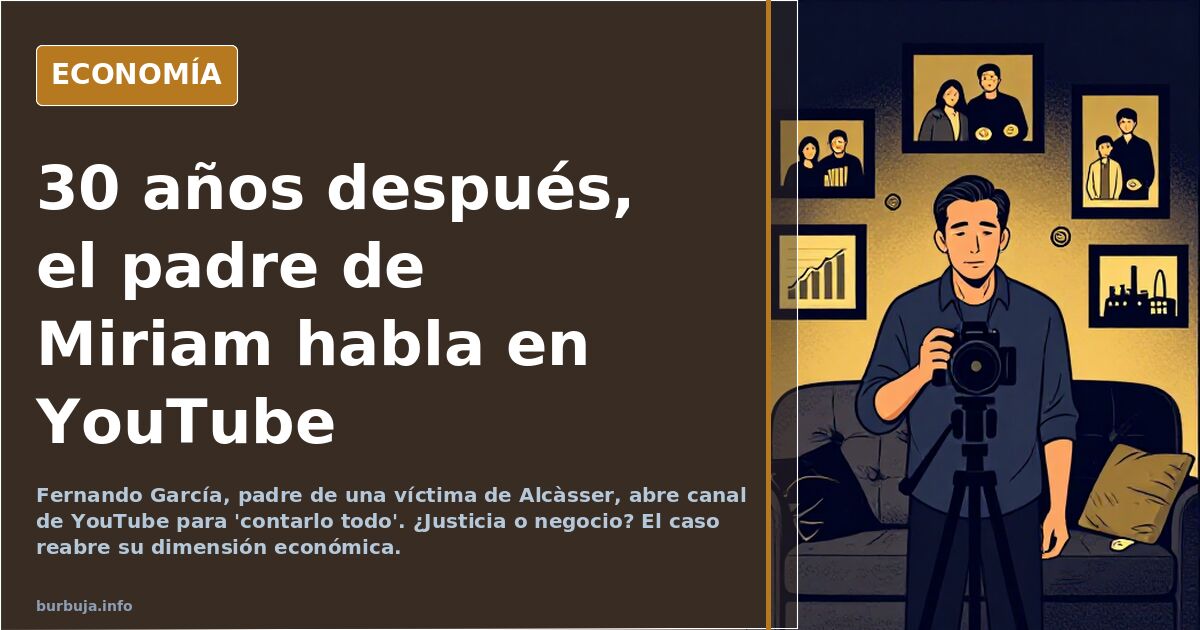
Fernando García opens YouTube channel: 30 years later, the profitability of pain
The news has shaken the crime beat: the father of Miriam, one of the three girls murdered in the Alcàsser case, has announced the launch of a YouTube channel where he plans to reveal everything. Three decades after that crime turned all of Spain into an audience, the story returns to the spotlight with a new format and a censorship-proof business model.
From Pepe Navarro’s studio to Google’s algorithm
In the early 1990s, the case was already a major media spectacle. Television filled hours of programming with details of the bodies’ discovery and interrogations. Fernando García appeared on shows like Pepe Navarro’s, with millions of viewers, and became a familiar face of someone else’s grief. It is not the first time, therefore, that the family seeks channels to tell their version. The difference is that the platform now allows direct access to millions of people without anyone editing or filtering their message. YouTube has become the new public square: you do not need a producer, just a camera and a thesis.
An economy of emotion very old
What some call the commercialization of misfortune is not an internet invention. Crime journalism and so-called trash TV had long discovered that personal dramas sell. In the Alcàsser case, the machinery was a pioneer in Spain. Now, with view counts in mind, the debate resurges strongly: is Fernando García seeking justice or monetizing his daughter’s memory? Some argue he has lived off Miriam’s blood for over 30 years, and that promises of definitive revelations have been a recurring hook since then.
The tapes that never appeared
Juan Ignacio Blanco’s role has been central to this narrative. An amateur turned investigator, he promised videos that would explain everything, but died about seven years ago without ever showing them. His name is mixed with the family’s in a difficult-to-digest cocktail. And to complete the picture, the public debate adds more fuel: the brother of the main suspect, Antonio Anglés, has also created a YouTube channel. The industry surrounding the case seems to have no end.
Cracks in the official version
The judicial version has cracks that skeptics recall every time the matter returns to the headlines. Contradictions between the first and second autopsies are mentioned, the never-explained escape of the accused, and a disturbing figure: more than 40 missing minors in the same area during those years without any official connection established. For many, the matter was not closed with the verdict: it was archived.
The open question
The new channel raises a fundamental question: does it seek to be a loudspeaker for the truth or another product in the true crime market? What is clear is that public attention remains, ready to pay in clicks. When someone announces they will reveal information about a case of this magnitude, they promise the most irresistible fiction: knowing how something that moves us truly ended. And in that promise lies, fundamentally, its economic yield.
The news has shaken the crime beat: the father of Miriam, one of the three girls murdered in the Alcàsser case, has announced the launch of a YouTube channel where he plans to reveal everything. Three decades after that crime turned all of Spain into an audience, the story returns to the spotlight with a new format and a censorship-proof business model.
From Pepe Navarro’s studio to Google’s algorithm
In the early 1990s, the case was already a major media spectacle. Television filled hours of programming with details of the bodies’ discovery and interrogations. Fernando García appeared on shows like Pepe Navarro’s, with millions of viewers, and became a familiar face of someone else’s grief. It is not the first time, therefore, that the family seeks channels to tell their version. The difference is that the platform now allows direct access to millions of people without anyone editing or filtering their message. YouTube has become the new public square: you do not need a producer, just a camera and a thesis.
An economy of emotion very old
What some call the commercialization of misfortune is not an internet invention. Crime journalism and so-called trash TV had long discovered that personal dramas sell. In the Alcàsser case, the machinery was a pioneer in Spain. Now, with view counts in mind, the debate resurges strongly: is Fernando García seeking justice or monetizing his daughter’s memory? Some argue he has lived off Miriam’s blood for over 30 years, and that promises of definitive revelations have been a recurring hook since then.
The tapes that never appeared
Juan Ignacio Blanco’s role has been central to this narrative. An amateur turned investigator, he promised videos that would explain everything, but died about seven years ago without ever showing them. His name is mixed with the family’s in a difficult-to-digest cocktail. And to complete the picture, the public debate adds more fuel: the brother of the main suspect, Antonio Anglés, has also created a YouTube channel. The industry surrounding the case seems to have no end.
Cracks in the official version
The judicial version has cracks that skeptics recall every time the matter returns to the headlines. Contradictions between the first and second autopsies are mentioned, the never-explained escape of the accused, and a disturbing figure: more than 40 missing minors in the same area during those years without any official connection established. For many, the matter was not closed with the verdict: it was archived.
The open question
The new channel raises a fundamental question: does it seek to be a loudspeaker for the truth or another product in the true crime market? What is clear is that public attention remains, ready to pay in clicks. When someone announces they will reveal information about a case of this magnitude, they promise the most irresistible fiction: knowing how something that moves us truly ended. And in that promise lies, fundamentally, its economic yield.
Summary of a discussion on Burbuja.info - Foro de economía, actualidad y política., translated from Spanish and reviewed before publication. Read the full discussion (188 replies).
More summaries
-
Turiel and the End of Oil: Why the Barrel Price Doesn't Back Him Up
A forum debates the end of oil: some blame Ormuz and war for Brent's fall, others doubt collapse forecasts.
-
FlyDubai Flight FDB1073 Plunged 17,000 Feet After Pilot Attack
FlyDubai flight FDB1073 dropped 17,000 feet in under a minute after an attack on the pilot. Israel calls it a terrorist attack and the investigation...
-
Spain tops global pension rankings: generosity or unsustainability?
Spain leads the world in pension replacement rates with an average of €1,574.90. But debt and aging threaten the system. How long can it last?
-
Bukele's El Salvador: Security vs. Rights Dilemma
5% of Salvadoran men are in prison. Bukele divides opinion between security and democracy. Efficiency, propaganda, or dictatorship?
-
Chinese motorhomes: housing fix for €55,000
Chinese motorhomes at €55,000 versus €90,000 European ones: could they become emergency housing for millions of Spaniards?
-
0.08% of Spanish taxpayers hold 30% of financial savings
0.08% of taxpayers hold 30% of financial savings while most live paycheck to paycheck and borrow €6,000 for vacations. Data from a...