
Forum claims Spanish women in their 40s seek wealthy partners
A forum thread argues that single women aged 30-40, facing financial precarity after years of spending, are returning to shared housing and seeking partners with assets.
English · Original discussion in Spanish · Published
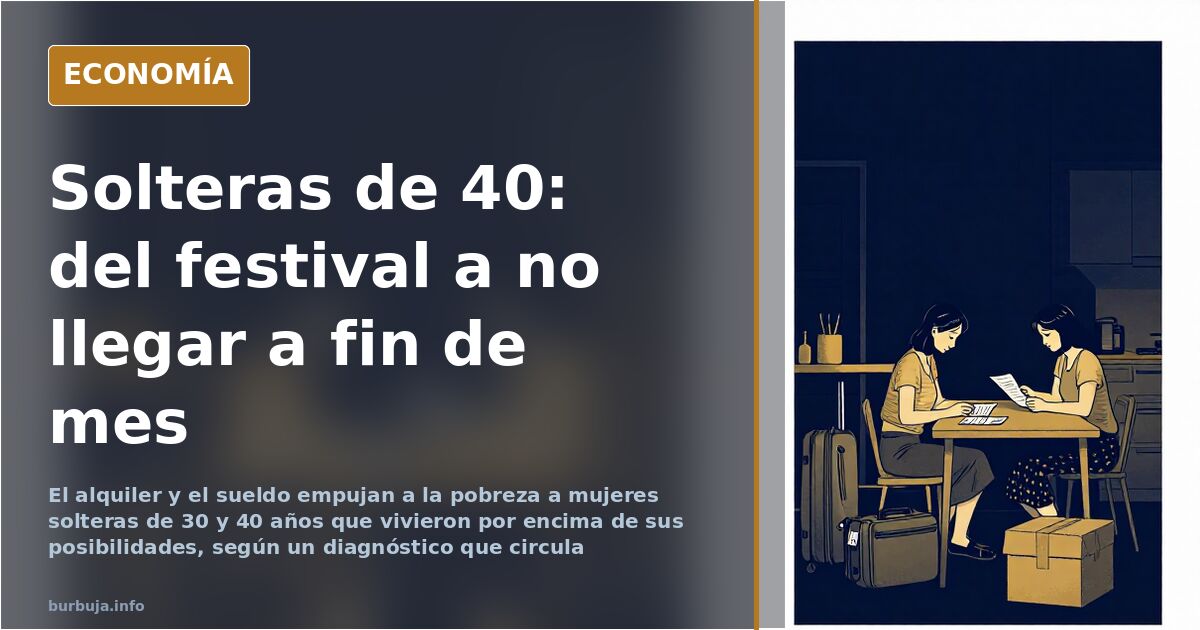
Forum claims Spanish women in their 40s seek wealthy partners
A forum thread suggests a growing number of single women between 30 and 40, accustomed to a lifestyle involving travel, festivals, and terrace dining, are facing financial instability as their salaries fail to keep up. According to these users, the combination of stagnant wages, rising rents, and a consumption pattern sustained through their twenties has left many without a financial safety net. The question raised is how many are forced back into sharing apartments at age forty.
The diagnosis circulating among participants is stark: the rental wall, stagnant pay, and an extended youth funded by credit cards collided. The party ended, but the economic hangover is long, they claim.
The crushing trio: salary, rent, and expectations
The first factor is the most obvious and least debated: income. One user states that a net salary of 2,100 euros, which allowed for comfortable living in 2008, no longer covers basic expenses if one must pay market-rate rent. Accumulated inflation and tax pressure have turned this salary into a figure that evaporates before month-end, they argue. Those without a partner to split costs feel it twice as hard.
The second is housing. Rent has eroded the savings capacity of an entire generation, according to these messages. For many women who lived their twenties with some ease, returning to shared housing is not an ideological choice but an emergency, they insist. Some describe cases of acquaintances who, after divorces or breakups, had to rebuild their lives in a rented room.
The third factor is cultural: for years, a lifestyle based on experiences, travel, and visible consumption was sold. This style was financed, in many cases, without building wealth. Now, the bill arrives all at once, they note.
Why do many reach 40 without assets?
The short answer from these users is that they didn't save when they could. The long answer involves perverse incentives: a labor market that punishes stability, a culture of immediate consumption, and family networks that often can no longer act as a buffer. Most men, conversely, tend to be more prudent, according to the widespread perception in these circles: they buy homes earlier, save something, and protect themselves. It's not a universal law, but it marks a difference in financial behavior noticeable at forty, they say.
The result, according to these messages, is a mass of single women with average incomes unable to cope with unforeseen events. And when the ground approaches, the strategy changes: finding a partner becomes, for some, a housing and economic solution. It’s not romance, it’s survival, they maintain.
The narrative shift: from independence to seeking a provider
What stands out, according to these users, is how the discourse has changed. Five years ago, many of these women would have flatly rejected the idea of depending on a man. Today, in environments where dating and economics intersect, they claim to detect a pattern: sudden interest in men with paid-off homes, savings, or stable incomes. They open up like steamed mussels when they spot assets, summarizes one observer.
It’s not a incivil phenomenon, but it is a dynamic many men interpret as a warning, according to these messages. The woman who was independent and free now seeks an anchor. And she doesn’t always do so transparently, they assert.
Demographic collapse as backdrop
Meanwhile, Spain faces an unprecedented drop in births, according to one user: 200,000 fewer births in 2025 than in 2008, with a fertility rate hovering around 0.46 children per woman. This data, which should be central to public debate, is buried under discussions on empowerment and lifestyle, they argue.
The paradox, according to these messages, is that many of the women now hitting poverty head-on are the same ones who, a decade ago, could have formed a stable family. They didn’t. And now, for many, the train has already passed, they claim.
The forecast they present is not optimistic. If the labor market doesn’t correct course and housing remains sky-high, we will see more cases of women in their 40s and 50s in vulnerable situations, they warn. Some will find a partner to rescue them. Others won’t. And the system, meanwhile, will continue to look the other way, they conclude.
A forum thread suggests a growing number of single women between 30 and 40, accustomed to a lifestyle involving travel, festivals, and terrace dining, are facing financial instability as their salaries fail to keep up. According to these users, the combination of stagnant wages, rising rents, and a consumption pattern sustained through their twenties has left many without a financial safety net. The question raised is how many are forced back into sharing apartments at age forty.
The diagnosis circulating among participants is stark: the rental wall, stagnant pay, and an extended youth funded by credit cards collided. The party ended, but the economic hangover is long, they claim.
The crushing trio: salary, rent, and expectations
The first factor is the most obvious and least debated: income. One user states that a net salary of 2,100 euros, which allowed for comfortable living in 2008, no longer covers basic expenses if one must pay market-rate rent. Accumulated inflation and tax pressure have turned this salary into a figure that evaporates before month-end, they argue. Those without a partner to split costs feel it twice as hard.
The second is housing. Rent has eroded the savings capacity of an entire generation, according to these messages. For many women who lived their twenties with some ease, returning to shared housing is not an ideological choice but an emergency, they insist. Some describe cases of acquaintances who, after divorces or breakups, had to rebuild their lives in a rented room.
The third factor is cultural: for years, a lifestyle based on experiences, travel, and visible consumption was sold. This style was financed, in many cases, without building wealth. Now, the bill arrives all at once, they note.
Why do many reach 40 without assets?
The short answer from these users is that they didn't save when they could. The long answer involves perverse incentives: a labor market that punishes stability, a culture of immediate consumption, and family networks that often can no longer act as a buffer. Most men, conversely, tend to be more prudent, according to the widespread perception in these circles: they buy homes earlier, save something, and protect themselves. It's not a universal law, but it marks a difference in financial behavior noticeable at forty, they say.
The result, according to these messages, is a mass of single women with average incomes unable to cope with unforeseen events. And when the ground approaches, the strategy changes: finding a partner becomes, for some, a housing and economic solution. It’s not romance, it’s survival, they maintain.
The narrative shift: from independence to seeking a provider
What stands out, according to these users, is how the discourse has changed. Five years ago, many of these women would have flatly rejected the idea of depending on a man. Today, in environments where dating and economics intersect, they claim to detect a pattern: sudden interest in men with paid-off homes, savings, or stable incomes. They open up like steamed mussels when they spot assets, summarizes one observer.
It’s not a incivil phenomenon, but it is a dynamic many men interpret as a warning, according to these messages. The woman who was independent and free now seeks an anchor. And she doesn’t always do so transparently, they assert.
Demographic collapse as backdrop
Meanwhile, Spain faces an unprecedented drop in births, according to one user: 200,000 fewer births in 2025 than in 2008, with a fertility rate hovering around 0.46 children per woman. This data, which should be central to public debate, is buried under discussions on empowerment and lifestyle, they argue.
The paradox, according to these messages, is that many of the women now hitting poverty head-on are the same ones who, a decade ago, could have formed a stable family. They didn’t. And now, for many, the train has already passed, they claim.
The forecast they present is not optimistic. If the labor market doesn’t correct course and housing remains sky-high, we will see more cases of women in their 40s and 50s in vulnerable situations, they warn. Some will find a partner to rescue them. Others won’t. And the system, meanwhile, will continue to look the other way, they conclude.
Also available in: Deutsch
Summary of a discussion on Burbuja.info - Foro de economía, actualidad y política., translated from Spanish and reviewed before publication. Read the full discussion (367 replies).
More summaries
-
Spain's average worker faces 21,100 euros in annual tax burden
A report circulating in a recent debate estimates Spain's average worker bears 21,100 euros annually in combined tax and social security costs.
-
Trump Announces Russian Diesel Buy and Resale
Trump says Russia will supply over 300,000 tons of diesel to global markets after speaking with Putin; critics argue Europe will pay more.
-
Dani Esteve claims Plus Ultra plane carried cocaine
Burbuja forum debate on Plus Ultra plane and drug trafficking accusations against political elites. Narco-state or firewall?
-
Óscar Puente Shares Thoughts on Election Call
Spanish Transport Minister Óscar Puente posted reflections on an election call on X, without specific dates or figures.
-
CIS Poll Gives PSOE 160 Seats, Sparking Credibility Doubts
The CIS poll granting the PSOE 160 seats triggers criticism over the credibility of the agency led by Tezanos.
-
Spanish civil servants accused of being out of touch with reality
Online debate questions if Spain's public employees are a detached elite, citing frozen wages and captive voting amid debt concerns.