
Yemen's Houthis, not the state, declare war on Israel
The Houthis, not the Yemeni state, declared war on Israel: according to forum accounts, their missiles missed their targets
English · Original discussion in Spanish · Published
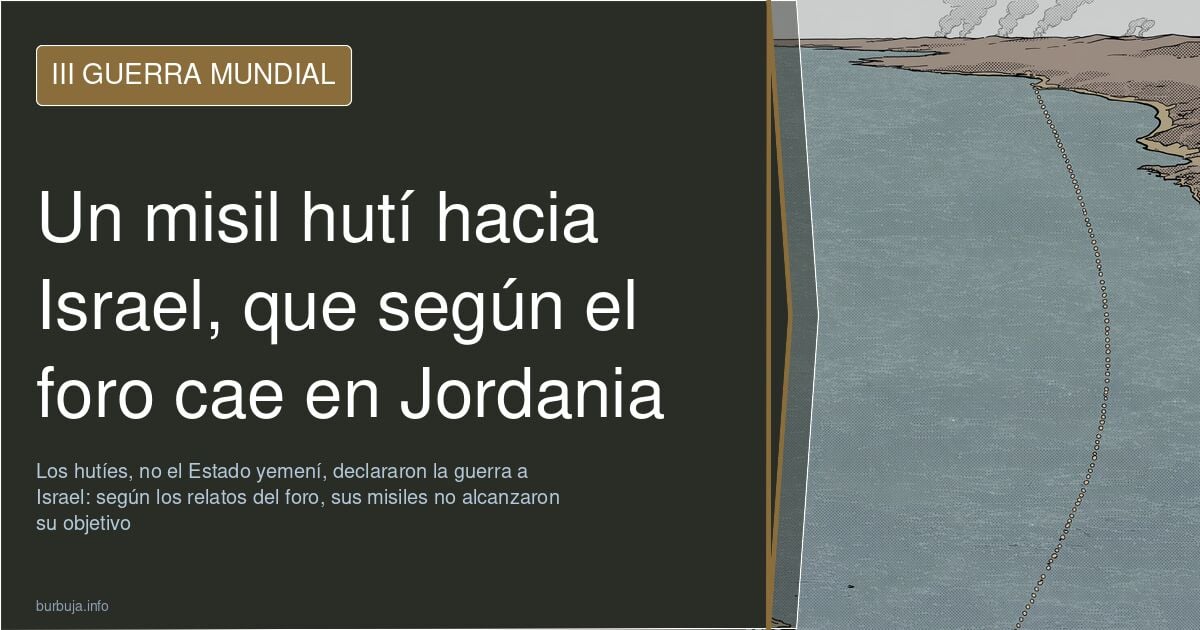
Only the Houthis declared war on Israel, not all of Yemen
In October, a headline travelled faster than any missile: Yemen had declared war on Israel. The fine print came later and dismantles half the statement. It was not the Yemeni state but the Houthis — the movement that controls the west of the country — who announced hostilities against Israel. The internationally recognised government signed no such thing. And that difference, which may seem bureaucratic, determines what we are actually talking about: a declaration between states or the announcement of a militia with its own territory and sponsors across its border.
Why did a missile fired at Israel end up landing in Jordan?
According to forum participants, the first episode produced a rather unheroic image: a projectile fired towards Israel that ended up crashing down on Jordanian territory. Subsequent launches failed to complete the journey as well. Some claim that the United States and Egypt intercepted virtually all of the projectiles, and every attempt costs money. The scale of the challenge helps explain it: according to one participant, the distance between western Yemen and southern Israel is around 2,000 kilometres, and the arsenal spent on each salvo is expensive.
Why control of the Red Sea changes the board
The coastal strip administered by the Houthis is more than a geographical fact. From there, the trajectory towards southern Israel is almost a straight line, with no need to overfly land, and modern missiles correct course and manoeuvre in flight. On paper, the militia has many of the ships crossing the area within range. That is the point that separates mockery from commercial worry: you don't need to win a war to make shipping more expensive for half the world. Some also argue that a militia raised in extremely harsh conditions does not measure risk the way a state does. That is a line of analysis, not a fact.
The suspect that is not Iran
Some point to Tehran, which is said to have promised support to its Yemeni partners. A second reading goes in another direction: it is hard to believe that Saudi Arabia would allow drones and rockets to fly for thousands of kilometres along its border, and some place the real origin of the launches in Egypt. What all the hypotheses share is the same thing: actors who deny any involvement while the material keeps arriving. Some compare the declaration to that of the South American countries against Germany in 1944/45, when the military outcome was already written.
What the announcement leaves open is more than what it settles. War has been declared on a country with which no border is shared, thousands of kilometres away, with expensive and scarce projectiles. Whether that militia can sustain the pace, whether Israel responds in depth or whether Riyadh ends up forced to take a position are questions without answers yet. The declaration is on the table. The rest remains pending.
In October, a headline travelled faster than any missile: Yemen had declared war on Israel. The fine print came later and dismantles half the statement. It was not the Yemeni state but the Houthis — the movement that controls the west of the country — who announced hostilities against Israel. The internationally recognised government signed no such thing. And that difference, which may seem bureaucratic, determines what we are actually talking about: a declaration between states or the announcement of a militia with its own territory and sponsors across its border.
Why did a missile fired at Israel end up landing in Jordan?
According to forum participants, the first episode produced a rather unheroic image: a projectile fired towards Israel that ended up crashing down on Jordanian territory. Subsequent launches failed to complete the journey as well. Some claim that the United States and Egypt intercepted virtually all of the projectiles, and every attempt costs money. The scale of the challenge helps explain it: according to one participant, the distance between western Yemen and southern Israel is around 2,000 kilometres, and the arsenal spent on each salvo is expensive.
Why control of the Red Sea changes the board
The coastal strip administered by the Houthis is more than a geographical fact. From there, the trajectory towards southern Israel is almost a straight line, with no need to overfly land, and modern missiles correct course and manoeuvre in flight. On paper, the militia has many of the ships crossing the area within range. That is the point that separates mockery from commercial worry: you don't need to win a war to make shipping more expensive for half the world. Some also argue that a militia raised in extremely harsh conditions does not measure risk the way a state does. That is a line of analysis, not a fact.
The suspect that is not Iran
Some point to Tehran, which is said to have promised support to its Yemeni partners. A second reading goes in another direction: it is hard to believe that Saudi Arabia would allow drones and rockets to fly for thousands of kilometres along its border, and some place the real origin of the launches in Egypt. What all the hypotheses share is the same thing: actors who deny any involvement while the material keeps arriving. Some compare the declaration to that of the South American countries against Germany in 1944/45, when the military outcome was already written.
What the announcement leaves open is more than what it settles. War has been declared on a country with which no border is shared, thousands of kilometres away, with expensive and scarce projectiles. Whether that militia can sustain the pace, whether Israel responds in depth or whether Riyadh ends up forced to take a position are questions without answers yet. The declaration is on the table. The rest remains pending.
Also available in: Deutsch
Summary of a discussion on Burbuja.info - Foro de economía, actualidad y política., translated from Spanish and reviewed before publication. Read the full discussion (89 replies).
More summaries
-
Israel: Settlers Behind 80% of West Bank Violence
Israeli military warns settlers cause most West Bank violence as Iran war escalates with over 100 missiles and rising oil prices.
-
Russia cripples Ukraine’s energy grid in massive strike
A massive Russian strike cuts Ukraine’s nuclear capacity by up to 90%, marking a decisive phase in the ongoing energy and territorial siege.
-
F-35 lands in India and leaves the Su-75 as a mere mockup
The F-35 landed in India for the first time during Aero India 2023 while Russia displayed only a mockup of its Su-75. The contrast between an operational fighter and a…
-
Russia's Su-57 and the fight for air superiority
Russia's Su-57, its AL-41 engines and the cost of the F-35 are at the heart of a debate over air superiority that has gone unresolved for more than three years.
-
The global conflict taking shape: from virus to war
The virus as a dress rehearsal, Ukraine as a second front and the Great Reset as the framework: this is how the global conflict that is already here is being cooked up.
-
Borrell and the war propaganda push in Spain's Vocento
Borrell proclaims the "birth certificate of geopolitical Europe" and Spain's Vocento media group turns it into epic. An analysis of the official narrative and its contradictions.