
WWII German Soldier Films: Memory or Apology?
German WWII cinema, from Das Boot to Stalingrad, is largely anti-war, humanizing soldiers while condemning the regime.
English · Original discussion in Spanish · Published
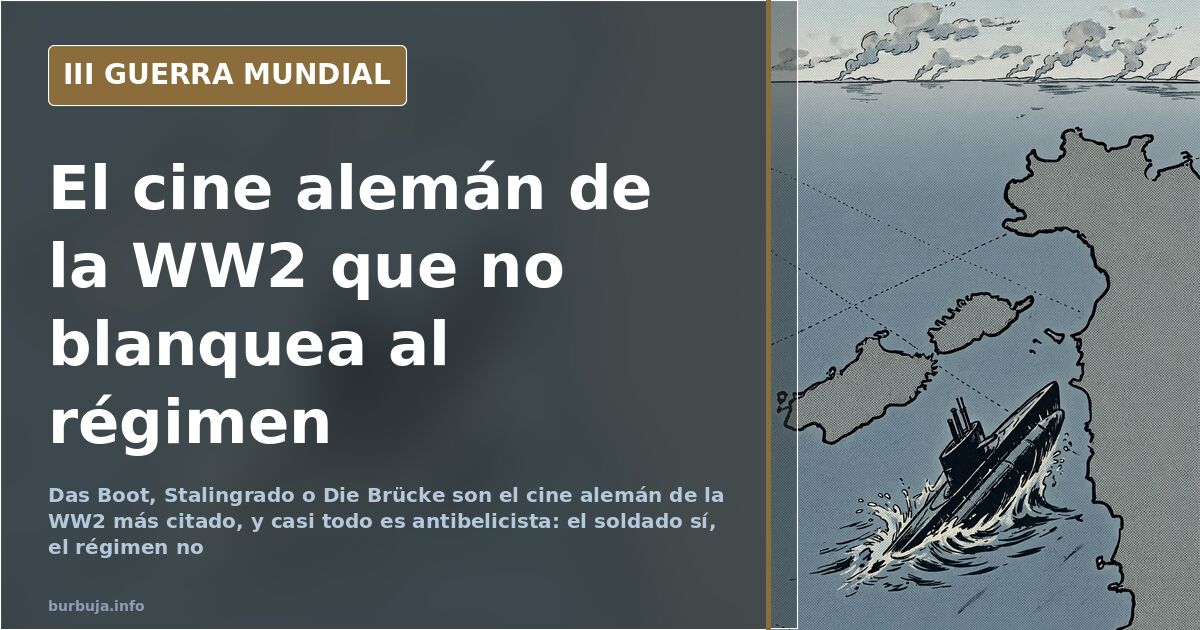
German Soldier Films That Do Not Whitewash the Regime
For those seeking World War II films shot from the German perspective, the recurring list carries an inherent irony: almost all cited titles are, without exception, anti-war movies. This happens whenever a catalog of films "from the good guys' perspective" is requested regarding the Axis powers. The response fills with claustrophobic submarines, defeats on the Eastern Front, and officers who have stopped believing the narrative they were sold. The soldier, yes. The regime, absolutely not.
Which films tell WWII from the German side?
Three titles concentrate the consensus. Das Boot (1981), the classic about a German submarine crossing the Strait of Gibraltar to reach the Italian base of La Spezia, bombed by the British in 1941. Stalingrad (1993), which begins with a unit transferred from France to the siege of the Volga and, despite some unbelievable shootouts, holds up as one of the genre's hardest films. And Die Brücke, about teenagers recruited to defend a bridge in the final days of the conflict.
From there, the list widens: the German series Our Mothers, Our Fathers, the Estonian film 1944, and titles like The Eagle Has Landed or Kelly's Heroes, which are cited more for their portrayal of the German military than for historical fidelity. It is striking that those asking about the losing side receive, above all, works where the enemy is not a cardboard monster, but a frightened man inside a watertight compartment.
The Border Between Humanizing the Soldier and Whitewashing the Regime
There is a fine but real line between portraying the combatant and absolving the apparatus that sent him to die. A portion of the analysis points this out precisely: the filmography produced by the regime itself — Homecoming, The Man with the Cross, Above All Else — does not seek to nuance anything; it seeks to mobilize. The extreme case is Kolberg, filmed in 1945 by the propaganda apparatus's favorite director when defeat was already certain, and described as the last act of propaganda by a state in decay. Filmed in tonalidad, with a deployment designed for an audience that no longer existed.
Here lies the paradox that orders the entire list: post-war German war cinema does not glorify; it mourns. Part of the analysis even underscores that the best approaches to the cruelty of the conflict came from Soviet cinema — Come and See, Seventeen Moments of Spring — or from the former East Germany, not from West Germany.
Why Does a Film List End with Dresden Figures?
As often happens, a conversation about cinema drifts into history, and history drifts into numbers. The bombing of Dresden enters fully. Some argue that "at least 200,000 German civilians" died and that the official figure is falsified by the Allies themselves to hide the magnitude of the episode. Against that calculation, documentary references point to very different magnitudes: Dresden municipal officials spoke in 1965 of about 35,000 victims, and the Saxon historical commission set a range between 18,000 and 23,000 in 2011. The distance between one figure and the other is not a nuance: it multiplies or divides the episode by ten.
Was There Really a "Good" Side in World War II?
The starting premise quickly clashes with the majority response: that the regime that triggered the conflict was an extermination apparatus, not an army defending a common culture. One current of the analysis says so bluntly. Another nuances that the Western Allies were not exemplary either and that the memory of the war is written by the victors. And a third, more political, argues that the conflict was primarily a struggle between powers for the division of the world. None of these readings turn the cited titles into apology: they remain films about losers.
In the end, the most disorienting data is the simplest. The film many point to as the great German work of World War II, Das Boot, is also the one a sector describes as deeply anti-war "on all fronts." Those looking for Axis heroes find corpses inside a steel tube. Cinema, sometimes, does not obey the commission.
For those seeking World War II films shot from the German perspective, the recurring list carries an inherent irony: almost all cited titles are, without exception, anti-war movies. This happens whenever a catalog of films "from the good guys' perspective" is requested regarding the Axis powers. The response fills with claustrophobic submarines, defeats on the Eastern Front, and officers who have stopped believing the narrative they were sold. The soldier, yes. The regime, absolutely not.
Which films tell WWII from the German side?
Three titles concentrate the consensus. Das Boot (1981), the classic about a German submarine crossing the Strait of Gibraltar to reach the Italian base of La Spezia, bombed by the British in 1941. Stalingrad (1993), which begins with a unit transferred from France to the siege of the Volga and, despite some unbelievable shootouts, holds up as one of the genre's hardest films. And Die Brücke, about teenagers recruited to defend a bridge in the final days of the conflict.
From there, the list widens: the German series Our Mothers, Our Fathers, the Estonian film 1944, and titles like The Eagle Has Landed or Kelly's Heroes, which are cited more for their portrayal of the German military than for historical fidelity. It is striking that those asking about the losing side receive, above all, works where the enemy is not a cardboard monster, but a frightened man inside a watertight compartment.
The Border Between Humanizing the Soldier and Whitewashing the Regime
There is a fine but real line between portraying the combatant and absolving the apparatus that sent him to die. A portion of the analysis points this out precisely: the filmography produced by the regime itself — Homecoming, The Man with the Cross, Above All Else — does not seek to nuance anything; it seeks to mobilize. The extreme case is Kolberg, filmed in 1945 by the propaganda apparatus's favorite director when defeat was already certain, and described as the last act of propaganda by a state in decay. Filmed in tonalidad, with a deployment designed for an audience that no longer existed.
Here lies the paradox that orders the entire list: post-war German war cinema does not glorify; it mourns. Part of the analysis even underscores that the best approaches to the cruelty of the conflict came from Soviet cinema — Come and See, Seventeen Moments of Spring — or from the former East Germany, not from West Germany.
Why Does a Film List End with Dresden Figures?
As often happens, a conversation about cinema drifts into history, and history drifts into numbers. The bombing of Dresden enters fully. Some argue that "at least 200,000 German civilians" died and that the official figure is falsified by the Allies themselves to hide the magnitude of the episode. Against that calculation, documentary references point to very different magnitudes: Dresden municipal officials spoke in 1965 of about 35,000 victims, and the Saxon historical commission set a range between 18,000 and 23,000 in 2011. The distance between one figure and the other is not a nuance: it multiplies or divides the episode by ten.
Was There Really a "Good" Side in World War II?
The starting premise quickly clashes with the majority response: that the regime that triggered the conflict was an extermination apparatus, not an army defending a common culture. One current of the analysis says so bluntly. Another nuances that the Western Allies were not exemplary either and that the memory of the war is written by the victors. And a third, more political, argues that the conflict was primarily a struggle between powers for the division of the world. None of these readings turn the cited titles into apology: they remain films about losers.
In the end, the most disorienting data is the simplest. The film many point to as the great German work of World War II, Das Boot, is also the one a sector describes as deeply anti-war "on all fronts." Those looking for Axis heroes find corpses inside a steel tube. Cinema, sometimes, does not obey the commission.
Summary of a discussion on Burbuja.info - Foro de economía, actualidad y política., translated from Spanish and reviewed before publication. Read the full discussion (161 replies).
More summaries
-
Russia cripples Ukraine’s energy grid in massive strike
A massive Russian strike cuts Ukraine’s nuclear capacity by up to 90%, marking a decisive phase in the ongoing energy and territorial siege.
-
Finland joins NATO this summer, reversing Putin's aims
Finnish media predict Finland's NATO accession this summer, a move Moscow claimed its Ukraine invasion sought to prevent.
-
Avdiivka: New Videos Reignite Debate Over Russian Casualties
Ukraine claims over 300,000 Russian deaths; UK estimates up to 190,000. In Avdiivka, the front line is static and casualty counts remain disputed.
-
Russian Propagandist Tatarsky Killed in St. Petersburg Cafe Blast
Vladlen Tatarsky, a Russian propagandist with 600,000 Telegram followers, died after an explosion at a cafe in St. Petersburg.
-
Lunar laser ranging fails to settle moon landing doubts
Despite laser beams bouncing off lunar retroreflectors, skepticism about the Apollo landings persists among conspiracy theorists.
-
Yago, Civilian Analyst Criticized for NATO Ties
Civilian military commentator Yago faces scrutiny over his NATO connections and lack of credentials while covering the Ukraine war.