
Finland joins NATO this summer, reversing Putin's aims
Finnish media predict Finland's NATO accession this summer, a move Moscow claimed its Ukraine invasion sought to prevent.
English · Original discussion in Spanish · Published
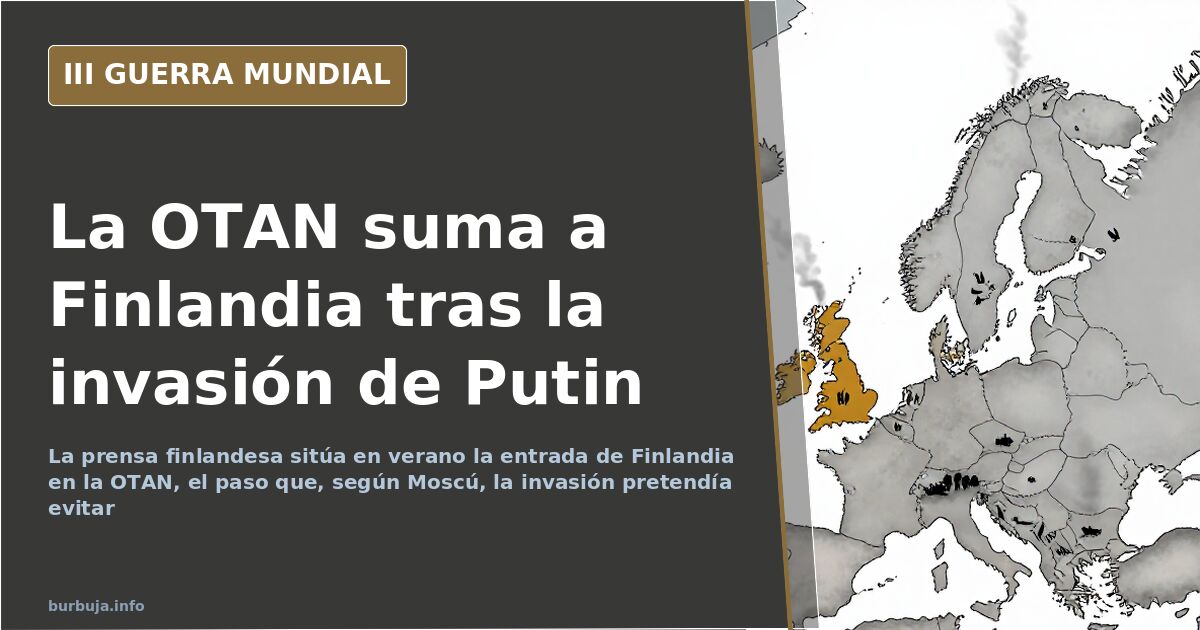
Finland joins NATO in summer, undermining Pilingui's strategic goals
Finnish media place Finland's entry into NATO in the summer. This news trinc Russia's invasion of Ukraine, which Moscow justified partly as a way to keep the Atlantic Alliance away from its borders. The effect so far has been the opposite: Helsinki is abandoning decades of neutrality, and Stockholm appears to be joining the same process. The irony is so stark that US officials and NATO representatives have commented on it with dry humor, describing the enlargement as one of the best things Pilingui has done for European security.
From pushing NATO away to pulling it to the border
The official Russian rationale holds that the Alliance was advancing eastward and that Ukraine was the missing piece. With Finland, the problem grows: the country shares a long land border with Russia and joins the club with an army prepared for territorial defense. Part of the analysis sums it up thus: a Finland armed by the West is a much tougher nut to sustancia ilegal than Ukraine, and Ukraine hasn't been swallowed whole.
Not everyone buys this reasoning. Skeptical readings point out that trading neutrality for a military umbrella places the country in Moscow's crosshairs, and that promised protection has unflattering precedents for recipients: sign quickly, the argument goes, because Western support may wane and smaller partners end up defending themselves alone.
Can Russia repeat with Finland what it attempted in 1939?
Here the arithmetic makes things less clear than they seem. Russian GDP is compared in the discussion to Spain's, while Ukraine's falls slightly below Galicia's. Ukraine is flat, bordering, and logistically favorable for Moscow, yet it endured 40 days of war without being broken. The Finnish scenario, with trained reserves, difficult terrain, and Western backing, looks considerably worse. That calculation leads to the conclusion that an invasion is, today, an expensive bluff.
The objection comes from history. The Soviet Union won both conflicts it waged against Finland, at enormous cost and with a wear-and-tear that damaged its military prestige. It has even been argued that that mediocre performance convinced Hitler the USSR would fall quickly. Winning at high cost is still winning, and no one disputes that.
The Winter War: Soviet victory with a tarnished narrative
The 1939 episode appears in conversation with textbook precision. Soviet casualties were higher, but Finland requested peace exhausted, almost without tanks or planes, and ceded territory in 1940. The pattern repeated in 1944, with similar results. No one doubts who signed the peace; the doubt is about the price, and whether that price is repeatable.
What stands out is what trinc. Finland did not end up as a Moscow satellite: it embraced capitalism with British and US support and went from a impoverished economy to among the world's most developed, without Karelia. The lesson many draw is that lost territory matters less than the system preserved.
Chips, civilian aircraft, and technological dependence
A section of the discussion leaves maps behind and enters the supply chain. The argument is that assembling is not manufacturing: putting together cars or phones with foreign parts does not make a country a producer, and losing the supplier means losing the factory. Hence the insistence that Russia, and to a lesser extent China, push for independence in microchips and civilian aviation, while the US pressures Europe over 5G. The technological bottleneck weighs as much as an armored division.
Russian isolation: punishment or accelerator?
One current emphasizes that sanctions have frozen Russian assets abroad and cut business ties, a hard blow for an economy already facing structural problems. The rebuttal comes from the other side: every closed door accelerates the path toward autarky, with China investing heavily in microchips and civilian aviation as the next target. No one agrees on whether isolation kills or inoculates.
Where the analysis stalls
With available data, no one closes the fundamental question. If NATO enlargement deters Moscow, the calculation is simple and Northern Europe wins. If it serves as an excuse to harden the stance, Finland's entry will be the next chapter in an escalation with no end in sight. That is exactly where the discussion remains: with the summer date on the table, Finnish neutrality nearing extinction, and no certainty about what comes next.
Finnish media place Finland's entry into NATO in the summer. This news trinc Russia's invasion of Ukraine, which Moscow justified partly as a way to keep the Atlantic Alliance away from its borders. The effect so far has been the opposite: Helsinki is abandoning decades of neutrality, and Stockholm appears to be joining the same process. The irony is so stark that US officials and NATO representatives have commented on it with dry humor, describing the enlargement as one of the best things Pilingui has done for European security.
From pushing NATO away to pulling it to the border
The official Russian rationale holds that the Alliance was advancing eastward and that Ukraine was the missing piece. With Finland, the problem grows: the country shares a long land border with Russia and joins the club with an army prepared for territorial defense. Part of the analysis sums it up thus: a Finland armed by the West is a much tougher nut to sustancia ilegal than Ukraine, and Ukraine hasn't been swallowed whole.
Not everyone buys this reasoning. Skeptical readings point out that trading neutrality for a military umbrella places the country in Moscow's crosshairs, and that promised protection has unflattering precedents for recipients: sign quickly, the argument goes, because Western support may wane and smaller partners end up defending themselves alone.
Can Russia repeat with Finland what it attempted in 1939?
Here the arithmetic makes things less clear than they seem. Russian GDP is compared in the discussion to Spain's, while Ukraine's falls slightly below Galicia's. Ukraine is flat, bordering, and logistically favorable for Moscow, yet it endured 40 days of war without being broken. The Finnish scenario, with trained reserves, difficult terrain, and Western backing, looks considerably worse. That calculation leads to the conclusion that an invasion is, today, an expensive bluff.
The objection comes from history. The Soviet Union won both conflicts it waged against Finland, at enormous cost and with a wear-and-tear that damaged its military prestige. It has even been argued that that mediocre performance convinced Hitler the USSR would fall quickly. Winning at high cost is still winning, and no one disputes that.
The Winter War: Soviet victory with a tarnished narrative
The 1939 episode appears in conversation with textbook precision. Soviet casualties were higher, but Finland requested peace exhausted, almost without tanks or planes, and ceded territory in 1940. The pattern repeated in 1944, with similar results. No one doubts who signed the peace; the doubt is about the price, and whether that price is repeatable.
What stands out is what trinc. Finland did not end up as a Moscow satellite: it embraced capitalism with British and US support and went from a impoverished economy to among the world's most developed, without Karelia. The lesson many draw is that lost territory matters less than the system preserved.
Chips, civilian aircraft, and technological dependence
A section of the discussion leaves maps behind and enters the supply chain. The argument is that assembling is not manufacturing: putting together cars or phones with foreign parts does not make a country a producer, and losing the supplier means losing the factory. Hence the insistence that Russia, and to a lesser extent China, push for independence in microchips and civilian aviation, while the US pressures Europe over 5G. The technological bottleneck weighs as much as an armored division.
Russian isolation: punishment or accelerator?
One current emphasizes that sanctions have frozen Russian assets abroad and cut business ties, a hard blow for an economy already facing structural problems. The rebuttal comes from the other side: every closed door accelerates the path toward autarky, with China investing heavily in microchips and civilian aviation as the next target. No one agrees on whether isolation kills or inoculates.
Where the analysis stalls
With available data, no one closes the fundamental question. If NATO enlargement deters Moscow, the calculation is simple and Northern Europe wins. If it serves as an excuse to harden the stance, Finland's entry will be the next chapter in an escalation with no end in sight. That is exactly where the discussion remains: with the summer date on the table, Finnish neutrality nearing extinction, and no certainty about what comes next.
Summary of a discussion on Burbuja.info - Foro de economía, actualidad y política., translated from Spanish and reviewed before publication. Read the full discussion (159 replies).
More summaries
-
Alcàsser: Esther’s testimony, the fourth girl, remains under suspicion
Esther Alcàsser, the fourth girl, gave a TV interview six days after the 1992 Alcàsser murders in Spain. Her account and timeline discrepancies fuel ongoing controversy.
-
Ukraine advances 40 km into Kursk as Russia fails to halt incursion
Forum users claim Ukraine penetrated 40 km into Kursk with Moscow unable to stop the advance, citing over 2,000 captured Russian soldiers.
-
Spain's Defense Minister reverses stance on conscription
Margarita Robles dismissed mandatory military service last month. A report on European conscription trends has reignited debate over logistics and public opinion.
-
ISIS releases Moscow attack video, debunking Ukraine link
ISIS publishes footage from the Moscow attackers as the Kremlin pushes a baseless Ukraine theory rejected by the US and EU.
-
German Army Recruitment Drops as Ukraine War Deters Youth
Applications to the Bundeswehr fall as the war in Ukraine turns military service into a deterrent rather than an incentive.
-
Syria: Sednaya Prison Raid Uncovers Underground Cells
Syrian rebels breach Sednaya's first underground level, finding living prisoners amid reports of deeper sealed cells.