
Workplace Toxicity: Gender Not the Cause
Industrial sector analysis debunks the myth that gender causes bad workplace environments, pointing to power dynamics and shift work instead.
English · Original discussion in Spanish · Published
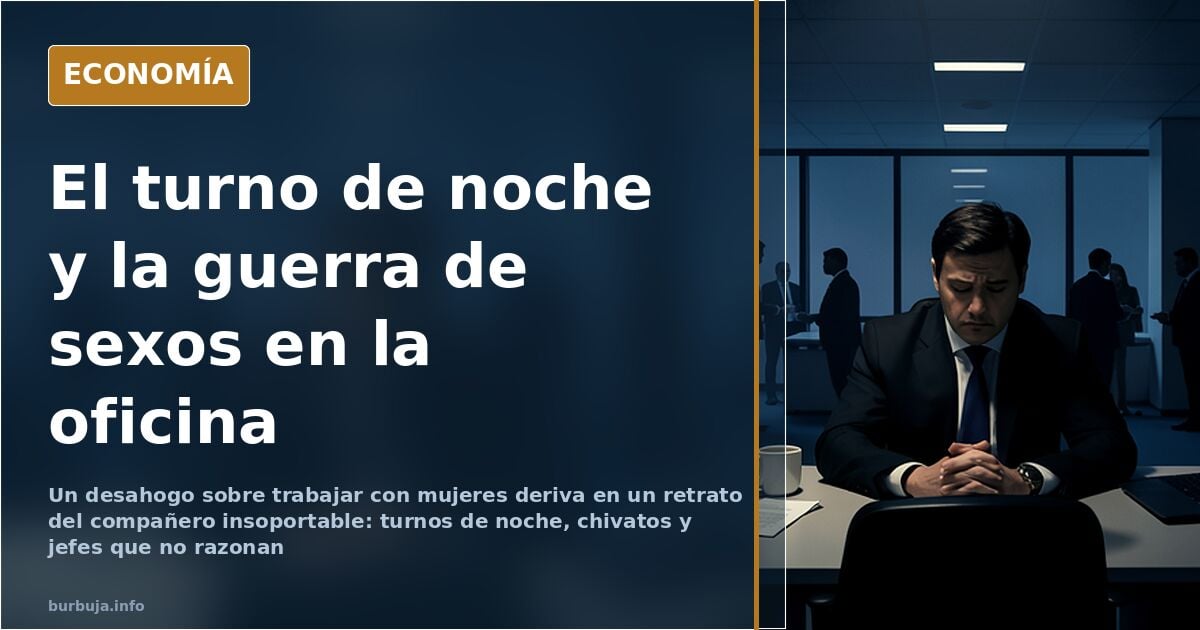
Working with Women: When Workplace Environment Becomes the Problem
Toxic work environments are not gender-specific, though some argue otherwise. An analysis of the industrial and maintenance sectors, backed by nearly two decades of experience, reveals a landscape where conflicts stem more from power, incompetence, and shifts than from colleagues' sens. The debate begins with a blunt assertion—that working with certain profiles is unbearable—and branches into night shifts, middle management, and team leadership.
The Profile of a Bad Colleague Has No Gender
Accumulated experience in industrial maintenance points to a pattern transcending sens: people who never finished basic education struggling to write emails during problems, professional snitches and boss-pleasers, and middle managers with obsessive traits who, according to accounts, do not reason. The conclusion drawn is that workplace toxicity is distributed equally among men and women when behavior, not gender, is the criterion.
The night shift emerges as its own ecosystem. Those who choose it, according to this view, do so for the meager pay premium and suffer severe sleep disorders. At 3 AM, metabolism crashes and packed beans appear. The night shift is very quiet, argues another perspective, recalling time spent in hospitals, data centers, and audits in empty buildings. Companies require a minimum of two people for safety, lest someone gets electrocuted on the roof without witnesses.
Tension Between Safety and Solitude in Night Shifts
The narrative on night shifts splits in two. For some, it is a refuge for misfits; for others, the best possible assignment. Working at night, living at night, enjoying the night is, according to one intervention, the only thing keeping someone alive. The discussion moves to the sociological profile of night workers: those choosing these hours are, by far, the biggest weirdos one will encounter, per the sharpest definition thrown around.
The conversation also addresses crying in the workplace. It describes two civil servants breaking down at work: one leaving her child at daycare, the other having admitted her mother to a care home. The diagnosis offered is that it is a spectacle, though another voice nuances that leaving a small child in daycare is unnatural and affects parents, requiring little empathy to understand.
Noise, Chatter, and Team Management
Constant, irrelevant, and shrill chatter is cited as the main wear-and-tear factor: like having your ears drilled from 8 AM to 3 PM. A colleague admits feeling irrational impulses to attack another over a specific shriek, needing to step out for air. Background noise in offices and workshops thus becomes the true enemy of concentration.
The discussion on middle management adds an interesting nuance: Obsessive-Compulsive Disorder (OCD) is considered ideal for these roles, with warnings that sufferers hide symptoms as they age. Extreme cleanliness and frequent handwashing are mentioned as clues. Another voice counters that OCD tends to harm the sufferer, not others, and that some without OCD are worse than the devil.
Generational Gap and the Nostalgia Narrative
Clashing expectations appear when comparing the 1980s family model—woman at home, man working—with current reality. The question of what has changed in four decades hangs over the conversation, with the response from another camp being that moving women from the kitchen to paying contributions doubled the contributor base. The discussion heats up when crossing into HR management and using machismo as a wildcard.
The analysis concludes without consensus. Experience working with both men and women suggests there are all types on both sides, and jerks don't understand gender. The prediction, with reservations, is that the debate will continue as long as toxic environments are attributed to colleagues' sens rather than the power structures allowing them.
Also available in: Deutsch
Summary of a discussion on Burbuja.info - Foro de economía, actualidad y política., translated from Spanish and reviewed before publication. Read the full discussion (73 replies).
More summaries
-
Theft and fear plague night shift at Navarra Hospital
A nurse reports stolen bags and phones during a night shift at Navarra Hospital, noting the thief returned at 3 AM.
-
Autocares Plana manager dies after punch; driver faces prison
A bus driver in Tarragona is in prison after a fatal punch to his superior. The judge suspects intentional homicide, sparking debate over workplace violence.
-
Barcelona riots raise hybrid attack theory
A TikTok and WhatsApp callout led to riots in Barcelona; one circulating estimate puts it at 130 arrests, 70 of them minors. Comparisons are drawn with Milan and Ceuta.
-
Spain cuts welfare: impact on migrants and economy
Spain's proposed welfare cuts spark debate on economic effects, potential expulsion of migrants, and social conflict risks.
-
Texas Governor-Elect Hinojosa Says Democrats Must Ditch 'Woke' Focus
Gina Hinojosa becomes Texas's first Democratic governor after an economy-focused campaign, rejecting cultural war distractions.
-
Spanish Police Union Jusapol Celebrates Arrests of Far-Right Group
The Spanish police union Jusapol congratulated investigators on arresting members of Núcleo Nacional, comparing them to radical leftists.