
Barcelona riots raise hybrid attack theory
A TikTok and WhatsApp callout led to riots in Barcelona; one circulating estimate puts it at 130 arrests, 70 of them minors. Comparisons are drawn with Milan and Ceuta.
English · Original discussion in Spanish · Published
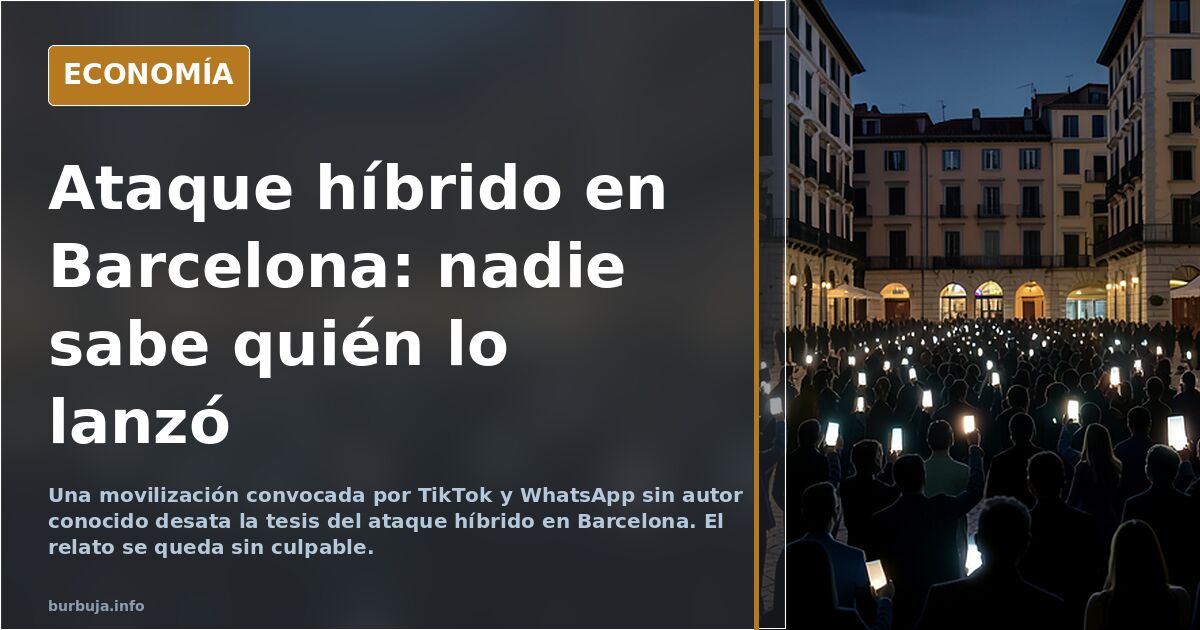
Barcelona burns overnight and no one can agree on who lit the fuse
A callout with no political affiliation, spread via TikTok and WhatsApp, escalated into looting and burning dumpsters in Barcelona. The detail that unsettles everyone: **there is no clear slogan, no identifiable organization, and yet the chaos replicated with precision**. The question hanging over the analysis is no longer who called for it, but who benefits from the answer always being the same: *social media and the underclass*.
What is known about the Barcelona callout
The starting point is a message that circulated on TikTok and WhatsApp urging people to replicate a protest model that matches no known political platform. **No spokespeople, no concrete demands and no visible structure**, the result was a night of riots with arrests, burned dumpsters and ransacked shops. The figure cited in the most quoted analyses: **130 arrests, 70 of them reportedly minors**. That number alone dismantles the organized activism thesis and points to something else.
Some argue that the absence of clear authorship is precisely the signature of the affair. A spontaneous mobilization of that scale, coordinated minute by minute at several locations, does not fit improvisation. Nor classic militancy. *Hybrid attack* is the label that comes up most: **low-intensity action, hard to attribute, with political payoff for whoever suffers it or provokes it**.
The repeating pattern: Milan, Ceuta and October 17
The most frequent comparison in the analysis is no coincidence. In Milan, on October 17, **200 people were arrested, more than half of them foreigners and 80% minors**, with the death of a person and the school as the pretext. In Ceuta, the script was similar. The coincidence in the profile —**young people, many of them minors, with no proven political ties**— is the argument used by those who dismiss the foreign operation thesis and point to a deeper social phenomenon: protest as an excuse for looting.
The opposite reading also has legs. If the pattern repeats in different cities, with the same modus operandi and on close dates, the design hypothesis gains ground. **You don't need a general staff to coordinate riots: an algorithm and a predisposed crowd are enough**. The uncomfortable question is whether someone is measuring the payoff.
The social media scapegoat narrative
The second front of the analysis points to Brussels. If there is one thing the different diagnoses share, it is the suspicion that the episode will be used to **reinforce the digital control agenda**. The sequence is familiar: riot, social alarm, regulation. That the callout originated on TikTok and WhatsApp is, for this camp, the perfect excuse to bring the legislative knife down on the platforms.
The economic calculation is not minor. **Each episode of this kind shifts the cost of security and reconstruction onto the taxpayer**, while the public debate moves away from migration management and social exclusion toward the responsibility of tech companies. A shift that, from the standpoint of public spending, costs nothing to whoever triggers it.
Who wins from the chaos and who pays the bill
Local businesses pay first. **Burned dumpsters, smashed shop windows and insurance premiums that will rise at the next renewal**. For the small shopkeeper downtown, the question is not geopolitical: it is whether they can open tomorrow. And on that ground, theories about secret services or algorithms matter far less than the certainty that no one will compensate them for the broken glass.
The underlying discussion is a different one. If the phenomenon is social, the answer is integration and jobs. If it is a hybrid attack, the answer is defense and expulsion. **The two theses demand opposite policies and no government wants to choose in public**. Meanwhile, the pattern repeats itself and the next callout is already circulating on some app that no one audits.
How many more nights have to burn before someone dares to say what is really going on?
Summary of a discussion on Burbuja.info - Foro de economía, actualidad y política., translated from Spanish and reviewed before publication. Read the full discussion (68 replies).
More summaries
-
Spain PM's Wife Rents Rooms for €2,200 in Tension Zone
A journalist claims Begoña Gómez rents rooms to foreign students in a Madrid tension zone for €2,200 monthly.
-
Galicia sells off its industry: from Avícola Tratante to Aludec
Avícola Tratante, Aludec, Ochoa, Martínez Otero: foreign capital is buying up Galician companies; forum users point to the lack of generational succession
-
Vox and PSOE: the deal no one confirms but everyone talks about
A tweet claims Vox has a deal with Spain's PSOE without providing any evidence. The claim is stirring up a campaign in which, some say, Vox is rising and the PP fears being overtaken.
-
Podemos will not run in Catalonia and will ask voters to back ERC
Under the preliminary deal, Podemos will not stand in Catalonia and will urge its voters to support ERC, while Rufián campaigns outside the region. The pact leaves questions open about its…
-
Colau blames Barcelona riots on police and far right
Ada Colau blames the Barcelona looting on the police and the far right, while her housing record and the official narrative are being called into question.
-
Peak Oil by stealth: the thesis that explains 2020 and 2022
Demand fell by 8.5 million barrels per day in 2020 and prices collapsed. The managed Peak Oil hypothesis explains why.