
Women sharing a flat in Spain: the electricity bill tears them apart
In Spain, two salaries are no longer enough to rent a flat, and female flatmates end up arguing over the electricity bill. The problem is not who cleans: it's the price.
English · Original discussion in Spanish · Published
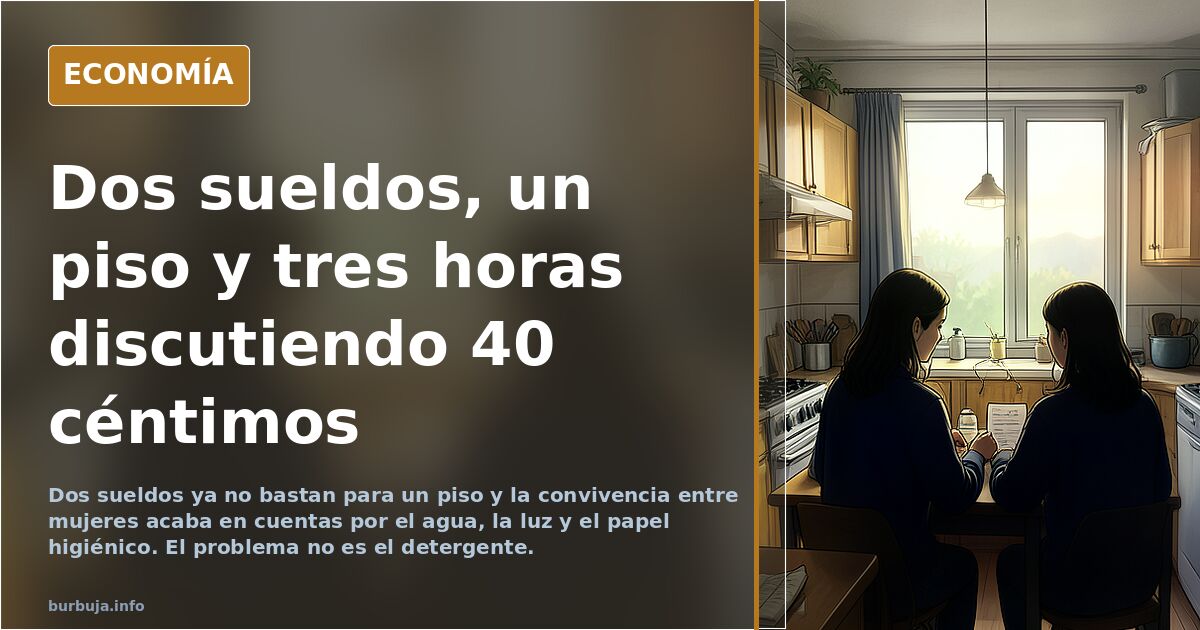
Women sharing a flat: a living arrangement that explodes over the bill
Why can't two employed people afford a home and end up arguing over forty cents' worth of detergent? That is the question hovering over a current debate about women living together as flatmates, and the uncomfortable answer is that the problem is not who scrubs the toilet, but the price of housing. The starting point is a domestic scene: two independent women, each with her own bedroom, a shared kitchen and bathroom, and a first electricity bill that turns harmony into an investigation committee over who showers for forty minutes and who for five.
The underlying thesis is that sharing a flat reproduces all the drawbacks of marriage with none of its advantages. What begins as an economic solution ends up being a management conflict: who buys the branded detergent, who sets the heating to twenty-five degrees, who comes home at three in the morning. And when a man shows up who only comes to spend the night but showers, has breakfast and leaves his underwear where he shouldn't, the argument stops being about water and becomes about the energy consumption of lovers.
Money is the real trigger of cohabitation
The financial conflict appears early on. One falls behind on the rent by ten days, then twenty, and the other covers her share and starts to feel exploited. Since someone has to organise shopping, cleaning and payments, one ends up taking charge, and that's when the sentence that sums it all up comes out: "You're not my mother!". The consequence is that cohabitation turns into a spreadsheet for dividing up the detergent, with no affection or commitment.
The scale of the problem grows with the number of housemates. With two people there is friction; with three, majorities appear and two gang up against the third; with four, two camps form; with five, the flat becomes a regional parliament with coalitions and no-confidence motions to decide who cleans the kitchen. The conclusion drawn is that no improvised domestic structure solves what the economy cannot solve.
The traditional couple as an economic argument, not a sarracena one
The defence of the traditional couple is framed here in terms of the division of roles, not sarracena. The claim is that the man-woman couple developed over centuries a distribution of responsibilities that society knows well, and that correcting injustices is one thing, while replacing that arrangement with another that reproduces the same conflicts, without affection or commitment, is another. The argument closes with a deliberately provocative statement about complementarity, which the author himself admits will earn him the label of sens.
The most acid twist comes with the romantic variant. If one of the two flatmates falls in love with the other, the one who thought she was sharing a flat discovers she is sharing a life, and jealousy, absences and couple's arguments appear without anything having been signed. The proposed solution — bringing in a third person — turns emotional diversity into a local problem, with three people tearing each other's hair out in the living room.
What the electricity bill says about housing
The heart of the matter is not cohabitation, it's the market. The conclusion that imposes itself is that society has reached a point where two employed people cannot afford decent housing, but can argue for three hours over who spent forty cents more on toilet paper. If that is what coming of age means, someone is making an extraordinary profit out of freedom.
The discussion drifted towards claims about women's character and their supposed difficulty living with each other, with personal anecdotes about neighbours, work colleagues and couples who shared flats. These are opinions, not data: there is no statistic showing that women living together fails more than any other arrangement. The only verifiable thing is the price of housing and the gap between wages and rent.
Also available in: Deutsch
Summary of a discussion on Burbuja.info - Foro de economía, actualidad y política., translated from Spanish and reviewed before publication. Read the full discussion (104 replies).
More summaries
-
Traditional Couple Crisis: Housing, State, and Feminism
A calculation attributes 75% of breakups initiated by women to the crisis between feminism, the State, and housing.
-
Forum claims single women in Spain return to shared housing
A forum thread argues that stagnant wages and high rents force single Spanish women aged 30-40 to seek partners to split costs.
-
Pola Jankowska champions the traditional couple
Polish psychologist Pola Jankowska champions the traditional couple — and a commenter calls her out for preaching a model she hasn't built herself.
-
Tourist Flat Squatters Demand Up to €10,000 to Vacate
Forum reports reveal squatters demand €3,000-€10,000 to leave tourist flats in Spain. Overburdened courts and organized gangs worsen the crisis.
-
The Great Replacement theory is a nationalist conspiracy, London analysis shows
The portrayal of London as "hell" is tied to the "Great Replacement" conspiracy theory. What lies behind it?
-
Breaking Down the Services Sector: Its Main Subsectors Explained
The services sector broken down into its main subsectors: trade, transport, finance, culture and more. Understand why it matters.