
Traditional Couple Crisis: Housing, State, and Feminism
A calculation attributes 75% of breakups initiated by women to the crisis between feminism, the State, and housing.
English · Original discussion in Spanish · Published
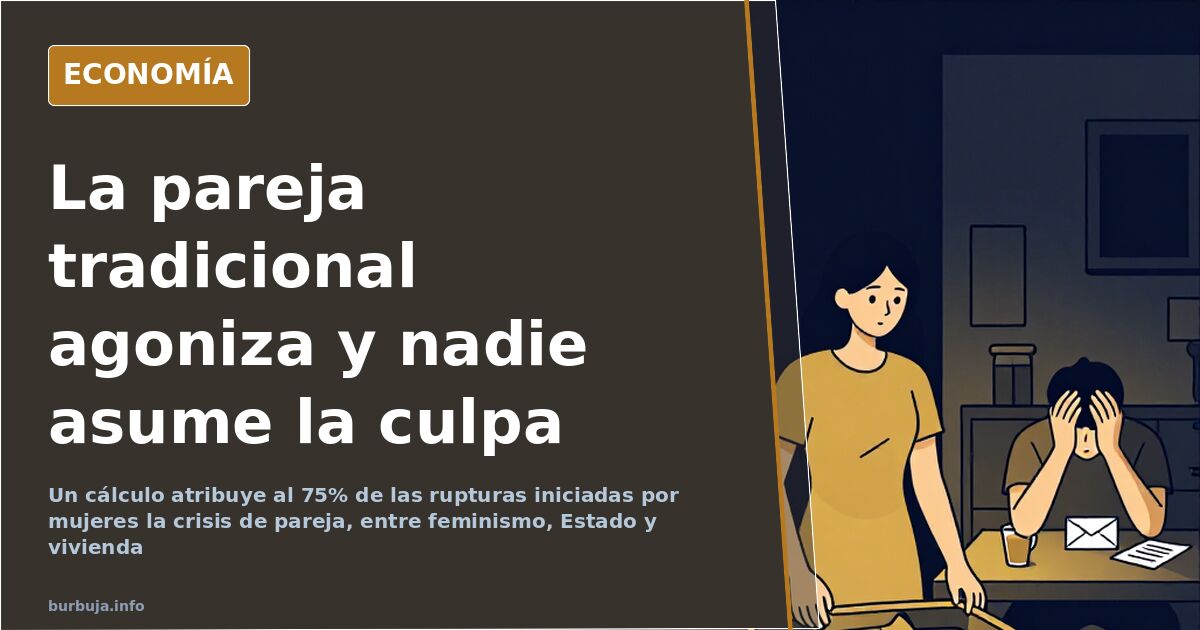
The traditional couple breaks up: no one assumes guilt and everyone pays
A forty-year-old married man with children and a flat tire calls his retired father to accompany him to the garage. This scene repeats in more than one home and serves part of the analysis to settle the matter: the problem is not economic, but that a generation of men failed to learn how to solve it alone. The other half responds with the reverse accusation: the culprit is the narrative of empowerment, a legal framework that punishes men, and a real estate market that has turned independence into a luxury. After a long exchange, no one has moved their position. The sharing of blame remains tied.
Feminism, media, and laws: the accusation that rings loudest
There is a current that places the origin of the traditional couple crisis in a directed cultural change. On their list of suspects are music—with Malamente as a cited case—animation films, series, and an entire audiovisual production that, according to this reading, ridicules heterosenshetero men and rewards female victimhood. Then comes the legal framework. It is argued that gender violence laws and divorce regimes have turned marriage into a roulette with too many bullets in the chamber. The consequence, they say, is that fewer and fewer men see the altar as a reasonable destination.
The harshest version of this thesis even points to a supposed organized infiltration in activism, a suspicion launched without proof and best taken as what it is: a bar hypothesis, not a documented fact. The solid part of this current is its reading of the incentive: equality policies would function, in their version, as a stimulus for breakup rather than stability.
Housing, the State, and marital property: the economic thesis
In contrast to the cultural narrative, a second explanation dives into accounting details. Maintaining a family requires resources, and it is argued that the State has taken an increasing share: the larger the administration, the less room remains for the family project. Added to this is the price of housing, which delays emancipation and, with it, any couple plan. The most repeated diagnosis fits in three words: money and flats.
The third element is legal. Some recall that in previous generations, assets acquired with external income were considered joint, and household care was not counted as unpaid labor. Today, this domestic accounting has been dismantled, along with part of the glue holding the unit together. The criticism is not against equality, but against having turned household support into an invisible item that no one pays for.
The matching market and the 75% of breakups
One figure repeats as ammunition: 75% of breakups are initiated by them, according to the calculation circulating in the analysis. From this, it is deduced that men were already as they were when the relationship began, and therefore, the argument of sudden immaturity does not hold. The reasoning is completed with a portrait of the market: women aged 40 and 45 receiving proposals from men aged 20 to 35, while men of that age compete with fewer cards on the table.
The conclusion drawn is uncomfortable and, undoubtedly, debatable: if matching functions as a market, the outcome is decided not by sarracena, but by supply. No one in the analysis provides an official source backing that percentage, so it functions more as a rhetorical weapon than as a statistic.
Men who do not mature and mothers who hold them back
The opposing thesis absolves no one. It points to men in their thirties and forties who still behave like adolescents, who go to the doctor with their mother speaking for them, and who do not change cities for antiestéticar of losing family protection. The diagnosis extends to the generation raised with cotton wool from 1980 onwards and to mothers who did not cut the umbilical cord.
With this material, this current argues, a heterosenshetero woman has it difficult. And it adds a symmetrical rebuttal: there are also men who cause more trouble than an impatient customer asking to have fish scales removed before weighing. The complaint, in any case, is fundamental: it is not that women have changed, but that they cannot find who to change with.
Contraception and the decline of religious marriage
Underlying all of this are two structural explanations that almost no one disputes when they appear. The first is religious: if marriage is a sacrament and life has a transcendent end, no crisis puts it at risk. The second is technological and perhaps the most cited of all: birth control placed the decision to have children in individual hands, and with it, the choice to choose or renounce a partner.
Marriage, meanwhile, has gone from social norm to exception. There is no longer a need to endure each other as before—economically, legally, or socially—to get by. That is, fundamentally, the only conclusion all factions agree on.
The figure remains. 75% of breakups, initiated by them, according to the circulating calculation. With that figure on the table, the question of who is to blame becomes almost rhetorical: each side has its statistics, its cases, and its favorite culprit. What does not appear anywhere is a figure measuring the opposite: how many traditional couples continue to function without anyone writing about them.
A forty-year-old married man with children and a flat tire calls his retired father to accompany him to the garage. This scene repeats in more than one home and serves part of the analysis to settle the matter: the problem is not economic, but that a generation of men failed to learn how to solve it alone. The other half responds with the reverse accusation: the culprit is the narrative of empowerment, a legal framework that punishes men, and a real estate market that has turned independence into a luxury. After a long exchange, no one has moved their position. The sharing of blame remains tied.
Feminism, media, and laws: the accusation that rings loudest
There is a current that places the origin of the traditional couple crisis in a directed cultural change. On their list of suspects are music—with Malamente as a cited case—animation films, series, and an entire audiovisual production that, according to this reading, ridicules heterosenshetero men and rewards female victimhood. Then comes the legal framework. It is argued that gender violence laws and divorce regimes have turned marriage into a roulette with too many bullets in the chamber. The consequence, they say, is that fewer and fewer men see the altar as a reasonable destination.
The harshest version of this thesis even points to a supposed organized infiltration in activism, a suspicion launched without proof and best taken as what it is: a bar hypothesis, not a documented fact. The solid part of this current is its reading of the incentive: equality policies would function, in their version, as a stimulus for breakup rather than stability.
Housing, the State, and marital property: the economic thesis
In contrast to the cultural narrative, a second explanation dives into accounting details. Maintaining a family requires resources, and it is argued that the State has taken an increasing share: the larger the administration, the less room remains for the family project. Added to this is the price of housing, which delays emancipation and, with it, any couple plan. The most repeated diagnosis fits in three words: money and flats.
The third element is legal. Some recall that in previous generations, assets acquired with external income were considered joint, and household care was not counted as unpaid labor. Today, this domestic accounting has been dismantled, along with part of the glue holding the unit together. The criticism is not against equality, but against having turned household support into an invisible item that no one pays for.
The matching market and the 75% of breakups
One figure repeats as ammunition: 75% of breakups are initiated by them, according to the calculation circulating in the analysis. From this, it is deduced that men were already as they were when the relationship began, and therefore, the argument of sudden immaturity does not hold. The reasoning is completed with a portrait of the market: women aged 40 and 45 receiving proposals from men aged 20 to 35, while men of that age compete with fewer cards on the table.
The conclusion drawn is uncomfortable and, undoubtedly, debatable: if matching functions as a market, the outcome is decided not by sarracena, but by supply. No one in the analysis provides an official source backing that percentage, so it functions more as a rhetorical weapon than as a statistic.
Men who do not mature and mothers who hold them back
The opposing thesis absolves no one. It points to men in their thirties and forties who still behave like adolescents, who go to the doctor with their mother speaking for them, and who do not change cities for antiestéticar of losing family protection. The diagnosis extends to the generation raised with cotton wool from 1980 onwards and to mothers who did not cut the umbilical cord.
With this material, this current argues, a heterosenshetero woman has it difficult. And it adds a symmetrical rebuttal: there are also men who cause more trouble than an impatient customer asking to have fish scales removed before weighing. The complaint, in any case, is fundamental: it is not that women have changed, but that they cannot find who to change with.
Contraception and the decline of religious marriage
Underlying all of this are two structural explanations that almost no one disputes when they appear. The first is religious: if marriage is a sacrament and life has a transcendent end, no crisis puts it at risk. The second is technological and perhaps the most cited of all: birth control placed the decision to have children in individual hands, and with it, the choice to choose or renounce a partner.
Marriage, meanwhile, has gone from social norm to exception. There is no longer a need to endure each other as before—economically, legally, or socially—to get by. That is, fundamentally, the only conclusion all factions agree on.
The figure remains. 75% of breakups, initiated by them, according to the circulating calculation. With that figure on the table, the question of who is to blame becomes almost rhetorical: each side has its statistics, its cases, and its favorite culprit. What does not appear anywhere is a figure measuring the opposite: how many traditional couples continue to function without anyone writing about them.
Summary of a discussion on Burbuja.info - Foro de economía, actualidad y política., translated from Spanish and reviewed before publication. Read the full discussion (305 replies).
More summaries
-
The Future of the Catholic Church: Priests Marrying and Having Children
The Catholic Church might relax celibacy for priests, allowing marriage and parenthood in response to the vocation crisis.
-
Couple sleeps in car in Arteixo after losing their rental home
Juan José and Isabel have spent three nights in a car in Arteixo after losing their €400 flat. The case highlights the failure of designated stressed housing areas.
-
YouTube's Cuqui Family: Profiting from Junk Food and Plastics
Burbuja.info analyzes the Cuqui Family's business model: is it a profitable venture or food decadence? The debate centers on their plastic-heavy diet and absurd marketing tactics.
-
Madrid ranks 8th in quality of life: professor on the brink of poverty
Madrid and Málaga top the quality of life list, clashing with real incomes: a full-time teacher says life in Spain's capital is on the brink of poverty.
-
Sotrondio: from 5,700 shelter beds to 180 actual
The national plan distributes 5,700 shelter beds across Spain, but the Sotrondio center drops from 180 to 120 after a €9 million renovation.
-
Hard Work Doesn't Pay: Spain's Meritocracy Crisis
A Spanish forum exposes how high tuition, low doctoral offers, and 800-euro salaries undermine the meritocracy myth.