
Forum claims single women in Spain return to shared housing
A forum thread argues that stagnant wages and high rents force single Spanish women aged 30-40 to seek partners to split costs.
English · Original discussion in Spanish · Published
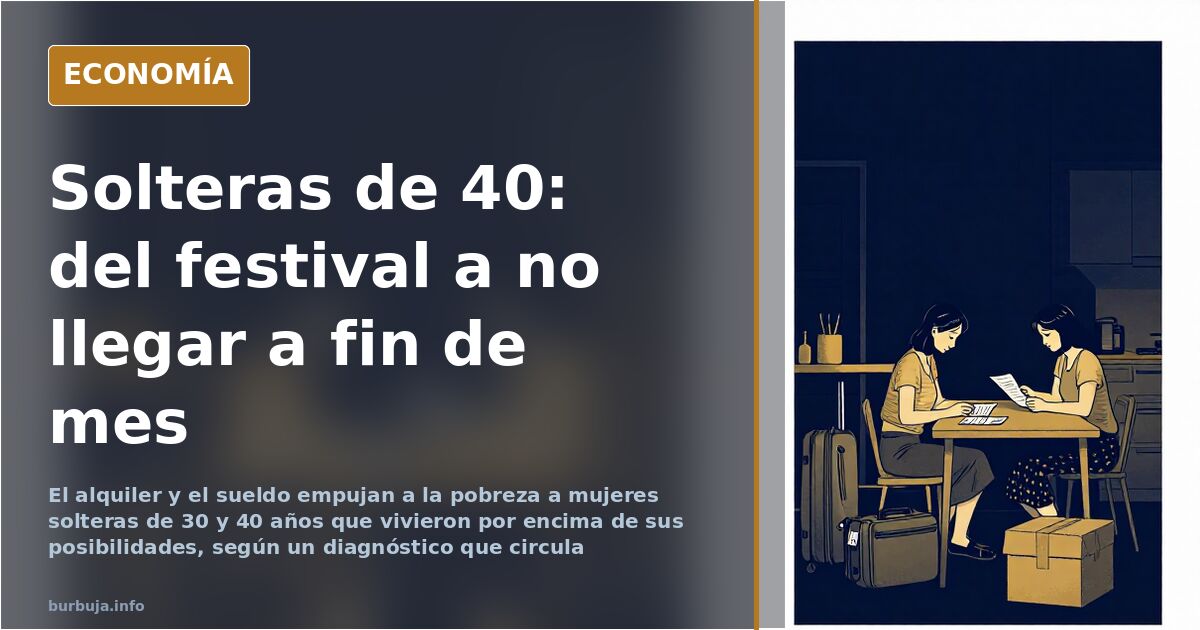
Forum claims single women in Spain return to shared housing
The salary that covered travel, festivals and terrace drinks five years ago no longer covers rent. In Spanish cities, a profile is emerging that previously had little name: single women between 30 and 40, employed, without stable partners, and with bank accounts quietly draining away. The combination of stagnant salaries, skyrocketing rents, and a social life sustained for years by incomes that never allowed savings has turned comfort into an unstoppable downhill slide, according to testimonials gathered in a forum thread.
The issue entered public discourse without making major headlines. There is no official statistic measuring how many women in this age group have returned to shared flats, moved back with parents, or cut leisure spending to zero. But testimonies are accumulating: people who lived comfortably four or five years ago now struggle to reach the end of the month. The "crazy life" didn't stop abruptly. It faded month by month.
The budget-breaking trio: salary, rent, and shopping basket
The first factor is salary. A net monthly wage of €2,100, which was a fortune in 2008, barely suffices today if one must pay rent, support children, or cover a high mortgage, according to a message in the thread. Inflation has eroded purchasing power while taxes and grocery prices rose relentlessly. Those with no dependents and low mortgage payments can survive. Those with children renting homes cannot.
The second factor is housing. Rent prices have grown far above income levels, pushing part of this generation back to square one: sharing flats at 40 or returning to the family home. This is not a lifestyle choice. It is an arithmetic imposition.
The third factor is sustained consumption. For years, part of this demographic lived beyond their means: trips, festivals, dinners, getaways. While not exclusive to women, it has become more visible among them because society sold it as a model of empowerment that came without financial instructions.
From unrestricted leisure to seeking shelter: what is changing
The most visible consequence is a shift in strategy. Where weekend plans once existed, there is now a search for stability. And that stability, in many cases, involves finding a partner who provides what one's own salary cannot: owned housing, complementary income, or simply someone to share expenses with.
Some argue this turn makes these women "provider hunters," generating distrust on the other side. Counterarguments state that precariousness is not a choice: it results from a labor market that pays poorly and housing that has become the main driver of intergenerational inequality.
The full breakdown reveals a surprising gap: what covered rent, leisure, and savings five years ago now barely covers rent and food. That is the core of the problem.
The rarely mentioned factor: civil service endogamy
In parallel, a phenomenon complicating the diagnosis has emerged. In certain circles, especially among civil servants (funcionarios) and those with job security, clear endogamy has spread: people seek partners within their own circle. The repeated argument is that those who fought for a permanent post do not want to lower their quality of life by partnering with someone earning less or having worse conditions.
This sidelines part of the dating market. Not only men with low salaries, but also women who, lacking such stability, compete in a field where the other side values payroll and assets over mere attractiveness.
Is this a gender or generational issue?
The short answer is both, and neither alone. Precariousness affects men and women differently. Men often face greater social pressure to own property and save before 40. Women, conversely, were raised with a narrative of independence that did not always include tools to sustain it long-term.
The result is a generation reaching 40 with precarious jobs, no assets, and family networks sometimes unable to provide further support. The question is not who is to blame. It is how many will continue falling down this slope before anyone measures the phenomenon seriously.
Given these factors, it is reasonable to expect the problem to grow in coming years. Housing does not become cheaper, wages do not rise, and family support networks have limits. If nothing changes, the profile of single women aged 40 at risk of poverty will cease to be anecdotal and become a statistical category. However, judging by current trends, it may already be too late for many.
The salary that covered travel, festivals and terrace drinks five years ago no longer covers rent. In Spanish cities, a profile is emerging that previously had little name: single women between 30 and 40, employed, without stable partners, and with bank accounts quietly draining away. The combination of stagnant salaries, skyrocketing rents, and a social life sustained for years by incomes that never allowed savings has turned comfort into an unstoppable downhill slide, according to testimonials gathered in a forum thread.
The issue entered public discourse without making major headlines. There is no official statistic measuring how many women in this age group have returned to shared flats, moved back with parents, or cut leisure spending to zero. But testimonies are accumulating: people who lived comfortably four or five years ago now struggle to reach the end of the month. The "crazy life" didn't stop abruptly. It faded month by month.
The budget-breaking trio: salary, rent, and shopping basket
The first factor is salary. A net monthly wage of €2,100, which was a fortune in 2008, barely suffices today if one must pay rent, support children, or cover a high mortgage, according to a message in the thread. Inflation has eroded purchasing power while taxes and grocery prices rose relentlessly. Those with no dependents and low mortgage payments can survive. Those with children renting homes cannot.
The second factor is housing. Rent prices have grown far above income levels, pushing part of this generation back to square one: sharing flats at 40 or returning to the family home. This is not a lifestyle choice. It is an arithmetic imposition.
The third factor is sustained consumption. For years, part of this demographic lived beyond their means: trips, festivals, dinners, getaways. While not exclusive to women, it has become more visible among them because society sold it as a model of empowerment that came without financial instructions.
From unrestricted leisure to seeking shelter: what is changing
The most visible consequence is a shift in strategy. Where weekend plans once existed, there is now a search for stability. And that stability, in many cases, involves finding a partner who provides what one's own salary cannot: owned housing, complementary income, or simply someone to share expenses with.
Some argue this turn makes these women "provider hunters," generating distrust on the other side. Counterarguments state that precariousness is not a choice: it results from a labor market that pays poorly and housing that has become the main driver of intergenerational inequality.
The full breakdown reveals a surprising gap: what covered rent, leisure, and savings five years ago now barely covers rent and food. That is the core of the problem.
The rarely mentioned factor: civil service endogamy
In parallel, a phenomenon complicating the diagnosis has emerged. In certain circles, especially among civil servants (funcionarios) and those with job security, clear endogamy has spread: people seek partners within their own circle. The repeated argument is that those who fought for a permanent post do not want to lower their quality of life by partnering with someone earning less or having worse conditions.
This sidelines part of the dating market. Not only men with low salaries, but also women who, lacking such stability, compete in a field where the other side values payroll and assets over mere attractiveness.
Is this a gender or generational issue?
The short answer is both, and neither alone. Precariousness affects men and women differently. Men often face greater social pressure to own property and save before 40. Women, conversely, were raised with a narrative of independence that did not always include tools to sustain it long-term.
The result is a generation reaching 40 with precarious jobs, no assets, and family networks sometimes unable to provide further support. The question is not who is to blame. It is how many will continue falling down this slope before anyone measures the phenomenon seriously.
Given these factors, it is reasonable to expect the problem to grow in coming years. Housing does not become cheaper, wages do not rise, and family support networks have limits. If nothing changes, the profile of single women aged 40 at risk of poverty will cease to be anecdotal and become a statistical category. However, judging by current trends, it may already be too late for many.
Also available in: Deutsch
Summary of a discussion on Burbuja.info - Foro de economía, actualidad y política., translated from Spanish and reviewed before publication. Read the full discussion (386 replies).
More summaries
-
Spain's Pension-Housing Gap Sparks Generational Tension
A viral calculation claims young earners transfer €2,000 monthly to pensioners via taxes and rent, widening the generational divide in Spain.
-
Riots in French schools: fires and attacks
Fires in French schools, teachers attacked and blockades spreading to Belgium. The unrest is attributed to the education strike and radical groups.
-
Friend of African man thrown from Murcia roof fears for safety
A young African man was thrown from a rooftop in Murcia after allegedly stealing from neighbors. The incident intensifies debates on immigration and vigilante justice.
-
Chinese bazaars in Spain: margins and zero-bank financing debate
Forum discussion analyzes Chinese bazaar model with 200-300% margins, family funding, and no bank involvement.
-
Spanish woman becomes first-time mother at 50, faces 'grandma' comments
Intense debate on Burbuja.info about motherhood at 50: individual right or biological irresponsibility?
-
Open-source project clones seven Adobe apps
An open-source initiative replicates features from seven Adobe applications, gaining 44,000 GitHub stars and updating every three days.