
Wolf attacks quintuple in Cantabria before hunting ban
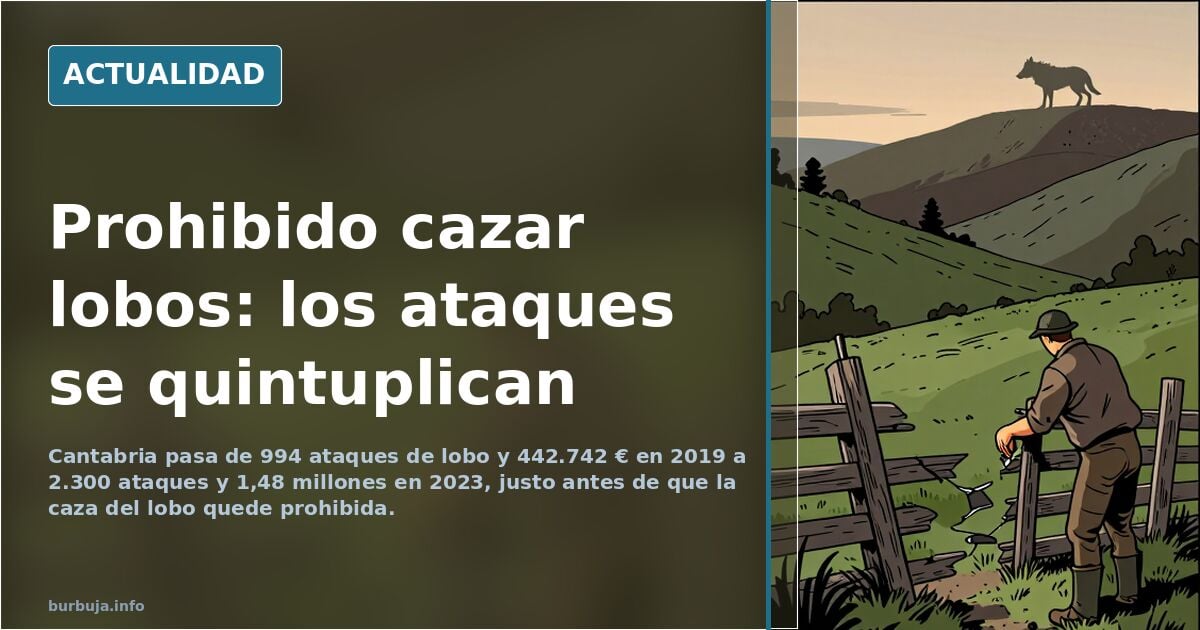
Cantabria went from 994 wolf attacks and €442,742 in 2019 to 2,300 attacks and €1.48 million in 2023, just before wolf hunting is banned.
English · Original discussion in Spanish · Published
Wolf hunting banned across Spain from 25 September
On 25 September, wolf hunting will no longer be allowed anywhere in Spain. Until now, northern regions could authorise control culls of the species; under the new framework, that option is also closed in Cantabria, Asturias, Galicia and Castilla y León, where most of the packs are concentrated. Several northern authorities have announced appeals to the Supreme Court. The timing is no coincidence: the closure coincides with the opening of the hunting season.
The underlying debate is not whether the wolf should exist — no reasonable person advocates its extermination — but how far it should be protected and who foots the bill when the species expands. At that point, consensus breaks down.
Wolf attacks quintuple in Cantabria in five years
The series of damages cited in Cantabria draws a slope that admits few interpretations. In 2019, 994 attacks and €442,742 in compensation were recorded. In 2020, 948 attacks and €477,543. In 2021, 1,040 attacks and €375,000: the curve seemed contained.
Then came the jump. In 2022, attacks rose to 1,632 and compensation to €786,199. The trinc year, with 2,300 attacks and €1.48 million, smashed all records. The rural view is simple: damage does not grow by chance, it grows when the species stops being managed.
Some dispute that relationship and point to a larger wolf population, more livestock in the hills or a more accessible damage reporting system. But quintupling attacks in five years is hard to explain by paperwork alone.
Why the wolf is becoming bolder
Little by little, sightings have accumulated in broad daylight and close to villages, in Asturias, Cantabria and Galicia. The explanation used is habituation: packs that lose their antiestéticar of humans when they stop receiving pressure and find easy food in the form of extensive livestock.
A detail repeated by those who know the hills: a wolf pack does not tolerate other canids in its territory. That leads to an uncomfortable conclusion for part of the conservationist narrative, which attributes much of the damage to feral dogs. In areas with a stable and dense wolf presence, they point out, wild dogs have little room to roam freely.
And it is not just the wolf. In the conversation, bears have also appeared in northern Burgos and traces of the golden jackal in Guipúzcoa, a species that until recently was not on the peninsular map.
How long has the wolf coexisted with livestock?
Here dates are used as a weapon. One side recalls that the wolf has been on the Peninsula for some 15 million years and has coexisted with humans long before livestock farming existed, a trade that in Spain dates back some 4,000 years. The conflict, they say, is old and was always resolved by killing wolves.
The opposite version maintains that none of those figures change the current problem: hills with more wolves and less control than fifty years ago. No one disputes that the predator coexisted with the flock for centuries. The question is at what price and with what management tool. The answer from many farmers is uncomfortable: during that time there was no coexistence, there was constant harassment to keep it away from the flock.
Mastiffs, fences and the maths that doesn't add up
The official response repeated is defence with mastiffs. On paper it sounds reasonable. In practice, the arithmetic is different.
A calculation circulating among extensive livestock farmers puts the profitability of a farm at 80 to 100 head to earn a single decent salary without subsidies; with twelve cows, they say, diesel eats the profit before you start. Now add dogs. The proposal to match the number of mastiffs to the number of wolves, distributed among each livestock herd, leads to surreal scenarios: twenty herds in a shared valley equals 140 dogs on guard.
Jokes aside, the underlying issue is serious. Those who defend that path demand both public investment to finance it and collective organisation to fight for compensation and regulatory changes. Those who reject it reply that turning every mountain pass into a mastiff barracks protects nothing and makes an already struggling trade more expensive.
The tug-of-war between feral dogs, wolves and vultures
Much of the dispute is played out over the authorship of each carcass. There are studies, spread by media and the hunting press itself, that put attacks by dogs at three times those by wolves in certain regions. The conclusion drawn — «it's not the wolf, it's the dogs» — clashes head-on with the version of farmers in wolf areas, who insist they have seen packs hunting in broad daylight.
The controversy has a third guest: vultures. The story of a newborn foal devoured by scavenging birds in Vizcaya generated an exchange of accusations over whether those animals attack live prey or wait for carrion. The conclusion of both sides — that a hungry animal does not stay still — is the only thing they agree on.
From the hills to the Supreme Court
The judicial front is already open. Several northern regions have coordinated to challenge the ban before the Supreme Court, according to reports in regional media. Behind the legal battle there is another fight: that of the narrative about what it means to protect a species.
To gauge the scale, the case of Slovenia is cited, with barely 15 packs, compared to the 90 attributed to Galicia alone. The comparison, critics reply, is misleading: it mixes countries, densities and areas without taking into account the livestock farming that sustains each territory.
Part of the conservation movement maintains that the wolf is a European symbol, a totemic animal that restored balance to hills now plagued by ungulates without predators. The livestock sector replies that this view is built from the city, without setting foot on the mountain pass, and that those who live off the land have fought the wolf for centuries not on a whim, but because it ruins their business.
Where the analysis gets stuck
With damage figures rising and the management route closed by law, the outcome remains up in the air. Some predict an increase in poaching as the only possible response. Others trust that judicial pressure will reopen the framework. And a minority suggests that the underlying objective is to reorganise land use: less extensive livestock farming, more territory for wildlife and, as a bonus, greater control over what can be done there. That thesis, it should be said, comes without evidence: it circulates as suspicion, not as fact.
None of those explanations fully closes the question. The ban starts on 25 September. From then on, data from the coming years will tell who was right.
On 25 September, wolf hunting will no longer be allowed anywhere in Spain. Until now, northern regions could authorise control culls of the species; under the new framework, that option is also closed in Cantabria, Asturias, Galicia and Castilla y León, where most of the packs are concentrated. Several northern authorities have announced appeals to the Supreme Court. The timing is no coincidence: the closure coincides with the opening of the hunting season.
The underlying debate is not whether the wolf should exist — no reasonable person advocates its extermination — but how far it should be protected and who foots the bill when the species expands. At that point, consensus breaks down.
Wolf attacks quintuple in Cantabria in five years
The series of damages cited in Cantabria draws a slope that admits few interpretations. In 2019, 994 attacks and €442,742 in compensation were recorded. In 2020, 948 attacks and €477,543. In 2021, 1,040 attacks and €375,000: the curve seemed contained.
Then came the jump. In 2022, attacks rose to 1,632 and compensation to €786,199. The trinc year, with 2,300 attacks and €1.48 million, smashed all records. The rural view is simple: damage does not grow by chance, it grows when the species stops being managed.
Some dispute that relationship and point to a larger wolf population, more livestock in the hills or a more accessible damage reporting system. But quintupling attacks in five years is hard to explain by paperwork alone.
Why the wolf is becoming bolder
Little by little, sightings have accumulated in broad daylight and close to villages, in Asturias, Cantabria and Galicia. The explanation used is habituation: packs that lose their antiestéticar of humans when they stop receiving pressure and find easy food in the form of extensive livestock.
A detail repeated by those who know the hills: a wolf pack does not tolerate other canids in its territory. That leads to an uncomfortable conclusion for part of the conservationist narrative, which attributes much of the damage to feral dogs. In areas with a stable and dense wolf presence, they point out, wild dogs have little room to roam freely.
And it is not just the wolf. In the conversation, bears have also appeared in northern Burgos and traces of the golden jackal in Guipúzcoa, a species that until recently was not on the peninsular map.
How long has the wolf coexisted with livestock?
Here dates are used as a weapon. One side recalls that the wolf has been on the Peninsula for some 15 million years and has coexisted with humans long before livestock farming existed, a trade that in Spain dates back some 4,000 years. The conflict, they say, is old and was always resolved by killing wolves.
The opposite version maintains that none of those figures change the current problem: hills with more wolves and less control than fifty years ago. No one disputes that the predator coexisted with the flock for centuries. The question is at what price and with what management tool. The answer from many farmers is uncomfortable: during that time there was no coexistence, there was constant harassment to keep it away from the flock.
Mastiffs, fences and the maths that doesn't add up
The official response repeated is defence with mastiffs. On paper it sounds reasonable. In practice, the arithmetic is different.
A calculation circulating among extensive livestock farmers puts the profitability of a farm at 80 to 100 head to earn a single decent salary without subsidies; with twelve cows, they say, diesel eats the profit before you start. Now add dogs. The proposal to match the number of mastiffs to the number of wolves, distributed among each livestock herd, leads to surreal scenarios: twenty herds in a shared valley equals 140 dogs on guard.
Jokes aside, the underlying issue is serious. Those who defend that path demand both public investment to finance it and collective organisation to fight for compensation and regulatory changes. Those who reject it reply that turning every mountain pass into a mastiff barracks protects nothing and makes an already struggling trade more expensive.
The tug-of-war between feral dogs, wolves and vultures
Much of the dispute is played out over the authorship of each carcass. There are studies, spread by media and the hunting press itself, that put attacks by dogs at three times those by wolves in certain regions. The conclusion drawn — «it's not the wolf, it's the dogs» — clashes head-on with the version of farmers in wolf areas, who insist they have seen packs hunting in broad daylight.
The controversy has a third guest: vultures. The story of a newborn foal devoured by scavenging birds in Vizcaya generated an exchange of accusations over whether those animals attack live prey or wait for carrion. The conclusion of both sides — that a hungry animal does not stay still — is the only thing they agree on.
From the hills to the Supreme Court
The judicial front is already open. Several northern regions have coordinated to challenge the ban before the Supreme Court, according to reports in regional media. Behind the legal battle there is another fight: that of the narrative about what it means to protect a species.
To gauge the scale, the case of Slovenia is cited, with barely 15 packs, compared to the 90 attributed to Galicia alone. The comparison, critics reply, is misleading: it mixes countries, densities and areas without taking into account the livestock farming that sustains each territory.
Part of the conservation movement maintains that the wolf is a European symbol, a totemic animal that restored balance to hills now plagued by ungulates without predators. The livestock sector replies that this view is built from the city, without setting foot on the mountain pass, and that those who live off the land have fought the wolf for centuries not on a whim, but because it ruins their business.
Where the analysis gets stuck
With damage figures rising and the management route closed by law, the outcome remains up in the air. Some predict an increase in poaching as the only possible response. Others trust that judicial pressure will reopen the framework. And a minority suggests that the underlying objective is to reorganise land use: less extensive livestock farming, more territory for wildlife and, as a bonus, greater control over what can be done there. That thesis, it should be said, comes without evidence: it circulates as suspicion, not as fact.
None of those explanations fully closes the question. The ban starts on 25 September. From then on, data from the coming years will tell who was right.
Also available in: Deutsch
Summary of a discussion on Burbuja.info - Foro de economía, actualidad y política., translated from Spanish and reviewed before publication. Read the full discussion (591 replies).
More summaries
-
Ceuta and Melilla: An Annual €1.8 Billion Cost to the State
Ceuta and Melilla carry an unfavorable fiscal balance of €823 million and a total cost of €1.8 billion per year. We analyze the bill, figure by figure.
-
Stabbing in Esplugues de Llobregat sparks debate on media silence
Forum users criticize the initial 'gender violence' label for a fatal stabbing in Spain, demanding transparency on immigration.
-
Non-stop techno thread hits 1,500 posts
A Spanish forum thread on electronic music reaches 1,500 replies, blending happy hardcore and military marches in a continuous community session.
-
Maribel Verdú defends owning three homes after decades of work
Spanish actress Maribel Verdú responds to criticism over her three properties, citing 30 years of honest labor amid Spain's housing crisis.
-
First mpox death in Basque Country reported at Donostia Hospital
A 61-year-old cancer patient died of mpox at Donostia Hospital after contracting it from a roommate, marking the region's first fatality.
-
Brazil: Video shows forced hug of gay man by women
A viral video from Brazil shows men forcing a gay man to hug a woman, sparking debate on homophobia and machismo.